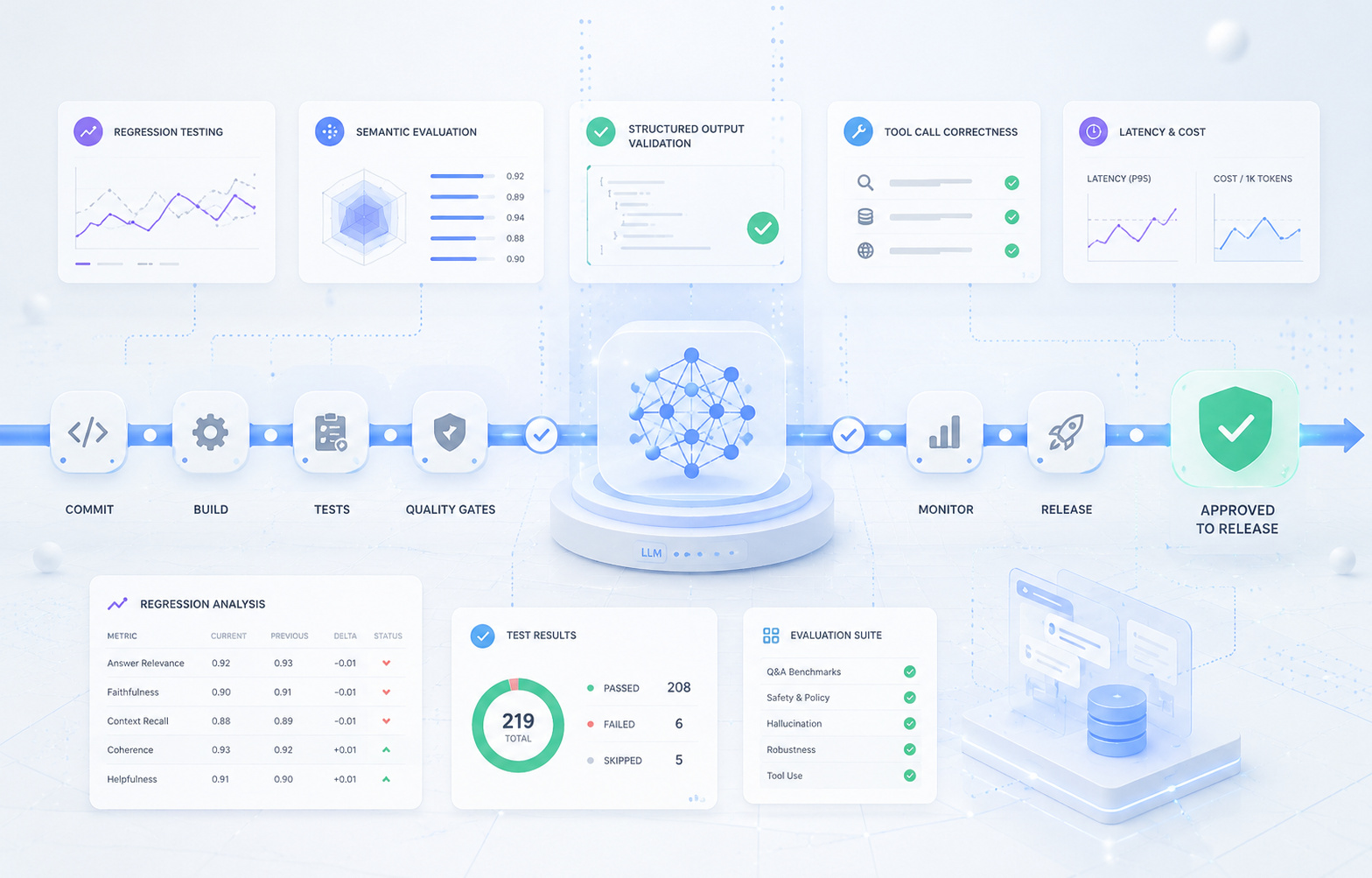
How to build CI/CD quality gates for AI features — and what evidence a pipeline should require before it lets one ship
A pull request lands. It doesn't touch application code. It changes forty words in a system prompt, tightening the instruction that tells a customer-support assistant when to cite a knowledge-base article versus when to escalate. The build compiles. Unit tests pass — there was never any application logic to break. Integration tests pass — the API contract between the frontend and the assistant service hasn't moved. The container builds, the deployment rolls out, the health checks come back green, and the pipeline reports success in the usual shade of green a team has learned to trust without reading closely.
Nobody on the team can answer a much more basic question: is the assistant now better, worse, more expensive, less reliable, or just different?
This is not a hypothetical edge case. It is the default condition of shipping AI features through infrastructure that was built to answer a narrower set of questions. A conventional pipeline is very good at telling you whether a program does what its author told it to do — whether the syntax is valid, whether the function returns the type it promises, whether a previously passing assertion still passes byte-for-byte. It has almost nothing to say about whether a probabilistic system, reconfigured by a sentence of natural language, will behave the way the business needs it to behave across the range of things real customers will type into it.
That gap is not a testing failure in the traditional sense. Every deterministic gate the team already has did exactly its job. The build system verified that the software was assembled correctly. It said nothing — because it was never asked to say anything — about whether the behavior inside that software should have been allowed to reach production. A green pipeline, in the AI-feature case, certifies deployment mechanics. It does not certify the decision to deploy.
This distinction is the subject of this article: not "how to test LLMs" in the abstract, and not a tour of the growing landscape of evaluation vocabulary — groundedness, faithfulness, hallucination rate, LLM-as-a-judge — treated as trivia to be defined and moved past. Those terms only matter to a release engineer to the extent they can be turned into something a pipeline can check, weigh, and act on. The question this article answers is narrower and more useful:
What evidence should a CI/CD pipeline require before it allows an AI-powered feature to be released?
Answering that well means building something more deliberate than a dashboard. It means constructing what is best thought of as an executable release contract — a set of conditions, evidence requirements, thresholds, and consequences that a release candidate must satisfy before a human or a machine is willing to say it has earned production traffic. The rest of this article builds that contract, piece by piece, in the order an engineering team would actually need to build it: starting with what "green" should mean, moving through how evaluation datasets, deterministic checks, semantic judges, agent trajectories, structured-output contracts, statistical regression, cost and latency budgets, and CI staging fit together, and ending with the governance question every CTO eventually asks — who gets to override a red build, and on what evidence.
Green Is Not a Statement About Behavior
Start with the vocabulary problem, because it causes real engineering mistakes. Tests, evaluations, benchmarks, monitoring, quality gates, and release policies get used interchangeably in most conversations about AI quality, and they are not the same thing, even though each one produces something that looks like a score.
A test asserts a specific, known condition about a specific input: given this request, the response must contain a valid order ID, or must not call the refund tool, or must return HTTP 200. A benchmark measures general capability against a fixed, usually public dataset, mostly useful for comparing models in the abstract, rarely useful for deciding whether your prompt against your customers should ship today. An evaluation is broader than a test — it produces a graded or scored judgment about output quality, often using a rubric, a reference answer, or another model as a judge, and it can be run once for research purposes or continuously as infrastructure. Monitoring watches production traffic after the fact and tells you what is currently happening, not what is safe to ship next. A quality gate is an evaluation (or a test, or a monitoring signal) wired to a decision rule and a consequence: pass this condition or the release does not proceed. A release policy is the full set of gates, their owners, their thresholds, and the exceptions process around them, applied to a specific release candidate.
The distinctions matter because teams routinely build the middle of this list — a nice evaluation notebook, a quality dashboard, a benchmark comparison between two prompts — and believe they have built the end of it. They haven't. An evaluation only becomes operationally useful once its result can change whether code ships. A dashboard that produces a number nobody is required to act on is a report, not a gate. This is the thesis this whole article is organized around: AI evaluation becomes operationally useful only when its results can change a release decision. Everything else — rubric design, dataset curation, judge calibration — is in service of that one property.
Binary pass/fail thinking, inherited from deterministic testing, breaks down here in a specific way. Deterministic tests fail because a program did the wrong thing. AI systems fail in a wider and stranger space, because "correct" for a generative system is usually a region, not a point. An answer can be technically accurate and still unacceptable in tone; syntactically well-formed and still wrong in substance; better on average and worse for one customer segment that happens to be the one your legal team cares about most. This produces a category of problem worth naming precisely: behavioral regression — a change that leaves the software working exactly as designed while making the AI feature worse in a way traditional tests cannot see.
Behavioral regression takes several concrete shapes, and a release engineer should be able to recognize each one on sight:
- An answer still reads fluently and confidently, but the evidence backing it has quietly thinned — a prompt change loosened the constraint that previously forced the model to cite a specific policy clause, and it now paraphrases from memory instead.
- Output format is still readable to a human but no longer parses against the downstream contract a workflow engine depends on — a field that used to always be a string is now sometimes an array.
- Aggregate response quality improves, while accuracy for a specific, smaller customer segment (say, non-English speakers, or accounts flagged as high-risk) gets measurably worse.
- A prompt edit that reduces hallucinated claims also raises the refusal rate on questions the assistant should be answering, trading one failure mode for another that a general quality score may not distinguish.
- Tool selection becomes more accurate on average, while the added deliberation the model performs to get there triples response latency.
- A new model version raises the mean score on a general benchmark while failing a small number of business-critical cases the benchmark never covered.
Every one of these is invisible to a single aggregate number moving in the right direction. That is the reason this article keeps returning, in different sections, to a specific engineering principle: an average score alone should rarely determine whether a production AI feature ships. An average is a fine way to notice a trend across weeks of releases. It is a poor gatekeeper for any individual release candidate, because it is mathematically designed to let large numbers of small wins hide a small number of large losses.
Figure 1 — Two kinds of pipeline evidence. A side-by-side diagram contrasting a conventional CI/CD pipeline's evidence chain (build → unit test → integration test → deploy → health check, each a binary pass/fail on deterministic state) against an AI feature's evidence chain (build → deterministic output checks → semantic evaluation → baseline comparison → critical-regression suite → cost/latency budget → release decision), showing that the second chain has no single point equivalent to "the test passed."
Write the Contract Before You Write the Eval
The most common sequencing mistake in AI evaluation work is choosing metrics before defining what "acceptable" means for the product. Teams reach for the nearest available scorer — a semantic similarity score, a generic helpfulness rubric, an off-the-shelf hallucination detector — and only later discover the metric doesn't map to anything a stakeholder actually cares about. The better order of operations is to translate product requirements into testable release conditions before selecting the tooling that will measure them.
Take a concrete product requirement: the assistant must use the customer knowledge base when answering account-policy questions. That single sentence decomposes into several distinct, independently measurable dimensions:
- Retrieval success — did the system fetch a knowledge-base article relevant to the question at all?
- Citation correctness — does the answer point to the article that actually supports the claim, rather than a plausible-looking but wrong one?
- Groundedness — is every material claim in the answer traceable to something in the retrieved context?
- Unsupported-claim rate — how often does the model add detail that the retrieved context does not contain?
- Completeness — does the answer cover the parts of the policy relevant to the question, or does it stop short?
- Refusal behavior when evidence is unavailable — when nothing relevant is retrieved, does the system say so, or does it answer anyway from parametric memory?
Each of these dimensions can then be turned into a gate — but not all gates should behave the same way, and conflating them is where release policies go wrong. It helps to sort gates into five families, each with a different tolerance for ambiguity and a different consequence structure.
Hard gates encode conditions with zero acceptable violation. A response that claims to be JSON but fails to parse is not "70% correct" — it is broken. A tool the system is contractually forbidden from calling in a given context (issuing a refund without a matching return record, for instance) must never be called, full stop. In a regulated workflow, a specific category of scenario — say, a request that should trigger a mandated disclosure — may need a 100% pass rate with no tolerance, because a single miss is a compliance incident, not a statistic.
Statistical gates describe conditions that are true in aggregate, over a population of test cases, with an accepted rate of failure below a defined threshold: a task-success rate, a groundedness rate, a mean judge score, a retrieval recall figure, a refusal-precision number. These are appropriate exactly where individual misses are tolerable and what matters is the overall shape of behavior.
Relative gates compare the candidate against a live reference — almost always the current production configuration — rather than against a fixed absolute number. A release policy built this way might state that the candidate must not be materially worse than production on the general dataset, must show measurable improvement on the specific capability the change targeted, and must show zero regression on a defined set of critical segments. Relative gates are usually more durable than absolute ones, because "materially worse than what customers currently get" is a more stable release criterion than "above 0.85," which has to be re-justified every time the product, model, or user base shifts.
Budget gates treat non-functional properties — latency, token consumption, external API call count, retrieval request volume — as first-class release criteria rather than an afterthought measured only after an incident.
Human-review gates exist for the cases where none of the above produces sufficient confidence — new risk categories, ambiguous policy interpretation, anything a legal or trust-and-safety function needs to see with human eyes before it reaches customers.
None of these families is inherently superior; the engineering judgment is in matching the family to the risk. A structured-output format check belongs in the hard-gate family because "mostly valid JSON" is not a usable property for a downstream parser. A general helpfulness rubric belongs in the statistical family because no single phrasing choice is going to be perfect for every user. Cost per request belongs in the budget family because it is a business constraint, not a correctness question, and treating it as one either invites cost blowouts or forces a false choice between quality and affordability that the release policy should be making explicit rather than accidental.
Figure 2 — Anatomy of an AI release contract. A layered diagram showing a release candidate at the center, surrounded by five gate categories (hard, statistical, relative, budget, human-review), each annotated with an example condition, an evidence source, and a consequence on failure.
The Dataset Is the Test Infrastructure
Everything downstream of this point — deterministic checks, semantic judges, baseline comparisons, regression suites — depends on the quality of the dataset those checks run against. Teams that treat their evaluation dataset as a loose folder of example prompts eventually discover that their "94% pass rate" describes performance on ninety easy cases and ten hard ones weighted the same as each other, which tells them almost nothing about production risk.
A production-grade evaluation dataset needs deliberate composition, not organic accumulation. Useful categories to build toward, in combination rather than isolation, include:
- Golden datasets — a curated, relatively stable core of examples with agreed-upon expected behavior, used as the primary regression bar.
- Edge-case collections — inputs deliberately chosen because they sit at a boundary: ambiguous intent, partial information, conflicting instructions.
- Production-derived examples — real (and properly reviewed, de-identified, and consented) interactions pulled from actual traffic, which capture the phrasing and structure real users actually produce and synthetic data reliably fails to anticipate.
- Synthetic examples — useful for scaling coverage of known patterns quickly and cheaply, dangerous when a team leans on them exclusively, because a model-generated dataset evaluated by a similar model can quietly reward the very failure modes both models share.
- Adversarial inputs — cases designed to probe prompt injection, jailbreak attempts, or manipulation of tool-calling behavior.
- Tool-use scenarios — cases that specifically exercise the agent's decision about whether, when, and how to call an external function.
- Business-critical examples — a small, explicitly labeled set tied directly to revenue, legal exposure, or safety, regardless of how rare the underlying scenario is in raw traffic volume.
- Historical production failures — every real incident, converted into a permanent regression case, so the system is structurally incapable of quietly regressing on a bug it already paid to discover once.
A dataset with ten thousand easy, redundant examples produces false confidence more effectively than a dataset a tenth its size that is properly stratified. It is worth deliberately segmenting the dataset along at least these axes: common workflows (the bulk of real traffic), high-value workflows (disproportionate business impact per interaction), high-risk workflows (disproportionate downside per failure), known failure classes (things that have already gone wrong once), and rare-but-catastrophic cases (low frequency, unacceptable consequence). A release policy can then require different pass thresholds — or zero-tolerance behavior — for each segment, instead of blending them into a single average that hides the segment that matters most.
Reproducibility is the other half of dataset discipline, and it is where many teams quietly lose the ability to trust their own historical evaluation results. An evaluation score is only meaningful in the context of every configuration that produced it:
application release
prompt version
model version (including provider-side minor version)
retrieval configuration
tool definitions and schemas
evaluation dataset version
evaluation code / assertion version
judge model and judge prompt version
Change any one of these silently and a score shift becomes ambiguous — is it the feature that changed, or the yardstick? Version all of them together, the same way application code is versioned, and a score shift becomes traceable to a specific cause. This also surfaces two adjacent risks worth naming directly. Data leakage happens when examples used to develop or tune a prompt end up in the "held-out" evaluation set, inflating scores in a way that will not survive contact with real traffic. Benchmark contamination happens at the model level, when a public benchmark's answers have leaked into a model's training data, making the model's benchmark score a poor predictor of its performance on your private evaluation set — one more reason a team's own production-derived regression dataset matters more over time than any public leaderboard.
Every evaluation record in the dataset should carry enough structure to be independently useful — machine-checkable where possible, and explicit about what failure it exists to catch. A workable, extensible schema looks like this:
{
  "id": "policy-refund-window-014",
  "input": "My order arrived damaged after the 30-day window, can I still get a refund?",
  "context": {
    "retrieved_docs": ["kb-refund-policy-v3"],
    "account_tier": "standard",
    "prior_turns": []
  },
  "expected_behavior": "Cite the damaged-goods exception clause; do not apply the standard 30-day window; offer the correct next step.",
  "forbidden_behavior": [
    "Stating the refund window applies without exception",
    "Fabricating a policy clause not present in retrieved_docs",
    "Calling the refund-issue tool without a matching support ticket"
  ],
  "severity": "critical",
  "tags": ["rag", "policy", "refund", "legal-sensitive"],
  "eval_methods": ["schema_check", "groundedness_judge", "forbidden_action_check"]
}
The forbidden_behavior field deserves particular attention. Most evaluation schemas focus entirely on what a correct answer should contain and underspecify what an unacceptable one looks like. For anything in the critical or legal-sensitive tier, an explicit list of disqualifying behaviors is often more reliable to check — deterministically or with a targeted judge prompt — than trying to define correctness positively and hoping the absence of a score captures the failure.
Figure 3 — Dataset segmentation for release evaluation. A quadrant diagram plotting evaluation examples by frequency (common ↔ rare) and consequence of failure (tolerable ↔ catastrophic), with each quadrant labeled by the gate strategy it should receive — statistical thresholds for the common/tolerable quadrant, zero-tolerance hard gates for the rare/catastrophic quadrant.
Let Ordinary Software Judge What Ordinary Software Can Judge
The most expensive mistake in AI evaluation pipelines is routing every check through a model-based judge, including the ones ordinary software already knows how to answer with certainty. If a schema either validates or it doesn't, that is not a judgment call — it is a parser's job, and a parser is faster, cheaper, and more consistent than any LLM asked to eyeball the same question.
A useful discipline is to enumerate everything about an AI feature's output that can be checked deterministically before reaching for anything probabilistic:
- JSON schema validity and required-field presence
- enum and type constraints (a status field that must be one of a fixed set of values)
- regex or pattern validation (order IDs, phone numbers, currency formats)
- URL and citation-reference validity (does the cited source actually exist in the retrieved set?)
- correct tool name selected from the available tool list
- tool argument types and required-argument presence
- expected HTTP response codes from any downstream call the agent triggers
- resulting database state after a workflow completes (did the record actually get created, and correctly?)
- workflow completion (did a multi-step task reach a defined terminal state?)
- forbidden actions (a tool call that should never occur under the given conditions)
- permission-boundary compliance (an action attempted outside the caller's authorized scope)
These checks share a property that makes them ideal as a first pass: they are cheap, fast, and produce unambiguous verdicts. A well-designed evaluation pipeline runs them before anything that requires a model call, and treats a deterministic failure as an immediate stop — there is no reason to spend a judge-model call and the associated latency and cost scoring the semantic quality of an answer that has already failed schema validation and would be rejected by the downstream consumer regardless of how well-written its prose is.
candidate output
      │
      ▼
[ parser / schema check ] ──fail──▶ FAIL (stop, log reason, skip judge)
      │ pass
      ▼
[ business rule checks ]   ──fail──▶ FAIL (stop, log reason, skip judge)
      │ pass
      ▼
[ tool-call assertions ]   ──fail──▶ FAIL (stop, log reason, skip judge)
      │ pass
      ▼
[ semantic evaluation / judge ] ──▶ score + rationale
This ordering does three concrete things for a team running evaluation at scale. It reduces cost, because the most expensive evaluation step — a model call, sometimes several for a multi-pass judge — only runs on outputs that have already earned the right to be judged on substance. It reduces noise, because a semantic judge asked to score an output that violates a hard structural constraint tends to produce inconsistent or misleading results, since the rubric wasn't designed to reason about malformed input in the first place. And it reduces debugging ambiguity: an engineer looking at a failed release candidate can immediately tell whether the failure was structural (a parsing or business-rule violation, fixable and explainable in one line) or semantic (a quality judgment requiring more investigation), instead of having to unpack a single blended score to figure out which kind of problem they're looking at.
Semantic Quality Has No Universal Metric
Once deterministic checks have filtered the population down to outputs that are structurally valid, the harder and more interesting question remains: is the content actually good? There is no single technique that answers this for every product, and treating "quality score" as a portable concept across products is a reliable way to build an evaluation system that measures the wrong thing precisely.
The available techniques sit on a spectrum from strict to loose, and each earns its place under different conditions:
- Exact match is appropriate only when there is genuinely one correct string — a classification label, a extracted numeric value, a specific entity name — and is otherwise too brittle for anything involving natural-language generation.
- Partial match / span overlap relaxes exact match enough to tolerate formatting variation while still anchoring to a known-correct answer, useful for extraction tasks.
- Reference-based evaluation compares a candidate output to a known-good reference answer, using anything from string overlap metrics to embedding similarity to a judge model asked to compare the two; strongest when a reference genuinely exists and is trustworthy, weak when "correct" legitimately varies in phrasing.
- Reference-free evaluation scores an output against the input and context alone, without a gold answer — necessary for open-ended generation where no single reference is representative, and the dominant approach for judging free-form assistant responses.
- Semantic similarity measures how close a candidate is to a reference in embedding space; fast and cheap, but only a proxy for correctness, since two answers can be semantically close and still differ on the one fact that matters.
- Rubric-based scoring decomposes "quality" into named, separately scored criteria (accuracy, completeness, tone, actionability) rather than a single number, which is almost always more diagnostic and more stable under model or prompt drift than a holistic score.
- Task completion asks a narrower, more objective question than general quality: did the interaction achieve the user's actual goal, independent of how eloquently it did so?
- Groundedness / faithfulness measures whether the claims in an answer are supported by retrieved context, distinct from whether the answer is generally true — an answer can be faithful to bad context and still wrong, or unfaithful to good context and still coincidentally correct, and conflating the two hides real failure modes. The retrieval-augmented-generation evaluation literature typically separates this into faithfulness (is the response consistent with retrieved context) and answer relevance (does the response actually address the question), because a system can satisfy one while failing the other.
- Factual consistency checks specifically for contradiction between an output and a trusted source, whether or not that source was retrieved as part of the current turn.
- Retrieval relevance evaluates the retrieval step in isolation from generation — precision and recall over retrieved chunks against known-relevant documents — because a generation failure caused by bad retrieval needs a different fix than one caused by the model ignoring good retrieval.
- Pairwise comparison / preference evaluation asks a judge (human or model) which of two candidate outputs is better, rather than scoring either in isolation; often more reliable than absolute scoring because relative judgments are cognitively easier and more consistent to make than assigning an absolute number on an arbitrary scale.
- Model-based judging (LLM-as-a-judge) — covered in depth in the next section — uses another model to apply a rubric at scale, trading some reliability for coverage a fully human process cannot achieve.
- Human evaluation remains the highest-fidelity signal available and the most expensive and slowest, reserved for calibration, high-stakes review, and cases nothing automated can resolve confidently.
What determines the right combination is the product, not a universal best practice. A customer-support assistant answering policy questions cares most about groundedness, factual consistency, and refusal behavior when evidence is thin. A retrieval-augmented search assistant cares most about retrieval relevance and answer relevance, because a beautifully written answer built on the wrong retrieved chunk is a retrieval-system failure wearing a language-quality costume. An AI coding feature cares about whether generated code compiles, passes tests, and satisfies static analysis — deterministic, executable checks dominate here far more than for conversational products. A document-extraction system cares almost entirely about field-level accuracy against ground truth, which looks more like classical structured-data testing than open-ended language evaluation. An autonomous workflow agent cares about trajectory correctness and side-effect safety at least as much as the quality of whatever text it eventually produces. A single "AI quality score" applied uniformly across all five of these products would either be too strict for some or too lenient for others, and would fail to localize the actual defect in every case.
Figure 4 — From deterministic to semantic evaluation. A flow diagram showing the layered evaluation pipeline described above (parser → business rules → tool-call assertions → semantic judge), annotated with relative cost and latency at each stage, illustrating why cheap checks should run first and expensive ones should only run on survivors.
The Judge Needs a Judge
LLM-as-a-judge deserves the substantial treatment it usually doesn't get, because it has become the default technique for scoring open-ended output at the volume a CI/CD pipeline requires, and because it is simultaneously powerful and easy to trust more than it has earned.
Rubric design is the first lever, and the details matter more than they look like they should. Binary rubrics (pass/fail against a specific criterion) are more reliable and easier to calibrate than ordinal scales (say, 1–5), because graders — human or model — apply fine-grained numeric scales inconsistently; a judge asked "does this response fabricate a policy clause, yes or no" produces a more stable signal than one asked to rate faithfulness from one to five. Where an ordinal or continuous score is genuinely needed — comparing two similarly good responses, for instance — pairwise comparison tends to outperform absolute scoring for the reason noted above: relative judgments are easier to make consistently than absolute ones.
The known failure modes of model-based judging are well documented in current research and worth building into the evaluation design rather than discovering by accident in production. Position bias is the tendency of a judge to favor a response based on where it appears in the prompt rather than its content — well-established enough in pairwise-comparison literature that any pairwise judge setup should evaluate both orderings and check for a preference shift before trusting a verdict. Verbosity bias is a documented tendency for judges to favor longer responses independent of actual quality, which matters directly for release decisions, because a regression that makes an assistant more verbose without becoming more useful can look like an improvement to an uncalibrated judge. Self-preference bias — a judge model favoring output produced by the same model family — has been measured directly in recent research and argues for judging with a different model family than the one generating production output wherever practical. Beyond these three most-studied biases, the broader literature has catalogued additional distortions worth watching for: sensitivity to the exact wording of a rubric (small rewordings shifting scores meaningfully), inconsistency across repeated runs at nonzero temperature, and sensitivity to superficial formatting or surface polish independent of substance.
None of this makes LLM-as-a-judge unusable. It makes it a component that requires the same engineering rigor as any other piece of evaluation infrastructure, starting with a calibration process that establishes, empirically, whether the judge's verdicts track what a qualified human would actually decide:
- Draw a representative sample from the evaluation dataset — large enough to be meaningful, deliberately spanning easy and hard cases rather than only the easy majority.
- Have qualified human raters — domain experts where the domain demands it — independently score the sample against the same rubric the judge will use.
- Run the automated judge against the identical sample and rubric.
- Measure agreement between the judge and the human labels, not as a raw percentage-match number (which is misleadingly inflated whenever most labels fall into one class) but using a chance-corrected agreement statistic — Cohen's kappa for two raters, Krippendorff's alpha for more raters or non-nominal scales.
- Investigate the specific cases where judge and human disagree, looking for a pattern rather than treating each as noise — a systematically lenient judge and a systematically strict judge require different fixes.
- Refine the rubric based on what the disagreement pattern reveals — often the fix is not "make the judge smarter" but "make the rubric less ambiguous," since much of what looks like judge unreliability is actually rubric underspecification.
- Re-run the calibration sample against the refined rubric and confirm agreement improved rather than merely shifted.
- Define, explicitly, what level of agreement is acceptable to trust the judge for release decisions — current practice in the field generally treats a kappa in the 0.6–0.8 range as an acceptable operating floor and above 0.8 as strong agreement, though the right bar for a given product depends on how much is riding on the decision the judge is informing.
- Recalibrate periodically and any time a dependency of the judge changes — because calibration is a snapshot, not a permanent property.
That last point is the one teams most often skip, and it is the one with the sharpest consequences. A judge model upgrade, a change to the judge's own prompt or rubric, or a shift in the judge's temperature or sampling configuration is an evaluation-infrastructure change, not a free improvement, and it should be versioned and re-validated with the same discipline applied to the application prompt it is judging. A judge that quietly gets swapped for a newer model version can shift the mean score of every release candidate evaluated afterward without any change to the feature itself — which, if the shift isn't caught, produces exactly the failure mode described at the start of this article: a pipeline that stays green while what it's measuring silently stops meaning what the team assumes it means.
Figure 5 — The judge-calibration loop. A cyclical diagram: sample → human labeling → judge scoring → agreement measurement → rubric refinement → re-calibration → deployment of the judge as trusted infrastructure → scheduled recalibration trigger, closing back to sampling.
When the Right Answer Isn't Enough: Agent Trajectories
Everything covered so far generalizes reasonably well from single-turn generation to agentic systems, but agents introduce a failure mode that pure output evaluation cannot see: a system can produce a correct-looking final answer while having taken an entirely wrong or unsafe path to get there. Evaluating only the final response, for an agent, is like code-reviewing only the return statement of a function and ignoring everything it did along the way — including the side effects.
This motivates a specific distinction that current agent-evaluation research treats as foundational: outcome correctness versus trajectory correctness. Outcome correctness asks whether the final state — the answer given, the record updated, the ticket resolved — is correct. Trajectory correctness asks whether the sequence of actions the agent took to get there was itself acceptable. For some products only the outcome matters and the path is genuinely irrelevant. For others — anything involving write access to a system of record, financial actions, or customer-facing communication sent mid-task — the trajectory itself must be constrained regardless of whether the final outcome happened to land correctly, because an agent that reaches the right answer by calling the wrong tool, or by attempting an unauthorized action that happened to fail harmlessly, has demonstrated a defect the next similar case may not survive.
A practical trajectory-evaluation checklist, applied against realistic but generic tools such as a search function, a CRM-update function, a support-ticket-creation function, an email-draft function, and a database-query function, covers:
- Tool selection — did the agent choose the correct tool for the step, out of the available candidates? This is checkable deterministically against a known-correct trajectory when one exists: correct tool calls divided by total tool calls at each decision point.
- Necessity — should a tool have been called at all, or did the agent invoke one unnecessarily (a support-ticket creation for a question that didn't need one) or fail to invoke one that was required?
- Argument correctness — did the agent select the right tool but populate it with wrong, incomplete, or fabricated arguments?
- Sequence correctness — for tasks with real ordering dependencies (verify identity before issuing a refund, not after), did the agent respect the required order?
- Permission compliance — did every action stay within the scope the agent was actually authorized to take in this context?
- Duplicate actions and retries — did a transient failure cause the agent to issue the same side-effecting action twice, and did it handle the retry safely (idempotently) or unsafely (double-charging, double-emailing)?
- Recovery behavior — when a tool call failed or returned an unexpected result, did the agent recover sensibly, or did it proceed on a false assumption?
- Stopping conditions — did the agent correctly recognize when the task was complete, rather than continuing to act past the point where action was needed, or stopping short of it?
Current agent-evaluation benchmarks reflect exactly this shift in emphasis: function-calling correctness at the level of an individual call (whether a model produces a structurally valid, correctly parameterized tool invocation) has become a comparatively well-solved evaluation problem, assessed at scale by public leaderboards designed for exactly that. What the field has moved on to is trajectory-level evaluation — fine-grained diagnostics that separate a wrong-tool failure from a wrong-argument failure from a wrong-order failure, because each implies a different fix, and multi-step tasks compound small per-step error rates into surprising overall failure rates the way any pipeline of imperfect stages does. This is also why repeated-trial consistency belongs in the evaluation design for anything agentic: a long trajectory strings together many probabilistic decisions, and a single successful run says less about reliability than the same task succeeding across several independent attempts.
Illustrative assertions, in pseudo-code, for a support-workflow agent:
assert trajectory.tool_calls[0].name == "search_customer_account"
assert trajectory.tool_calls[1].name in {"issue_refund", "escalate_to_human"}
if trajectory.tool_calls[1].name == "issue_refund":
    assert trajectory.preceded_by("verify_identity")
    assert trajectory.tool_calls[1].args["amount"] <= order.refundable_amount
assert not trajectory.contains_duplicate_side_effecting_call()
assert trajectory.terminates_within(max_steps=6)
This is deliberately kept at the level of release-quality assertions rather than a security audit — the point is not to enumerate every possible exploit against an agent's tool permissions, but to establish that a release candidate's behavioral pattern, not only its final message, is part of what a quality gate has to evaluate.
Figure 6 — Outcome correctness vs. trajectory correctness. Two parallel paths reaching the same correct final state, one taking a compliant sequence of tool calls and one taking a sequence that violates ordering and permission constraints along the way, both ending in an identical final answer — illustrating why final-answer scoring alone cannot distinguish them.
Structured Output Is an API Contract
Any AI feature that produces JSON, a classification, extracted entities, a workflow parameter set, or a database-ready structure is, functionally, producing an API response — and should be evaluated with the same rigor applied to any other API contract, not treated as a stylistic nicety of the response.
It's useful to separate three distinct properties that get conflated under the single word "valid":
- Syntactic validity — is the output parseable as JSON (or whatever the target format is) at all?
- Schema validity — does the parsed structure match the required shape: correct field names, correct types, required fields present, enums respected?
- Semantic correctness — are the values in that valid structure actually right?
The gap between the second and third is where subtle, expensive defects live. An invoice-extraction response can be syntactically perfect JSON, fully schema-valid, and still assign the tax amount to the subtotal field, or extract the wrong line-item quantity — a failure invisible to a schema validator and only catchable by a business-rule or semantic check layered on top. This is why structured-output evaluation should run as a stack of increasingly specific checks rather than a single validation step:
- Parser — does the output parse at all, without special-casing markdown fences, stray preambles, or trailing commentary the model appended around the structure?
- Schema validation — does the parsed object satisfy the required JSON Schema (or equivalent), including required fields, types, and enum constraints?
- Business rules — do the values satisfy domain-specific constraints a generic schema can't express (a tax amount can't exceed the subtotal; a delivery date can't precede an order date)?
- Semantic evaluation — for fields that require judgment rather than a mechanical rule (was the correct clause cited; was the extracted sentiment actually accurate), apply the appropriate evaluation technique from the earlier section.
There is a genuinely useful piece of current engineering context worth folding in here: most major model providers now offer constrained decoding as a native capability, where the token-generation process itself is restricted to only the tokens that keep the output within a target JSON Schema, which has meaningfully reduced the rate of syntactically malformed output compared to prompting-only approaches. This matters to a release-gate design in two ways. First, it means the syntactic-validity layer of the stack above should, on modern providers with this feature enabled, essentially never fail — which means a persistent syntactic-validity failure rate in production is itself a signal something in the configuration is misconfigured, not an expected background noise level to tolerate. Second, and less widely appreciated, constrained decoding guarantees the shape is correct without saying anything about whether the values are correct — schema compliance and semantic correctness are independent properties, and recent published research on structured-generation frameworks reports that some models show measurable degradation in task accuracy under heavy structural constraints, particularly on smaller models handling complex schemas. A release gate that only checks schema validity and treats a 100% pass rate there as evidence of quality is measuring the easier and less important half of the problem.
This layered structured-output stack is one of the strongest candidates in the entire evaluation surface for full CI/CD automation, specifically because the first three layers are fully deterministic and only the fourth requires anything probabilistic — meaning most of a structured-output regression suite can run fast, cheap, and on every pull request, reserving the semantic layer for a smaller, more targeted set of cases.
Testing a System That Doesn't Answer the Same Way Twice
Deterministic software testing assumes that running the same test against the same code twice produces the same result. That assumption is the foundation of "run once and trust it." It does not hold for LLM-backed features, and pretending it does is one of the more common ways evaluation infrastructure quietly loses credibility.
Repeated execution of the identical input against the identical model, prompt, and configuration can yield different outputs — because of sampling temperature, provider-side load-balancing across replicas, or genuine model-level variance in how it resolves ambiguous instructions. This has direct consequences for how a test suite should be structured. A single pass on a single run tells you the model can produce an acceptable answer for that input, not that it reliably does. For anything above a low-stakes tier, the right question is a pass rate across repeated samples, not a binary pass/flag from one execution.
That said, running every test fifty times multiplies evaluation cost and latency by fifty, which is not economically sound applied indiscriminately across an entire suite. Repeat count should scale with risk, not be applied uniformly:
- Test severity — critical-tier cases (legal, safety, financial) warrant more repeats than routine-tier ones, because the cost of missing an intermittent failure is asymmetric.
- Historical instability — a case that has shown variance in past runs deserves more repeats than one that has been stable for months.
- Release type — a model or provider-side version bump, which can shift behavior broadly, warrants more repeated sampling across the suite than a narrow, well-scoped prompt tweak.
- Uncertainty near a threshold — a case scoring close to the pass/fail boundary is more informative to re-sample than one scoring comfortably on either side.
This produces a distinction worth naming precisely, because it resolves a common confusion about what an "average improving" release candidate actually tells you: a critical single-example failure is not the same category of problem as a statistically meaningful population regression, and a release policy needs separate handling for each. Consider a candidate where 999 of 1,000 evaluation scenarios show measurable improvement, and one — a workflow with genuine legal exposure — begins fabricating a required policy condition it previously stated correctly. The population-level average moves strongly positive. Averaged over the full dataset, this candidate looks like an unambiguous improvement. It is not one, because the one regression sits in a tier where the release policy's own gate design (recall the hard-gate category from the release-contract section) should have marked zero tolerance regardless of what happens everywhere else. This is the concrete, mechanical reason average scores must never be the sole release criterion: they are structurally incapable of representing exactly this shape of risk, where the thing that matters most is small in sample count and large in consequence.
Practically, this argues for running the general evaluation dataset with a modest sample count sufficient to estimate a stable rate, while running the small, explicitly tagged critical-severity subset — the severity: critical examples from the dataset schema introduced earlier — at a higher repeat count and a zero-tolerance threshold, independent of how the rest of the suite performs.
Figure 7 — Population regression vs. critical single-case failure. A scatter plot showing hundreds of evaluation cases as points shifting upward (improving) between baseline and candidate, with one point — visually marked as critical-severity — shifting sharply downward, and an accompanying note that a simple mean of all points would report net improvement despite the critical failure.
Ship Against a Baseline, Not Just a Bar
Fixed absolute thresholds age poorly. A groundedness threshold that made sense against last quarter's model and last quarter's traffic mix can become either too strict or too lenient as both shift, and re-justifying an absolute number every release cycle is its own maintenance burden. A more durable approach compares the release candidate directly against a live reference — almost always the configuration currently running in production — rather than, or in addition to, a fixed bar.
This comparison typically takes the form of a pairwise evaluation: the same input run through both the production baseline and the release candidate, judged (by rubric, by human, or by both) on which output is better, with results aggregated into win/tie/loss rates across the dataset. Two distinct release policies can be built on top of this comparison, and they answer different questions. A non-regression policy asks only whether the candidate is not meaningfully worse than the baseline anywhere that matters — appropriate for changes not specifically targeting a quality improvement, like an infrastructure migration or a cost-optimization change to the prompt. A targeted-improvement policy additionally requires the candidate to show a measurable win on the specific capability the change was meant to improve, which matters because a change can pass a non-regression bar everywhere while failing to actually deliver the improvement it was built for — a wasted release that nonetheless looks safe.
An illustrative — not universally prescriptive — way to encode both together:
Target capability (the reason this change was made):
    candidate must show a win rate ≥ X over baseline

Critical segments (legal, safety, high-value accounts):
    zero regression allowed — any candidate loss on these
    segments blocks the release regardless of overall win rate

General dataset (the broad population of everyday cases):
    regression must remain within a defined tolerance band
    (a small number of individual losses is expected noise;
     a systematic shift is not)

Latency:
    candidate p95 must remain within budget

Cost:
    candidate cost per request must remain within an
    approved increase, if any increase is approved at all
Every numeric value in a structure like this is a placeholder for a judgment call specific to the product, its regulatory environment, its customers, and its business risk tolerance — there is no universal "acceptable win rate" any more than there is a universal acceptable hallucination rate, and a release policy that borrows someone else's numbers without re-deriving them for its own context is adopting someone else's risk tolerance by accident.
Latency and Cost Are Quality Metrics
It's tempting to treat answer quality as the entire evaluation surface and latency and cost as separate operational concerns tracked elsewhere, in a different dashboard, by a different team. That separation produces releases that pass every quality gate and still make the product measurably worse to use or measurably more expensive to run, because nothing in the release process was positioned to say no on those grounds.
The relevant signals for an AI feature extend beyond what conventional application performance monitoring already tracks:
- p50/p95 latency, where the tail matters more than the median for user-facing experience — a model that is fast most of the time and occasionally very slow can violate a product's usability bar even with an excellent median.
- First-token latency, distinct from total response latency, particularly relevant for any interface that streams output and depends on perceived responsiveness.
- Total response latency, the full round trip a user actually waits through.
- Token consumption, input and output, which drives cost directly and often scales in non-obvious ways with prompt changes — a prompt edit that adds few-shot examples to improve quality can quietly double the input token count on every request.
- Model API cost per request, aggregated across the full request — including any additional calls a judge, a retriever, or a multi-step agent trajectory makes along the way.
- Tool-call count and retrieval-request count, each of which usually carries its own latency and cost, and each of which can silently increase when a prompt change makes a model more "thorough" in ways that look like quality but behave like cost.
- Retries, which compound both latency and cost whenever a structural validation failure triggers a re-prompt.
The core release-engineering question this section exists to raise directly: a new prompt improves the judge score by a small, real margin, while doubling token consumption and meaningfully increasing response time. Should it ship? There is no universally correct answer, and that's precisely the point — the answer depends on the product's latency sensitivity, its unit economics, and how much the quality improvement is actually worth to the business, none of which a quality score alone can express. What a release policy can do is make sure that tradeoff gets decided deliberately, by encoding cost and latency as budget gates alongside quality gates, rather than letting the tradeoff happen by default because nobody's gate was positioned to catch it. A release candidate that improves quality by two points on a judge rubric while blowing through the latency budget should fail the release the same way a candidate that improves quality while breaking a schema contract should fail it — the mechanism of failure is different, but the release-blocking consequence should not be.
Figure 8 — The quality-cost-latency tradeoff surface. A three-axis diagram plotting several hypothetical release candidates by quality delta, cost delta, and latency delta relative to production baseline, with a shaded "acceptable region" defined by the release policy's budget gates, visually showing candidates that pass on quality alone but fall outside the acceptable region on cost or latency.
Where Each Gate Lives in the Pipeline
None of the gate types described so far are useful in the abstract; they need a place to run, and running everything on every commit is neither economically sound nor necessary. A workable design tiers evaluation the same way conventional testing already tiers unit, integration, and end-to-end tests — not by inventing an artificial "AI testing pyramid" as a branding exercise, but by applying the same underlying logic: cheap, fast, narrow checks run constantly; expensive, broad, slow checks run less often and at higher-stakes moments.
A realistic conceptual pipeline, expanded from the earlier sketch:
PR opened (prompt, retrieval config, or tool schema changed)
    │
    ▼
unit tests (application code, unaffected by prompt changes but still run)
    │
    ▼
integration tests (API contracts, service boundaries)
    │
    ▼
AI deterministic checks (schema validity, business rules, forbidden actions)
    │
    ▼
fast evaluation suite (small, high-signal subset; cheap judge calls; single-sample)
    │
    ▼
candidate-vs-baseline comparison (pairwise, on a broader sample)
    │
    ▼
critical-regression suite (zero-tolerance tier; repeated sampling where warranted)
    │
    ▼
cost / latency budget checks
    │
    ▼
release decision (automated approve, automated block, or route to human review)
    │
    ▼
optional human approval (for flagged or high-risk changes)
    │
    ▼
deploy → post-deployment evaluation against real traffic
This maps naturally onto distinct evaluation tiers, each scoped to a different moment in the development lifecycle and a different cost tolerance:
- Pull-request suite — fast and inexpensive by design, running on every relevant change: deterministic checks in full, plus a small, carefully chosen, high-signal sample of semantic and pairwise evaluation. The goal here is quick feedback to the engineer making the change, not exhaustive coverage.
- Merge/main suite — broader regression coverage, run once a change lands on the trunk rather than on every push to a PR branch, affordable because it runs less frequently.
- Pre-release suite — the full dataset, including the more expensive judge-based and repeated-sampling evaluations, run before a candidate is promoted toward production traffic.
- Scheduled evaluation — runs periodically (nightly or weekly, independent of any specific code change) against the current production baseline, catching drift caused by provider-side model updates, data distribution shifts, or accumulated small configuration changes that individually passed their own gates.
- Post-deployment evaluation — checks real-world behavior against live traffic, feeding the production-to-regression loop covered later in this article.
The economic argument for tiering is not abstract. Running the full pre-release suite — with repeated sampling on critical cases and a full pairwise comparison against baseline — on every keystroke-level change to a prompt during active development would make iteration prohibitively slow and expensive, and predictably, teams facing that friction bypass the process entirely rather than wait for it, which defeats the entire purpose of building it. Tiering solves this the same way it solved the equivalent problem in conventional testing: cheap feedback close to the change, comprehensive feedback close to the release, with each tier's scope explicitly justified by what decision it needs to inform.
Figure 9 — Tiered evaluation pipeline. A funnel diagram showing four tiers (PR, merge, pre-release, scheduled) with relative sample size, cost per run, and run frequency labeled at each tier, illustrating the inverse relationship between coverage depth and run frequency.
Writing the Policy Down
Everything described so far needs to exist somewhere as an explicit, versioned artifact — not tribal knowledge about what "usually" gets a release blocked. A vendor-neutral, illustrative configuration format makes the release policy inspectable and reviewable the same way infrastructure-as-code makes deployment configuration inspectable and reviewable:
# conceptual / vendor-neutral illustration — not a real product schema
ai_quality_gates:
  structured_output:
    required: true
    schema_validity: hard          # zero tolerance

  critical_regressions:
    dataset_tag: "severity:critical"
    tolerance: 0                   # any failure blocks release
    repeat_samples: 5

  task_success:
    minimum: 0.90                  # illustrative, product-specific
    dataset: "golden-v7"

  groundedness:
    maximum_regression_vs_baseline: 0.02   # illustrative tolerance band

  tool_call_correctness:
    tool_selection_precision_minimum: 0.95
    forbidden_actions: hard

  latency:
    p95_ms_maximum: 4000

  cost:
    max_increase_vs_baseline_pct: 15

  judge:
    calibration_required: true
    max_days_since_last_calibration: 30
    minimum_kappa_vs_human: 0.6
This is a conceptual illustration, not a claim about any specific vendor's real configuration schema — the value is in the shape of the policy, not the exact keys. What it makes explicit is worth dwelling on: every gate has an owner-legible name, a threshold or tolerance, and an implicit or explicit severity. Nothing here is a dashboard number waiting for someone to notice it; each entry is written as something a pipeline is expected to act on.
The decision logic that consumes a configuration like this needs to combine multiple dimensions rather than reduce them to one number before deciding:
def evaluate_release_candidate(results, policy):
    if results.critical_failures > 0:
        return block_release("critical regression: zero-tolerance tier failed")

    if not results.schema_validity_passed:
        return block_release("structured output failed schema validation")

    if results.forbidden_action_triggered:
        return block_release("forbidden tool action occurred")

    if results.task_success < policy.task_success.minimum:
        return block_release("task success below floor")

    if results.groundedness_regression > policy.groundedness.maximum_regression_vs_baseline:
        return block_release("groundedness regressed beyond tolerance")

    if results.p95_latency_ms > policy.latency.p95_ms_maximum:
        return block_release("latency budget exceeded")

    if results.cost_increase_pct > policy.cost.max_increase_vs_baseline_pct:
        return route_to_human_review("cost increase requires approval")

    if not results.judge_calibration_current:
        return route_to_human_review("judge calibration stale — evidence not trustworthy")

    return approve_release()
The ordering in this pseudo-code is deliberate: hard, zero-tolerance conditions are checked first and short-circuit everything else, because there is no reason to compute a nuanced statistical comparison for a candidate that already violated a non-negotiable constraint. Budget and infrastructure-trust conditions (a stale judge calibration) route to human review rather than an automatic block, reflecting that not every failure mode deserves the same consequence — a design point developed further in the ownership section below.
Why One Number Can't Approve a Release
Suppose a release dashboard reports:
AI Quality Score: 91.7
This single figure is one of the most seductive artifacts a team can build, and one of the most dangerous to release decisions, because it is almost always a weighted average sitting on top of exactly the kind of segment-level and critical-case risk this article has been describing. A weighted average can rise while a specific customer segment's experience deteriorates, as long as enough other segments improve to compensate. It can rise while a small number of critical cases fail outright, as long as the failing cases are numerically outweighed by passing ones. It is vulnerable to metric gaming in the mundane sense that any optimizable proxy is — a prompt tuned specifically against the metric the team is watching will eventually learn to satisfy the metric's blind spots rather than the underlying goal. And it drifts: a judge model update, a rubric rewording, or a shift in the evaluation dataset's composition can move the number in ways that have nothing to do with the feature actually changing.
None of this means aggregate scores are useless — they're a reasonable trend signal across weeks of releases, and a sharp unexplained drop is a legitimate reason to investigate. What they should not be is the sole release criterion for an individual candidate. The alternative this article has been building toward is a gate matrix: several independently evaluated dimensions, each compared against its own baseline and its own threshold, reviewed as a set rather than collapsed into one score before a decision gets made.
| Dimension | Baseline | Candidate | Gate | Result |
|---|---|---|---|---|
| Task success | 0.88 | 0.91 | ≥ 0.90 | Pass |
| Groundedness | 0.94 | 0.93 | regression ≤ 0.02 | Pass |
| Critical-tier failures | 0 | 1 | 0 tolerance | Fail |
| Tool-selection precision | 0.96 | 0.97 | ≥ 0.95 | Pass |
| p95 latency (ms) | 2,100 | 2,050 | ≤ 4,000 | Pass |
| Cost per request | $0.014 | $0.017 | ≤ +15% | Pass (+21%… flag) |
(All values above are illustrative, not representative of any real product's actual thresholds.)
Read as a single average, a matrix like this could plausibly still land above 90 and look like a clean improvement. Read as a matrix, it makes the actual release decision unambiguous: the candidate should not ship, because a zero-tolerance critical-tier gate failed, and it also raises a second, independent flag on the cost line worth a conversation regardless of the critical-tier outcome. That is the entire value proposition of a gate matrix over an aggregate score — it forces the specific dimension that matters to stay visible instead of getting averaged into invisibility, and it lets a release decision be justified by naming the exact condition that blocked it rather than gesturing at a dashboard number that dropped.
Flaky Eval or Flaky Feature
Every team running evaluation at scale eventually hits the AI-native equivalent of the flaky test — a case that fails sometimes and passes other times with no code change in between. The instinct that has served teams badly for decades of flaky deterministic tests — quarantine it, ignore it, re-run until green — is even more damaging here, because in AI evaluation, the instability itself might be the signal, not the noise.
It's worth separating at least four distinct sources of instability, because each implies a different response:
- Expected model variance — sampling temperature and legitimate ambiguity in the input produce genuinely different acceptable outputs across runs. This is not a defect; it's why repeated sampling and pass-rate thresholds, covered earlier, exist in the first place.
- Evaluator variance — the judge itself is inconsistent across repeated scoring of the identical output, independent of any variance in the output being judged. This points back to judge calibration and rubric quality, not the feature under test.
- Infrastructure instability — flaky network calls, rate limits, timeouts, or retry logic in the evaluation harness itself producing spurious failures unrelated to model behavior at all.
- Genuinely unstable product behavior — the feature really does behave inconsistently in a way that matters, and the "flakiness" is an accurate report of a real reliability problem a user would also experience.
Automatically re-running a failed evaluation until it turns green destroys the entire purpose of having a gate, because it converts "the feature reliably does the right thing" into "the feature is capable of doing the right thing at least once," which is a much weaker and often unacceptable guarantee for anything above a low-stakes tier. The more disciplined response looks like conventional flaky-test hygiene adapted to this context: a defined retry policy that is explicit about how many attempts are allowed and why; repeated-sample thresholds that treat "8 of 10 passed" as the actual result rather than silently re-rolling until a single pass appears; confidence intervals where the sample size supports them; a formal quarantine process for cases under active investigation, distinct from cases quietly ignored; and a maintained log of known-unstable cases with an owner assigned to resolve, not just tolerate, each one.
The practical diagnostic a team needs is a reliable way to tell an unstable test from an unstable AI feature. A useful first move is isolating the variable: rerun the identical case against the same candidate output already generated (removing model-sampling variance from the picture) and check whether the judge's score is stable — if not, the instability lives in the evaluator, not the feature. If the judge is stable against a fixed output, but the feature produces meaningfully different outputs across repeated generations for the identical input, the instability is real and belongs to the product, not the test harness — and a case behaving this way should generally not be quarantined into invisibility, but promoted to a critical-tier, repeated-sampling evaluation, because inconsistent behavior on an important input is itself the defect a release gate exists to catch.
Models Are Dependencies Too
Everything discussed so far treats prompt changes as the primary trigger for evaluation. In practice, a comparable — and easier to miss — category of change comes from everywhere else in the stack that shapes model behavior without touching the application's own source code: a model vendor switch, a model version bump, a change in model size or tier, a system-prompt edit, a new retrieval strategy or embedding model, a temperature or sampling configuration change, a tool schema revision, or a change to the agent's orchestration logic.
The right mental model for all of these is the one software engineering already has for exactly this situation: a dependency change. Bumping a language runtime version, upgrading a third-party library, or switching a database engine all trigger the same instinct in a mature engineering organization — run the test suite, because behavior can shift even when the calling code didn't change a single line. The same discipline applies here, and for a specific, sharper reason: a model provider can update the weights behind an API endpoint under an existing version label, in ways an application's own git history will never show. This is not a claim that any specific vendor does this routinely or without notice — it is a structural property of consuming a model as a hosted API rather than a pinned artifact, and it means evaluation should not be gated exclusively on whether the application's diff is empty. A scheduled evaluation run against the current production configuration, independent of any pull request, is the practical mitigation — it is the only mechanism that catches a regression introduced by something outside the codebase entirely.
Treating each of these as a dependency change also clarifies ownership and process in a way that helps avoid a common failure: teams that rigorously gate prompt changes while treating a model-version upgrade as an infrastructure decision made in a completely separate conversation, evaluated with none of the same rigor. A model upgrade should trigger the same release contract a prompt change does — the same deterministic checks, the same semantic evaluation, the same baseline comparison, the same critical-regression suite — because from the perspective of what a customer experiences, a model upgrade and a prompt rewrite are the same category of event: something changed about how the system behaves, and that needs evidence before it reaches production traffic.
Closing the Loop from Production to Regression Suite
An evaluation dataset that only ever grows through deliberate, upfront curation will always lag behind what real users actually do. The most durable regression datasets are built with a structural pipeline connecting live production behavior back into the test suite, not a one-time curation effort:
production behavior
      │
      ▼
traces / failures / user feedback
      │
      ▼
triage (is this a real defect, and how severe?)
      │
      ▼
reusable evaluation case (input, context, expected/forbidden behavior, severity)
      │
      ▼
regression dataset (versioned, tagged)
      │
      ▼
CI quality gate (now structurally unable to regress on this case silently)
The signals worth watching for triage are broader than explicit complaints: thumbs-down feedback where a rating mechanism exists, escalations to a human agent, support tickets that reference the AI feature, explicit user corrections mid-conversation, abandoned interactions (a user who started using the AI feature and switched to a different path before completing their task), fallback usage (how often the system falls back to a safer, less capable behavior because it couldn't proceed confidently), tool errors, and human overrides of an agent's proposed action.
This pipeline needs one explicit caution that's easy to skip under delivery pressure: raw production conversations should never be converted automatically into evaluation cases without deliberate handling of privacy, cleaning, labeling, deduplication, and validation. A production trace can contain personal or sensitive information that has no business sitting in a shared evaluation dataset reviewed by engineers, contractors, or automated tooling with broader access than the original conversation had. It can also contain noise, mislabeled outcomes, or duplicated near-identical cases that inflate a dataset's apparent size without adding real coverage. Converting an incident into a permanent regression test is one of the highest-leverage practices described in this entire article — it is the mechanism that makes an organization's evaluation suite get structurally better every time something goes wrong in production, rather than merely getting a one-time fix with no lasting protection — but it has to be done deliberately, with the same care a team would apply to handling any other sensitive customer data, not as an automated firehose from logs straight into test fixtures.
Figure 10 — Production-to-regression feedback loop. A closed-loop diagram from live traffic through triage and case authoring into the versioned regression dataset and back into the CI quality gate, with a side annotation marking the privacy/cleaning/labeling checkpoint as a required gate within the loop itself, not an optional step.
Who Gets to Override Red
Every release-policy design eventually runs into the same organizational question, and it is the one a CTO actually needs answered clearly: when a quality gate fails, who is allowed to ship anyway, and what does that decision cost?
Ownership across an AI-feature release typically spans several functions with genuinely different expertise and genuinely different incentives — QA and quality engineering own the evaluation infrastructure itself and its reliability; AI/ML engineering owns the model, prompt, and retrieval configuration and understands the tradeoffs behind a given release candidate better than anyone else; product owns the actual acceptance criteria a gate is trying to approximate, and is often the right party to decide whether a specific regression is tolerable given a launch timeline; platform engineering owns the pipeline mechanics, the infrastructure the gates run on, and the reliability of the evaluation harness itself; and security or trust-and-safety functions, where a product's risk profile warrants it, own specific gate categories — adversarial-input handling, data-handling constraints — that shouldn't be overridable by anyone outside that function regardless of urgency.
The exception workflow is where a release policy either stays meaningful or quietly becomes decorative. A useful design answers each of the following explicitly, in writing, before the first override request ever happens rather than improvised under launch pressure: Who can override a failed gate — and does the answer depend on which gate failed, given that a latency-budget miss and a critical-tier safety failure are not remotely equivalent in who should be allowed to wave them through? What evidence is required to justify an override — a one-line Slack message, or a documented rationale attached to the release itself? Should an override expire, forcing the underlying issue to actually get fixed rather than quietly becoming the new normal? Does an override generate tracked technical debt with an owner and a deadline, the same way a merged pull request with a known-acceptable shortcut should? And is every override recorded somewhere durable and reviewable, so a pattern of overrides on the same gate becomes visible to whoever is responsible for deciding whether that gate's threshold itself needs to change, rather than becoming an invisible habit no one above the override moment ever sees?
None of this needs to become bureaucratic. A lightweight, consistently followed exception process — a required written rationale, a named approver appropriate to the gate's severity tier, an expiration date, and a log — is enough to prevent the single failure mode that actually matters here: an override mechanism that exists on paper but is used silently and habitually enough that the gate it's overriding has, in practice, stopped meaning anything. A quality gate that can be bypassed invisibly, by anyone, without record, is not a stricter version of no gate at all — it is functionally indistinguishable from no gate at all, with worse morale, because the team believes it has protection it does not actually have.
A Reference Release Contract: AI Customer-Support Assistant
Assembling the pieces above into one example makes the abstractions concrete. Take a realistic AI SaaS feature — a customer-support assistant that retrieves from a knowledge base and can take limited account-management actions through tools — and walk through what a full release contract for it looks like, and how three different release candidates fare against it.
Important behaviors the contract needs to protect: correct retrieval and citation of knowledge-base content for policy questions; refusal (rather than fabrication) when no relevant knowledge-base content exists; correct tool selection and argument construction for account actions; strict adherence to permission boundaries (never issuing a refund without a matching support ticket, for instance); and consistent structured output for any response consumed by the surrounding application rather than shown directly to a user.
Risk classes, mapped to the gate families introduced earlier: knowledge-base citation accuracy and refund-tool permission compliance sit in the critical, zero-tolerance tier; general helpfulness and tone sit in the statistical tier; response latency and per-request cost sit in the budget tier; and any request pattern the team hasn't seen before — a genuinely novel account-policy question outside existing coverage — routes to human review rather than an automatic decision.
Evaluation dataset: a golden set of roughly 400 policy questions stratified across the account tiers the product serves, a critical-tier subset of 40 cases covering refund permission boundaries and legally sensitive policy language, an adversarial subset probing prompt injection through customer-supplied text fields, and a continuously growing production-derived subset seeded from triaged real incidents.
Deterministic checks: JSON schema validation on every structured response field the frontend consumes; a hard rule that the refund-issuance tool can never be called without a preceding, successful identity-verification tool call in the same trajectory; citation-reference validation confirming every cited article ID actually exists in the retrieved set for that turn.
Semantic evaluations: a groundedness judge scoring whether every material claim in a policy answer is supported by retrieved context, calibrated against human support-team review at a measured kappa above the team's defined floor; a rubric-based helpfulness score decomposed into accuracy, completeness, and tone, run pairwise against the current production baseline.
Critical regression tests: the 40-case critical-tier subset, run at five repeated samples per case, zero tolerance for any failure across any sample.
Tool-call checks: tool-selection precision against a gold trajectory for the 60 account-action scenarios in the dataset; a hard assertion that no side-effecting tool is ever called twice for the same user turn.
Latency budget: p95 response time under an internally set ceiling appropriate to the product's chat interface.
Cost budget: per-request cost increase capped at an approved percentage over the current production baseline, escalating to human approval above that.
Judge calibration: recalibrated against a fresh 150-case human-labeled sample at least every 30 days, and immediately upon any change to the judge model or judge prompt.
CI stages: deterministic checks and a fast 50-case evaluation subset on every pull request touching the prompt, retrieval configuration, or tool schema; the full golden and critical-tier suites on merge to trunk; the full suite plus baseline pairwise comparison before promotion to a release candidate; a scheduled nightly run against current production to catch provider-side drift.
Production feedback loop: thumbs-down responses and support-team overrides triaged weekly, with anything representing a genuine new failure mode converted into a permanent addition to the critical-tier or production-derived dataset subset.
Against this contract, three illustrative release candidates land in three different places:
Candidate A raises the helpfulness rubric score meaningfully and passes every correctness and safety gate — but token consumption per request rises well past the approved cost-increase ceiling, driven by a prompt change that adds extensive few-shot examples. Every quality gate is green. The cost gate is not. Under this contract, that is a legitimate, complete reason to block the release, or route it to a human approver empowered to accept a larger cost increase deliberately rather than by default — not a case where quality improvement should be allowed to silently override an explicit budget constraint nobody was asked to waive.
Candidate B shows overall improvement across the golden dataset and improves the target capability the change was built for, but one case in the critical-tier subset — a refund-permission scenario — begins issuing the refund tool call before the identity-verification tool call completes, a sequencing violation the hard-gate check catches immediately. Under a single-aggregate-score policy, this candidate's strong overall numbers might have shipped. Under the gate-matrix and critical-tier design built throughout this article, the release is blocked outright, regardless of how the rest of the dataset performed, because this is exactly the shape of risk a zero-tolerance tier exists to catch.
Candidate C shows a smaller overall improvement than Candidate B, satisfies every gate — deterministic, semantic, critical-tier, tool-call, latency, and cost — with no exceptions required, and its judge calibration is current. This is the candidate that ships. Not because its quality delta is the largest of the three, but because it is the only one that has actually earned production traffic under the contract the team defined in advance, which is the entire point of building the contract before evaluating any candidate against it rather than deciding the outcome first and rationalizing it afterward.
Designing Your Own Quality Gate
Rather than a generic checklist, the following is a compact working template an engineering team can fill out together, per AI capability, in a planning session — not a branded framework, just the minimum set of questions a gate needs answered before it can function as a gate rather than a metric.
Behavior. What must the system do, stated specifically enough to be checkable — not "answer well," but "cite the specific policy clause that governs this account-tier's refund window."
Failure. What unacceptable behavior is this gate actually trying to catch? Naming the failure mode precisely, rather than the desired success state vaguely, is usually what makes a gate implementable.
Evidence. How will the team determine whether the failure occurred — a deterministic check, a model-based judge, a human reviewer, or some combination run in sequence?
Evaluator. Code, model, human, or hybrid — and if a judge model is involved, has it been calibrated for this specific behavior, or only for a general rubric that doesn't actually cover this case?
Threshold. What is acceptable — a hard zero-tolerance line, a statistical rate, a relative comparison against baseline, or a budget ceiling?
Severity. What happens if this specific case fails — does it block the release outright, does it require human sign-off, or does it only get logged for trend awareness?
Pipeline stage. Where does this check run — pull request, merge, pre-release, scheduled, or only observable in production after the fact?
Owner. Who investigates when this gate fails, and is that person actually positioned to diagnose it — an ML engineer for a model-behavior failure, a platform engineer for an infrastructure-caused one?
Override. Can this gate be bypassed, by whom, under what documented justification, and does the override expire?
Filled out honestly for every meaningful AI behavior in a product, this template is the release contract — not a metaphor for it, but its actual content, organized so a team can build it incrementally, one behavior at a time, instead of trying to design an entire evaluation system in one sitting.
What a Green Build Should Mean
Return to where this article started: a pull request that changed only a system prompt, deployed cleanly through a pipeline that had no way to evaluate the one thing that actually changed. At the start, green meant the software had been assembled and deployed correctly. That was never a small thing — deployment mechanics matter, and a broken build should absolutely stop a release. But it was never a sufficient thing either, and treating it as sufficient is precisely how a demo-quality prompt tweak reaches production customers with no evidence behind the decision beyond the fact that nothing crashed.
Everything this article has built — deterministic checks that catch what ordinary software can catch without spending a model call on it; semantic evaluation matched to what a specific product actually needs "correct" to mean; a calibrated, versioned judge treated as infrastructure rather than an oracle; trajectory-level scrutiny for anything that takes actions rather than only producing text; a structured-output contract treated with the same rigor as any other API; regression testing that accounts for genuine model variance without letting that variance excuse genuine instability; comparison against a live baseline instead of a stale absolute number; latency and cost treated as release-blocking properties rather than an afterthought; a tiered pipeline that keeps this economically sustainable; a gate matrix that refuses to let one number hide a critical failure; an explicit process for telling a flaky evaluation from a genuinely unreliable feature; model and configuration changes treated as dependency changes; a closed loop from production incidents back into the regression suite; and clear, accountable ownership over who can override a red build and on what evidence — all of it exists for one purpose: to redefine what a green build is allowed to mean.
A green AI build, under that redefinition, is not a claim that a model is perfect, and it was never trying to be. It is a specific, falsifiable claim: that critical behavior has not regressed, that expected tasks still succeed at an acceptable and measured rate, that tool usage remains within its permitted bounds, that structured contracts remain valid, that quality sits within limits the team chose deliberately rather than inherited by accident, that latency and cost remain inside their budgets, and that the evaluation infrastructure producing all of this evidence is itself trustworthy enough to be believed. None of that is a statement about the model in the abstract. It is a statement about whether this specific release candidate has produced enough evidence to earn the traffic it is about to receive — which is the only question a release pipeline was ever actually built to answer, for AI features exactly as much as for anything else that ships.
QAtronic works with engineering teams building exactly this kind of evaluation and release infrastructure for AI-enabled products — from designing the gate taxonomy and dataset architecture described here to wiring deterministic checks, calibrated judges, and baseline comparisons directly into existing CI/CD systems. The underlying discipline doesn't change with the technology: a release should ship on evidence, not on a demo.
Sources and further reading
- OpenAI, "Introducing Structured Outputs in the API" — constrained decoding for JSON Schema-conformant generation.
- Zheng et al. and related literature on LLM-as-a-judge bias, surveyed in "Self-Preference Bias in LLM-as-a-Judge" and "Judging the Judges: A Systematic Study of Position Bias in LLM-as-a-Judge" (Dartmouth College).
- Galileo, "How to Calibrate Your LLM Judge With Human Annotations" — inter-rater reliability, Cohen's kappa, and Krippendorff's alpha applied to judge calibration.
- Braintrust, "What are AI hallucination evaluations? Metrics and methods that work" and "Best hallucination detection tools for LLM applications" — groundedness, faithfulness, and reference-free evaluation.
- TRAJECT-Bench, "A Trajectory-Aware Benchmark for Evaluating Agentic Tool Use", and the Berkeley Function Calling Leaderboard lineage discussed in "Agentic Tool Use in Large Language Models" — the distinction between outcome and trajectory correctness in agent evaluation.
- Confident AI, "LLM Agent Evaluation Metrics: Tool Calling, Task Completion, Reasoning, and Trace-Based Evals" — trajectory evaluation dimensions for agentic systems.
- JSONSchemaBench, "A Rigorous Benchmark of Structured Outputs for Language Models" — coverage and reliability limits of constrained-decoding frameworks.
- OpenTelemetry, "Inside the LLM Call: GenAI Observability with OpenTelemetry" — the
gen_ai.*semantic conventions for spans covering model calls, tool execution, and agent orchestration, adopted across major observability platforms. - Traceloop, "Automated Prompt Regression Testing with LLM-as-a-Judge and CI/CD", and Langfuse, "Prompt CI/CD: version, gate, and roll out prompts like code" — practical patterns for wiring evaluation into pull-request and merge pipelines.