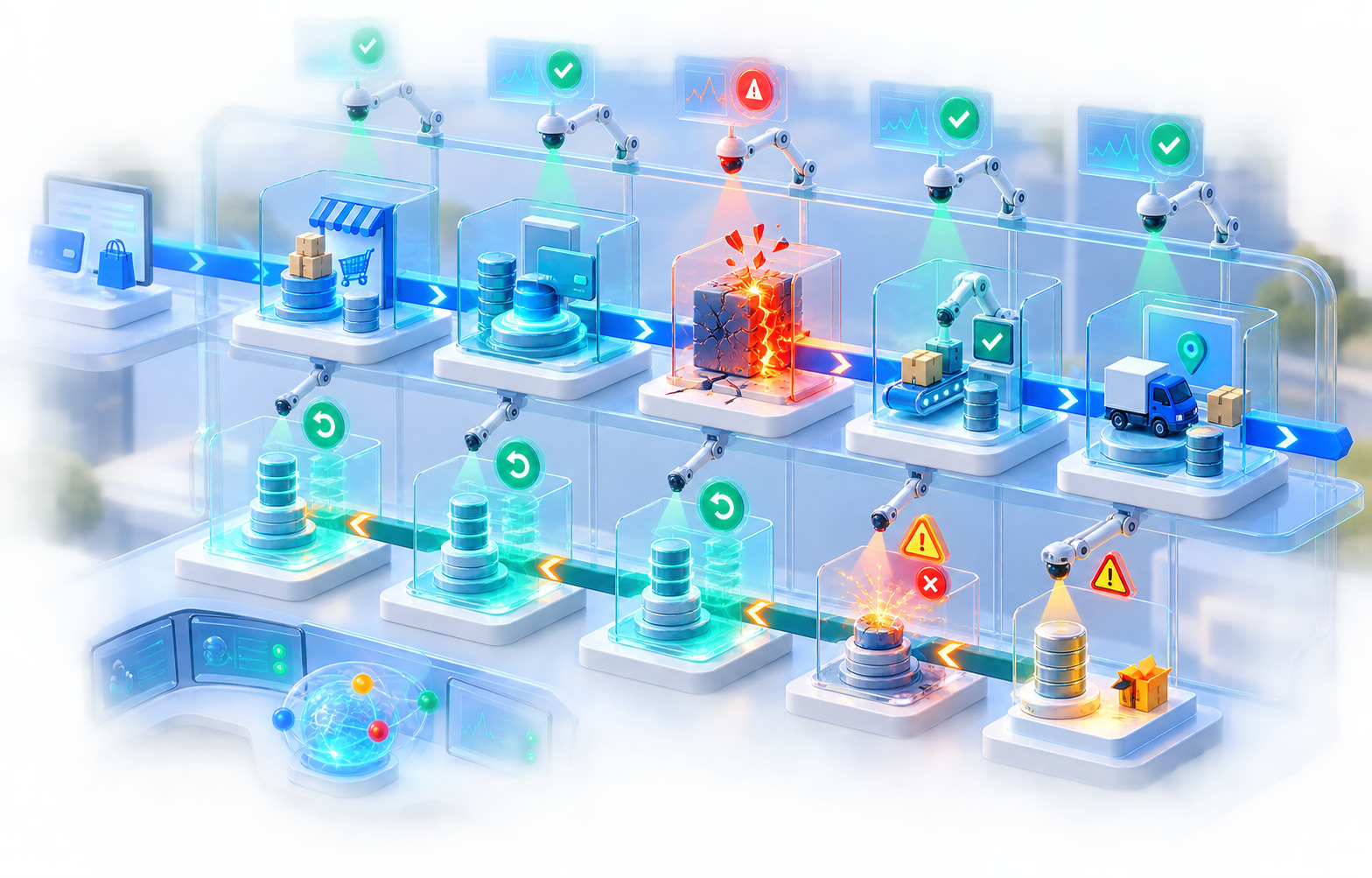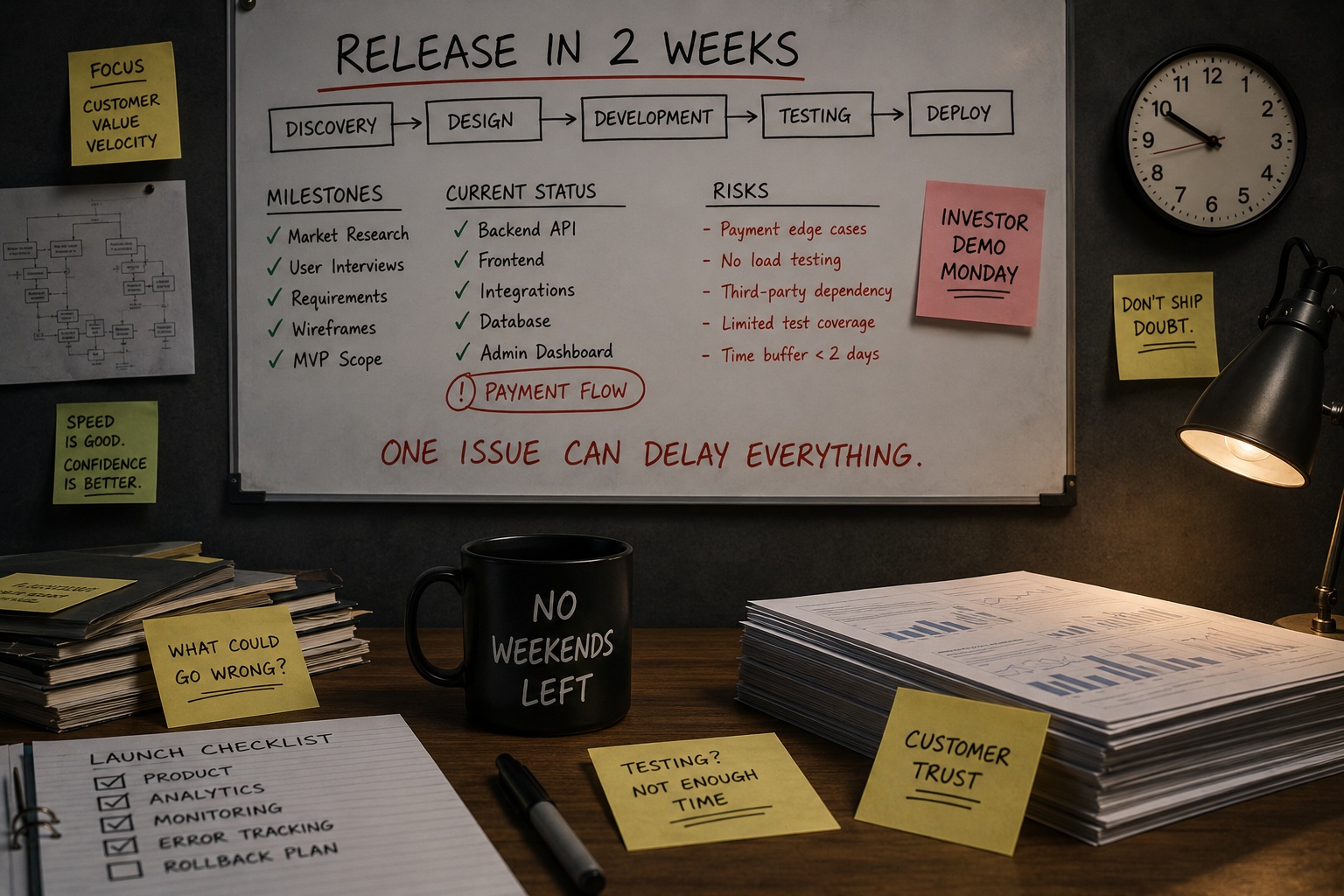
Your Release Is Two Weeks Away. You Can't Afford Another Delay.
Why the First Software Bug Is Usually Created Long Before Development Begins
It is 5 PM on a Friday.
The investor demo is Monday morning. The deck is done. The metrics slide is done. The founder has rehearsed the walkthrough four times, and the product looks, by every visible measure, ready.
Then the payment flow fails.
Not catastrophically. Not with a stack trace across the screen. It fails quietly — a discount code applied after tax calculation instead of before, so refunds come out three dollars short. Small enough to miss in a demo run-through. Large enough that a sharp investor, or a sharp customer, will notice within the first ten transactions.
The engineering lead is pulled in at 6 PM. By 8 PM, there are four Slack threads, two conflicting theories about the root cause, and a decision nobody wants to make: patch it overnight and hope, or pull the payment flow from the demo entirely and explain the gap to a room of people deciding whether to fund the company.
They pull it. The demo happens Monday, but it happens smaller than planned. The investor doesn't say no. They say "let's reconvene once the payment flow is solid." Everyone in the room hears that as a maybe. Everyone in the founder's head hears it as a no.
Here is the part worth sitting with: nobody on that team wrote bad code. The engineer who built the discount logic followed the ticket exactly as written. The ticket was correct as written. The problem is that the ticket was written six weeks earlier, during a sprint-planning session where "apply discount before tax" was said out loud, agreed to by everyone in the room, and never written down anywhere a developer would later see it.
The bug that cancelled the investor update wasn't created on Friday at 5 PM. It was created in a fifteen-minute planning conversation in early spring, when the team was moving fast, trusted each other, and didn't think a sentence needed to become a specification.
What makes this story worth dwelling on isn't the specific bug. It's what happened in the two days after. The founder didn't ask "who broke this." The founder asked "how many other decisions like this one are sitting in our product right now, unverified, waiting for the wrong customer to find them at the wrong moment." That is a much harder question to answer, and it's the question this article is actually about.
Most founders, when they retell this kind of story, tell it as a story about a stressful weekend. Told that way, the lesson is "test more before demos." That lesson is true but small, and it doesn't prevent the next version of the same problem from happening somewhere else in the product, six months later, with a different feature and a different customer. The larger lesson — the one that actually changes outcomes — is that a company's release risk is set long before release week, by how rigorously it converts conversation into specification, and specification into verified behavior. Everything else, including the Friday-night scramble, is downstream of that one variable.
This is the story almost every founder has lived, in some variation. A launch slips. A customer churns after a bad first week. A feature ships and immediately needs a hotfix. In the retro, someone always asks "how did we miss this?" — and the honest answer is almost never "the developer made a mistake." The honest answer is that the decision which created the defect was made long before a single line of code existed, by people who were doing exactly what the pressure of the moment told them to do.
This article is not about testing software. It's about why the highest-leverage decisions in a startup's product delivery happen upstream of development — in what gets agreed to, what gets written down, what gets assumed, and what gets deferred — and why founders who understand this stop being surprised by their own releases.
Why Founders Usually Discover Problems Too Late
Every founder decision that leads to a fragile release looked completely rational at the time it was made.
Runway is finite. A seed-stage company with eighteen months of cash does not have the luxury of a twelve-person engineering org with a dedicated quality function. The founder looks at the budget, looks at the roadmap, and makes a call: hire two more engineers who can ship features, not one engineer whose job is to ask hard questions about what "done" means. That call is not reckless. It is often the correct call, given the information available at the time.
The roadmap is aggressive because the market is aggressive. Competitors are shipping. Customers are asking for the next thing before the current thing is fully stable. Investors want evidence of velocity, not evidence of caution. A team that spends three extra days writing acceptance criteria for a feature can look, from the outside, like a team that is slower than a team that doesn't.
So the natural pattern emerges: developers test their own work, because there is no one else to do it. Founders test on weekends, because they are the only people outside engineering who understand the product well enough to catch something wrong. Everyone believes, reasonably, that this is temporary — a stage the company will grow out of once there's more revenue, more headcount, more time.
The problem is not that this approach is stupid. The problem is that it has a blind spot which is invisible by construction: the person who builds a feature is the worst-positioned person to notice when their own mental model of the requirement is wrong. A developer testing their own code is testing against their own understanding of what the code should do — which means the exact gap that caused the bug in the first place is the same gap that will cause them to sign off on it as correct.
Founders discover problems late for a structural reason, not a competence reason: the people closest to the code are structurally unable to see the requirement the way a customer, a support agent, or an auditor will see it. Nobody in the loop is looking at the product from outside the assumptions that built it. The gap doesn't announce itself. It waits until production, when a real customer with real money and a real deadline hits the exact case nobody thought to check.
The founders who avoid this pattern longest are not the ones with more QA headcount. They are the ones who notice, early, that "the developer tested it" and "someone verified it meets the business requirement" are two different claims — and that conflating them is where the risk hides.
There's also a timing problem baked into how most startups measure their own health. A founder tracking burn rate, MRR, and churn has excellent visibility into the outcomes of good or bad product decisions. What almost no founder tracks, especially pre-Series-A, is a leading indicator for release risk itself — something that would show a problem forming before it reaches a customer. Financial metrics are lagging indicators of engineering health; by the time churn moves because of a quality issue, the issue has usually existed for months. There is rarely an equivalent early-warning system on the product side, which means the first real signal a founder gets is often the worst possible one: a customer complaint, a failed demo, or a technical objection in a diligence call.
This is compounded by a subtle organizational dynamic worth naming directly: engineers, understandably, want to report good news. A sprint update that says "everything shipped on time" is more comfortable to deliver and more comfortable to hear than one that says "we shipped, but I'm not fully confident in three of these five tickets." Without a formal, safe channel for expressing that kind of doubt — a quality function whose entire job is to surface exactly this kind of uncertainty — that doubt tends to get rounded up to confidence by the time it reaches a founder. Nobody is lying. The information is simply being filtered, gently and unintentionally, at every layer between the person closest to the risk and the person who most needs to know about it.
Editorial illustration: A modern conference room, empty of people. A product roadmap spans the entire back wall, organized into clean columns and rows, every card marked green. In the bottom corner, nearly out of frame, a single small red sticky note sits half-hidden behind a chair leg — the only element in the room that isn't accounted for.
The First Software Bug Isn't Written In Code
If you trace almost any serious production defect backward — not the symptom, but the actual origin — you rarely land on a line of code. You land on a sentence that was ambiguous, a decision that was assumed rather than confirmed, or a workflow that was never fully mapped.
Consider the categories that quietly generate the majority of downstream defects:
Requirements ambiguity. A ticket says "users can filter by date." It doesn't say whether that includes a custom date range, whether the range is inclusive or exclusive of the end date, or what happens when the range returns zero results. Three developers will build three reasonable interpretations of that sentence. Only one interpretation will match what the product actually needs, and nobody finds out which one until a customer complains.
Missing acceptance criteria. A feature is "done" when the developer believes it satisfies the ticket. Without a written, agreed definition of done — specific inputs, specific expected outputs, specific edge cases — "done" is a feeling, not a fact. Feelings vary from person to person. Facts don't.
Wrong assumptions carried forward from an earlier conversation. Someone mentions in a hallway conversation that enterprise customers need SSO before self-serve customers do. That assumption shapes three sprints of prioritization. Nobody documents it, nobody revisits it, and by the time someone asks "wait, why did we sequence it this way?" the assumption has hardened into architecture.
Poor communication across functions. Product knows what the customer asked for. Design knows how it should look. Engineering knows how it will be built. Each function has a slightly different version of the requirement in their head, and the differences don't surface until integration — which is the most expensive possible moment to discover them.
Undefined workflows. A feature is specified as a single happy path: user logs in, user performs action, user sees result. Nobody specifies what happens if the user's session expires mid-action, or if they open the same workflow in two tabs, or if the action partially completes before a network failure. Those aren't edge cases in the pejorative sense — they are the majority of what real usage actually looks like.
Changing priorities mid-build. A feature scope shifts twice during a two-week sprint because a sales conversation surfaced a new must-have. Each shift is individually reasonable. The cumulative effect is that no single person holds the complete, current picture of what's actually being built — including the developer writing the code.
Incomplete user journeys. The team designs and builds the primary flow beautifully, but the account-recovery flow, the failed-payment flow, and the plan-downgrade flow were never walked end to end by anyone. These are the flows a customer hits during their worst moment with the product — and they are consistently the least-specified parts of the system.
Silent scope creep during implementation. A developer, mid-build, encounters a case the ticket didn't anticipate and makes a small, sensible-seeming judgment call to keep moving — without looping back to confirm it with anyone. Multiply that by a team of engineers working in parallel, each making their own small judgment calls, and the shipped feature becomes an accumulation of individually reasonable decisions that, together, nobody actually approved.
Tribal knowledge that never gets written down. In a five-person team, everyone remembers why a particular exception exists in the billing logic, because everyone was in the room when it was decided. At fifteen people, half the team wasn't in that room. At forty, almost nobody was, and the exception looks like a mistake to the next engineer who touches that code — so they "fix" it, reintroducing the very bug the exception existed to prevent.
None of these are coding failures. Every one of them happens before a developer opens an editor. And every one of them becomes, eventually, a ticket in a bug tracker that reads like a technical problem — a null pointer, a race condition, a miscalculated total — when the actual root cause was a decision made in a meeting, a Slack thread, or a moment of silence where a question should have been asked and wasn't.
This is the uncomfortable truth for founders: the bug tracker measures symptoms. It almost never measures causes. A team that only looks at the bug tracker to understand quality is reading the wrong document.
Editorial illustration: A row of large, evenly spaced domino blocks laid out in a straight line, each one labeled in clean serif type — Requirements, Discovery, UX, Architecture, Development, Testing, Release, Production. The first domino, Requirements, has a thin visible crack running through it. The rest of the row is mid-collapse, each block tipping into the next.
Why Developers Shouldn't Be The Last Line Of Defense
This is not an argument that developers are careless, or that engineering teams can't be trusted. It's the opposite: it's an argument for putting developers in the role they are actually best suited for, and not asking them to also hold a role they are structurally unsuited for.
A developer's job is to verify implementation: does this code do what I intended it to do? Does it compile, does it pass the unit tests I wrote, does it behave correctly against the inputs I thought to try? That is a genuinely hard job, and good developers are excellent at it.
Quality engineering asks a different question entirely: does this feature do what the business actually needs, for the customers who will actually use it, including the customers whose behavior nobody anticipated? That's not a harder version of the developer's question — it's a different question, requiring a different vantage point. The person who wrote the code is, by definition, anchored to the assumptions that produced the code. Someone standing outside those assumptions is far more likely to ask "what if the user does X instead" — because they were never inside the mental model that made X seem impossible.
This is why "the developer tested it" and "someone verified it meets business expectations" so often look identical on a status update and are, in practice, entirely different levels of confidence.
| Developer Mindset | Quality Mindset | Business Impact | Customer Impact | Release Confidence |
|---|---|---|---|---|
| Does this match what I built? | Does this match what was needed? | Fewer costly rebuilds after launch | Fewer surprises during real use | High — verified against intent, not just code |
| Tests the paths I anticipated | Tests the paths a customer will actually take | Reduced support escalations | Consistent experience across edge cases | Predictable, not hopeful |
| Confidence based on passing tests | Confidence based on validated requirements | Faster investor and enterprise due diligence | Trust builds instead of erodes | Releases stop feeling like gambles |
| Optimizes for shipping the ticket | Optimizes for shipping the outcome | Roadmap holds because releases don't boomerang | Fewer "this isn't what I expected" moments | Founders sleep the night before a release |
None of this is a critique of engineers. A carpenter who frames a house correctly according to the blueprint should not also be the building inspector — not because the carpenter is untrustworthy, but because the inspector's value comes precisely from not having built the thing themselves. The separation is what makes the inspection meaningful.
Startups that skip this separation aren't cutting a corner that doesn't matter. They're removing the one function in the organization whose entire job is to look at the product the way a paying customer, an auditor, or an investor's technical diligence team eventually will.
There's a second, quieter cost to skipping this separation, one that shows up not in the bug tracker but in how engineers spend their attention. A developer who knows they are also the last line of defense before release will, understandably, spend part of their mental energy worrying about what they might have missed, rather than fully concentrating on what they are building. That split attention is not a moral failing — it's a natural response to an unreasonable amount of responsibility concentrated in one role. Teams that separate implementation from verification consistently report that developers feel less anxious about shipping, not because the bar for quality has dropped, but because the bar is now being checked by someone whose full attention is on checking it.
It's worth being precise about what this separation is not. It is not a gate that slows engineering down for its own sake, and it is not a signal of distrust in the engineering team's competence. The best quality functions operate as a second set of eyes deeply embedded in the same goals as engineering — shipping fast, shipping well, and not getting paged at midnight — rather than as an external auditor working against the team's incentives. Framed that way, the relationship between developers and quality engineers looks less like a checkpoint and more like a second brain solving the same problem from a different angle, which is precisely what makes it valuable.
The Weekend Every Founder Knows
There's a particular weekend that almost every founder who has shipped software can describe in specific, visceral detail, even years later.
It starts with a release scheduled for Monday. By Friday afternoon, everything looks green. Then, sometime Saturday, someone — usually the founder, sometimes a developer who couldn't quite let it go — starts clicking through the product one more time, off-script, without a ticket to follow. And something breaks. Not something exotic. Something a real customer would hit in their first five minutes.
What follows is familiar to the point of being almost universal: a flurry of Slack messages that start calm and get shorter and more clipped as the hours pass. A phrase that shows up in nearly every one of these weekends, usually typed by someone slightly defensive: "Works on my machine." A last-minute fix, written fast, under pressure, by someone who is now debugging code they wrote three weeks ago and barely remember. A decision to patch and ship anyway, because postponing feels worse than the risk of shipping something not fully verified.
Sometimes it holds. Often it doesn't, and Monday brings a second emergency: a rollback, a customer support queue filling with confused messages, an apologetic email to the handful of customers who hit the bug first. The team that shipped the fix on no sleep now has to fix the fix, still on no sleep, while also managing the customers who noticed.
Nobody in this story is incompetent. Everybody in this story is exhausted, and exhaustion is not a quality control mechanism — it is, if anything, the condition under which mistakes are most likely, which makes it a strange thing to rely on as the last line of defense before a release.
The pattern repeats not because founders don't learn from it, but because each occurrence feels like a one-off crisis rather than a symptom of the same upstream cause described earlier: requirements that were never fully specified, workflows that were never fully walked, and a verification step that only happens under duress, close enough to the release date that there's no time left to do it well.
There is a specific irony worth naming here: the weekend scramble feels, from the inside, like diligence. The team is working hard, staying late, catching things. It looks and feels like quality control in action. But testing performed for the first time under deadline pressure, by the same people who built the feature, using no predetermined checklist, is close to the least effective form of verification available — not because the people involved aren't trying hard, but because the format itself is stacked against thoroughness. There's no time to think about the case nobody has thought of yet. There's only time to check the cases already top of mind, which are, by definition, not the cases most likely to have been missed.
The founders who eventually break this cycle don't do it by asking their teams to work harder on the weekend before a release. They do it by moving the verification earlier in the calendar, so that by the time Friday afternoon arrives, there's nothing left that depends on a late night to catch.
Editorial illustration: A dim, empty office at night. Rows of unoccupied chairs pushed in at odd angles. On the far wall, a large digital countdown reads "Monday — Release." Scattered across the desks: cold coffee cups, open notebooks with handwritten notes, no laptops open, no people in the frame — just the aftermath of a long night, suspended in stillness.
Hidden Business Costs Nobody Calculates
When a startup calculates the cost of a quality problem, it almost always calculates the visible cost: the hours spent on the hotfix, maybe the cost of a refund or a service credit. That number is real, but it is a small fraction of the total cost, and the rest of it hides below the surface where most financial models never look.
Lost customers rarely announce themselves as lost. They quietly downgrade, or they don't renew, or they simply stop opening the product — and by the time churn shows up in a dashboard, the decision to leave was made weeks earlier, usually right after a bad experience nobody flagged as significant at the time.
Lost investor confidence is similarly invisible until it isn't. A delayed demo, a buggy trial account, a technical due-diligence call where the engineering team can't clearly answer "what's your escaped defect rate" — none of these individually sink a round. Collectively, they shape a narrative about execution risk that shows up in a term sheet as a lower valuation, or doesn't show up as a term sheet at all.
Engineering burnout compounds quietly. Every hotfix under pressure borrows against the team's future capacity — the same engineers debugging a production incident at 11 PM are, by definition, not building the next feature, and they are measurably worse at both tasks the next day. Turnover on a startup's best engineers is expensive in a way that rarely gets attributed to its actual cause.
Context switching is the tax nobody puts on a roadmap. Every unplanned bug fix pulls an engineer off planned work, and the cost isn't just the hours spent on the fix — it's the twenty-to-thirty minutes of lost focus on either side of the interruption, repeated across a team, repeated across a year.
Delayed roadmap is the most direct casualty: every sprint spent firefighting is a sprint not spent building the feature that was supposed to drive the next stage of growth. Founders feel this as "we're always behind," without always connecting it to its source.
Negative reviews and support overload move slower than a production outage but last longer. A one-star review referencing a bug sits on an app store page for years. A support team perpetually handling avoidable tickets never gets the bandwidth to build the proactive, high-touch relationships that reduce churn.
Opportunity cost is the largest and least visible of all: the feature that didn't get built because the team spent the quarter stabilizing the last release instead of shipping the next one. This cost never appears on an invoice. It appears, eventually, as a competitor who moved faster.
Illustrative estimate, based on patterns typical of a Series A SaaS company: a single unresolved architectural quality gap can plausibly cost a twenty-person engineering org 15–25% of total sprint capacity in unplanned rework over two quarters — capacity that, redirected, would fund an entire additional feature line. These figures are illustrative, not a universal benchmark; the actual number depends heavily on product complexity and team maturity.
There is one more hidden cost worth naming on its own, because founders tend to underestimate it most: decision fatigue at the leadership level. Every unplanned production issue eventually reaches a founder's desk in some form — a customer escalation, a support summary, an engineer flagging a risk before a release. Each of these is a small decision: do we delay, do we patch, do we accept the risk. None of them, individually, feels large. But a founder who is making ten small quality-related decisions a week has ten fewer decisions' worth of attention left for the strategic choices that actually require a founder's judgment — pricing, hiring, positioning, fundraising. The cost isn't just engineering time. It's the founder's own decision-making bandwidth, which is arguably the scarcest resource in an early-stage company, quietly spent on problems that a more mature process would have resolved without ever reaching their inbox.
None of these costs show up as a single line item anywhere. That is precisely why they persist — a cost that can't be located on a spreadsheet is a cost that never gets prioritized against the costs that can.
Editorial illustration: An iceberg rendered in flat, muted tones, cross-sectioned to show above and below the waterline. Above the surface, a small labeled tip: "Visible Costs." Below, in successively larger and deeper layers: "Hidden Costs," "Lost Opportunities," "Burnout," "Delayed Growth," "Customer Churn" — each layer wider than the one above it, illustrating how the true mass of the cost sits unseen.
Case Studies
The following are illustrative composites, built from patterns commonly observed across early-stage and growth-stage software companies. They do not represent any single real company, and any resemblance to a specific organization is coincidental.
B2B SaaS — Workflow Automation Platform
Before: 14 developers, no dedicated quality function, releases every 5 weeks, averaging 31 production issues per release cycle. Decision: Introduced a small dedicated quality engineering function embedded in planning, not just testing after the fact. Implementation: Acceptance criteria became mandatory before a ticket entered a sprint; regression suites were built around the top customer workflows rather than every possible path. Business outcome: Release cadence tightened to every 2 weeks. Critical bugs fell by roughly 74%. Support tickets fell by roughly 42%. Customer onboarding completion improved by roughly 26%. Developer time spent on defect fixes dropped by roughly 37%, redirected into new feature work.
Healthcare — Patient Scheduling Software
Before: A ten-person engineering team building against tight regulatory deadlines, with quality verification handled informally by whichever developer had time. Decision: Formalized acceptance criteria specifically around compliance-sensitive workflows — appointment rescheduling, consent capture, and data-access logging — before development began, rather than validating them after the fact. Implementation: Built a small, high-coverage regression suite focused narrowly on the workflows most exposed to regulatory and patient-safety risk. Business outcome: Audit preparation time dropped substantially, since evidence of validated workflows already existed rather than being reconstructed after the fact. Patient-facing scheduling errors, previously a recurring support theme, became rare enough to stop appearing in monthly support reviews.
Fintech — Small Business Lending Platform
Before: A rapidly scaling team shipping weekly, where interest calculation and repayment logic changes were verified primarily through manual spot-checks. Decision: Introduced quality gates specifically around any change touching money movement or interest calculation, with mandatory sign-off before release regardless of deadline pressure. Implementation: Automated validation of calculation logic against a library of real-world repayment scenarios, reviewed and expanded quarterly. Business outcome: Calculation-related support escalations, previously a top-three ticket category, dropped out of the top five entirely within two quarters. Engineering leadership reported materially fewer emergency releases tied to financial logic.
Logistics — Route and Fleet Management
Before: A distributed engineering team building against a roadmap driven heavily by a handful of large enterprise contracts, with quality verification happening late, close to each release date. Decision: Moved requirement validation earlier, walking full user journeys — including dispatcher error-recovery flows — during planning rather than after build. Implementation: Built a shared, living specification document for each major workflow, reviewed by product, engineering, and a quality lead before a single ticket was written. Business outcome: Enterprise customer escalations tied to dispatch errors dropped noticeably within one release cycle. Sales reported an easier time closing renewals with customers who had previously flagged reliability concerns.
EdTech — Classroom Assessment Platform
Before: A small, fast-moving team focused heavily on feature velocity ahead of a back-to-school launch window, with quality checks largely limited to developer self-review. Decision: Introduced lightweight but mandatory acceptance criteria for any feature touching grading or student data, given the sensitivity and irreversibility of errors in that domain. Implementation: A small, focused regression suite targeting grading calculation and data-export accuracy, run before every release rather than only before major ones. Business outcome: Grading-related support tickets, previously a recurring seasonal spike, became flat across the launch window. District-level renewal conversations reportedly became noticeably smoother once reliability stopped being a recurring topic.
Marketplace — Two-Sided Booking Platform
Before: A growth-stage team scaling two-sided supply and demand, where new marketplace features were tested primarily by the developers who built them, under significant time pressure from a competitive category. Decision: Introduced structured requirement discovery sessions before each major feature, explicitly mapping both the buyer-side and supplier-side journeys before writing tickets. Implementation: A small quality function embedded directly in planning meetings, tasked with asking "what happens if" questions before development began, not after. Business outcome: Double-booking and payout-mismatch incidents, previously a recurring theme in supplier complaints, dropped substantially within two release cycles. Supplier retention, tracked internally as a leading indicator, showed measurable improvement in the following quarter.
What Actually Changed?
It would be easy to summarize all six cases as "they hired QA." That summary would miss the actual mechanism, and missing it is exactly how founders end up hiring a QA engineer and seeing no improvement at all.
What actually changed, in every case, wasn't headcount. It was the location of a specific kind of thinking inside the development process.
Requirements became measurable. Instead of "users can filter by date," the team wrote down exactly what inputs are valid, what the boundary conditions are, and what a correct result looks like for each one — before a developer touched the ticket.
Acceptance criteria became clear enough that two different people would reach the same conclusion about whether a feature was done. This sounds small. It is, in practice, the single highest-leverage change in the entire list, because it removes the ambiguity that every other problem in this article traces back to.
Regression became predictable instead of reactive — a known, maintained set of checks against the workflows that matter most, rather than a scramble to remember what might break before every release.
Developers focused on building, because they were no longer also responsible for independently verifying business intent — a job that was never really theirs to hold alone.
Founders focused on customers, because release day stopped being the day they found out whether the product worked.
None of this required a large team. In every case above, the quality function was small — often one or two people — embedded early, not a large team added late. The leverage came from when the thinking happened, not how many people were doing it.
This is the point most founders miss when they look at these outcomes and reach for the fastest available explanation. "They added QA" is a staffing story. The actual story is a sequencing story — the same amount of thinking that used to happen in the last week before release started happening in the first week of planning instead. Nothing about the total amount of rigor changed dramatically. What changed was where, in the calendar, that rigor was applied — and moving it earlier turned out to be worth far more than adding more of it later.
It's also worth noting what did not change in any of these cases. None of them slowed their roadmap down in any way that founders, in retrospect, regretted. Several accelerated. This tracks with a pattern common enough to be treated as a rule of thumb: time spent removing ambiguity before development is reliably cheaper than time spent removing the consequences of that ambiguity after release — often by a wide margin, because a requirement clarified in a five-minute conversation prevents a defect that would otherwise take days to trace, reproduce, and fix once it reaches production.
Build A Release Confidence System
The QAtronic Release Confidence Framework™
A release confidence system doesn't require an elaborate methodology. It requires five decisions, made deliberately, at five points where the risk described throughout this article actually accumulates.
The framework below is deliberately narrow. It is not a comprehensive engineering methodology, and it does not attempt to replace whatever development process a team already uses — agile, kanban, or something more bespoke. It sits alongside that process, addressing specifically the question this entire article has been circling: where does risk enter, and at which point is it cheapest to catch?
1. Discovery Purpose: Surface ambiguity and assumptions before they become architecture. Business value: Prevents the most expensive class of rework — the kind discovered after launch. Common mistake: Treating discovery as a formality to move past quickly rather than the highest-leverage stage in the entire process. Success metric: Percentage of features that reach development without a documented, agreed specification (target: as close to zero as possible).
2. Requirements Purpose: Convert conversation into a written, specific, testable definition of what "done" means. Business value: Removes the ambiguity that causes three developers to build three different interpretations of the same ticket. Common mistake: Writing requirements that describe the happy path only, omitting edge cases and failure states. Success metric: Percentage of production defects traceable to a missing or ambiguous requirement, tracked quarter over quarter.
3. Quality Gates Purpose: Establish non-negotiable checkpoints — specific to money movement, data integrity, and irreversible customer actions — that must pass before release, regardless of deadline pressure. Business value: Prevents the category of defect that causes the most reputational and financial damage, even if it's a small share of total defects. Common mistake: Applying the same rigor uniformly everywhere, which either slows low-risk work unnecessarily or under-protects high-risk work. Success metric: Number of high-severity incidents in gated areas versus ungated areas, over time.
4. Continuous Validation Purpose: Maintain an evolving, living regression suite around the workflows customers actually use, not every theoretically possible path. Business value: Makes each release cycle faster and less stressful than the last, instead of accumulating risk with every new feature. Common mistake: Letting the suite grow indefinitely without pruning, until it becomes too slow to run and gets skipped under pressure. Success metric: Time from code complete to release-ready, tracked release over release.
5. Production Confidence Purpose: Know, before a release ships, what "healthy" looks like in production — and detect deviation quickly if it doesn't. Business value: Converts release day from a leap of faith into a monitored, reversible decision. Common mistake: Defining monitoring only in technical terms (uptime, latency) without also tracking the business-level signals — completed checkouts, successful onboarding — that indicate real customer impact. Success metric: Mean time to detect a regression that affects customers, and mean time to resolve it.
These five pillars are sequential, not parallel — each one reduces the risk the previous one didn't catch. A team strong at Quality Gates but weak at Discovery will still be surprised, just later in the process and at higher cost.
A useful way to stress-test where a team currently stands is to ask, honestly, at which pillar most of last quarter's incidents would have been caught if the process had worked as designed. Teams new to this exercise are often surprised to find that the majority of their incidents trace back to the first pillar — Discovery — even though the incident itself surfaced during the fifth. The gap between where a problem originates and where it's finally noticed is, in most organizations, the single largest opportunity for improvement, and it is almost always larger than anyone assumed before measuring it directly.
Founder Self-Assessment
Answer each question with a simple Yes or No. Be honest rather than aspirational — the value of this exercise depends entirely on answering based on what actually happens, not what's supposed to happen.
- Do developers test their own features before release, with no independent review?
- Do you know your team's current escaped defect rate?
- Can you release on a Friday afternoon without private anxiety about the weekend?
- Is there one clearly identified owner of release quality, by name?
- Does your quality function (if one exists) participate in planning, or only in testing after the fact?
- Do requirements documents specify edge cases, or only the primary happy path?
- Has a feature ever shipped that three different team members would define as "done" differently?
- Do you have a written definition of "done" that a new hire could apply consistently?
- Has a production incident in the last quarter traced back to a requirement gap rather than a coding error?
- Do you track how much engineering time is spent on unplanned rework versus planned roadmap work?
- Can your team name the three workflows where a defect would be most damaging to the business?
- Are those three workflows subject to more rigorous verification than the rest of the product?
- Has a customer discovered a bug before your team did, in the last 90 days?
- Do you have a regression suite that runs before every release, not just major ones?
- Is that regression suite actively maintained, or has it been neglected as the product grew?
- Has an investor or enterprise prospect ever asked a technical due-diligence question your team couldn't answer confidently?
- Do you know how long it currently takes to detect a customer-impacting regression after release?
- Do you know how long it takes to resolve one once detected?
- Has a release ever been rolled back in the last six months?
- Was the root cause of that rollback documented and addressed, or simply patched?
- Do engineers on your team routinely say "works on my machine" as an informal sign-off?
- Is there a meaningful difference in your organization between "the code runs" and "the requirement is met"?
- Do your acceptance criteria specify expected behavior for failure states, not just success states?
- Has a feature ever needed to be substantially rebuilt within three months of shipping?
- Do you track cost or time lost to unplanned hotfixes as a distinct line item?
- Would your roadmap look meaningfully different if unplanned rework dropped by half?
- Has your team ever shipped a feature that quietly changed customer behavior in a way nobody predicted?
- Is there a documented process for how a requirement moves from conversation to written specification?
- Do product, design, and engineering routinely walk full user journeys together before development begins?
- Has ambiguity in a Slack thread ever become the de facto specification for a shipped feature?
- Do you have visibility into which parts of your product generate the most support tickets?
- Is that data used to prioritize quality investment, or only to prioritize new features?
- Has a team member left, in part, due to burnout from repeated crunch-mode releases?
- Do you have a way to measure release confidence before shipping, beyond "it feels ready"?
- Would your team describe your current release process as predictable?
- Has your company ever delayed a fundraising conversation due to a product quality concern?
- Do you review production incidents for root cause, not just for the immediate fix?
- Is there a clear, shared understanding across the company of what "quality" means for your specific product?
- Has your team's confidence in its own release process increased or decreased over the last year?
- If a new engineering leader joined tomorrow, would they be able to see your quality risks within a week — or would it take months to discover them the hard way?
Scoring: Count the number of answers that reflect a healthy practice (this varies by question — a "No" to question 1 is healthy; a "Yes" to question 2 is healthy).
- 0–10: High Risk. Quality issues are likely surfacing in production regularly, and the organization may not yet have visibility into the true cost.
- 11–20: Needs Attention. Some foundational practices exist, but gaps are likely causing recurring, avoidable rework.
- 21–30: Healthy. Core practices are in place; the focus now should be consistency and maintenance as the company scales.
- 31–40: Release Ready. Quality is functioning as a deliberate engineering strategy, not an afterthought.
Architecture Decision Records
The following are illustrative examples of how quality-related architectural decisions can be documented, using the standard ADR format of Context, Decision, Alternatives, Trade-offs, and Business Consequences.
ADR-01: Where Quality Verification Sits in the Development Lifecycle Context: Verification currently happens only after a feature is code-complete, close to the release date. Decision: Introduce requirement review and acceptance-criteria sign-off before a ticket enters a sprint. Alternatives considered: Leaving verification entirely post-development; adding verification only for large features. Trade-offs: Slightly longer time from idea to ticket; requires product, design, and engineering alignment earlier than the team is used to. Business consequences: Fewer late-stage surprises; slower start per feature, faster and more predictable finish.
ADR-02: Scope of the Regression Suite Context: No systematic regression coverage exists; testing before release is ad hoc and inconsistent between releases. Decision: Build a regression suite scoped to the top customer workflows by usage and business risk, not an attempt at exhaustive coverage. Alternatives considered: Full exhaustive test coverage across every possible path; no formal regression suite at all. Trade-offs: Some lower-priority paths remain unverified by automation; requires ongoing maintenance as workflows evolve. Business consequences: Meaningful reduction in customer-facing regressions with a sustainable, maintainable level of investment.
ADR-03: Quality Gates for Financial and Irreversible Actions Context: Features touching payments, refunds, and account-irreversible actions are currently verified with the same rigor as low-risk features. Decision: Apply mandatory, non-negotiable quality gates specifically to financial and irreversible-action workflows. Alternatives considered: Uniform verification rigor across all features; relying on post-release monitoring alone. Trade-offs: Slightly slower release cycle for a defined subset of features. Business consequences: Sharp reduction in the highest-cost class of incidents, at a small, targeted cost to velocity.
ADR-04: Ownership of Release Quality Context: No single individual is accountable for release quality; responsibility is diffused across the engineering team. Decision: Assign a named owner for release quality, distinct from feature delivery ownership. Alternatives considered: Continue with shared, informal ownership; assign ownership to engineering leadership as an additional responsibility. Trade-offs: Requires a dedicated role or a clearly carved-out portion of an existing role's time. Business consequences: Clear accountability shortens the time from incident to resolution and improves cross-team communication during releases.
ADR-05: Definition of Done Across Functions Context: Product, design, and engineering each maintain a slightly different informal definition of "done." Decision: Establish a single, written, cross-functional definition of done that applies to every ticket entering development. Alternatives considered: Allow each function to maintain its own definition; define "done" only at the engineering level. Trade-offs: Requires upfront cross-functional agreement, which can surface disagreements earlier than the team is used to addressing them. Business consequences: Reduces the single most common root cause of late-stage rework: features that were "done" by one function's standard but not another's.
Engineering Workshop
Questions for your leadership team to discuss together, ideally as a dedicated session rather than an agenda item squeezed into a standing meeting.
- Would our product roadmap change if releases became twice as predictable as they are today?
- How much runway has already been consumed by defects we could have caught earlier?
- If a new engineering leader joined tomorrow, how long would it take them to find our biggest hidden quality risk?
- What's the last production incident where the root cause was a requirement gap rather than a coding error — and what changed afterward?
- Who, specifically, owns release quality in our organization today?
- Which three workflows in our product would be most damaging to get wrong — and are they treated with more rigor than the rest?
- Do we know our escaped defect rate? If not, why not?
- What would have to be true for us to release on a Friday afternoon without anxiety?
- How much engineering time went to unplanned rework last quarter, and what could that time have built instead?
- Has an investor or enterprise customer ever asked a technical question we couldn't answer confidently?
- What's our current mean time to detect a customer-impacting regression — and is that number improving or getting worse?
- Where in our process does a requirement move from a conversation to something written down — and how reliable is that step?
- If we doubled quality investment tomorrow, where would it have the highest leverage — and is that where it currently sits?
- What's the most expensive bug we've shipped in the last year, and where did it actually originate?
- If our best engineer left tomorrow, would our quality risks leave with them, or are they documented anywhere else?
Executive Checklist
Immediate
- Identify a named owner of release quality.
- List the three workflows in your product where a defect would be most damaging.
- Check whether your last five production incidents trace back to a requirement gap, a design gap, or a coding error — and note the pattern.
- Confirm whether your team currently knows its escaped defect rate.
- Ask your engineering lead how much time was spent last sprint on unplanned rework.
- Review your most recent rollback, if any, for whether the root cause was actually addressed or only patched.
- Identify whether a written, shared definition of "done" exists across product, design, and engineering.
30 Days 8. Draft a written definition of "done" that a new hire could apply consistently. 9. Establish mandatory acceptance criteria for any new ticket touching money movement or irreversible customer actions. 10. Build a lightweight regression checklist for your top three highest-risk workflows. 11. Set up a basic dashboard tracking planned versus unplanned engineering time. 12. Walk one complete user journey — including failure states — as a cross-functional team, end to end. 13. Document one recent production incident using a simple context-decision-consequence format, and share it with the whole team. 14. Identify which parts of your product generate the most support tickets, and cross-reference against your roadmap priorities.
90 Days 15. Expand the regression checklist into a maintained, automated suite where feasible. 16. Introduce a requirement-review step before any ticket enters a sprint. 17. Establish quality gates specific to your highest-risk workflows, distinct from your general release process. 18. Track and report your escaped defect rate monthly. 19. Measure mean time to detect and mean time to resolve customer-impacting regressions. 20. Run the 40-question founder self-assessment with your leadership team and compare individual scores. 21. Identify one ADR-worthy decision from the last quarter and document it retroactively. 22. Set a target for reducing unplanned rework as a percentage of total engineering time.
180 Days 23. Reassess your escaped defect rate against your 90-day baseline. 24. Reassess your release cadence — has it become faster, slower, or more predictable? 25. Conduct a cross-functional retrospective specifically on quality, separate from your standard sprint retros. 26. Evaluate whether your current quality function (however informal) needs dedicated headcount or external support. 27. Revisit your definition of done and update it based on what's been learned. 28. Present updated quality metrics to your board or investors as part of a standard operating update. 29. Reassess whether your three highest-risk workflows have changed as the product has evolved. 30. Decide, deliberately, what your next 180-day quality investment should be — rather than letting it be decided by whatever breaks next.
Conclusion
Companies rarely fail because their developers wrote bad software. In almost every case worth examining closely, the developers did exactly what they were asked to do, correctly, given what they knew at the time.
Companies fail — or stumble in ways that cost them a funding round, a key customer, or a year of momentum — because quality entered the conversation too late to matter. It arrived at the end, as a final check before release, when the decisions that actually determined the outcome had already been made weeks or months earlier, in a planning meeting, a hallway conversation, or a ticket that seemed clear enough at the time.
The strongest engineering organizations don't distinguish themselves by testing more. They distinguish themselves by discovering risk earlier — pulling the moment of verification backward, out of the final week before release and into the first conversation about what should be built at all.
Quality, understood this way, is not a phase that happens after development, and it is not a department that exists to catch what engineering missed. It is an engineering strategy — a set of decisions about when ambiguity gets resolved, when assumptions get written down, and when the business's actual expectations get separated from an individual engineer's best guess at what those expectations were.
Founders who internalize this stop being surprised by their own releases. Not because nothing ever goes wrong — something always eventually does — but because when it does, it's detected early, understood clearly, and resolved without becoming a Friday-at-5-PM story that gets retold for years.
There's a particular kind of confidence that comes from this shift, and it's worth describing precisely because it's easy to mistake for something else. It isn't the confidence of a team that never encounters problems — that team doesn't exist. It's the confidence of a team that has stopped being afraid of its own release process, because it has stopped relying on hope, adrenaline, and a good weekend to get a feature out the door safely. That confidence shows up in small, concrete ways: a founder who can say yes to a Monday demo without a private moment of dread on Friday afternoon. An engineering lead who can answer a due-diligence question about defect rates with an actual number instead of a reassuring guess. A support team that spends its time helping customers succeed rather than apologizing for something that shouldn't have shipped.
None of this happens by accident, and none of it happens overnight. It happens because a company decided, at some point, that the conversation about quality belongs at the beginning of the process rather than the end of it — and then built the habits, the roles, and the small disciplines described throughout this article to make that decision durable.
When External Quality Engineering Makes Sense
Not every company needs to build an internal quality function immediately, and not every company should. For many early-stage teams, the right first step is simply the practices described throughout this article — clearer requirements, earlier discovery, a small regression suite around the workflows that matter most.
There are specific conditions, however, under which bringing in external quality engineering expertise tends to reduce delivery risk faster than building the capability from scratch:
Rapidly growing startups, where the pace of new feature development is outstripping the team's capacity to verify each one thoroughly, often benefit from an experienced external function that can be embedded quickly without a lengthy hiring and ramp-up cycle.
Investor deadlines, particularly around fundraising milestones or board updates, create a narrow window where release confidence matters disproportionately — and where the cost of a visible quality issue is highest.
Enterprise customers, who typically bring formal technical due diligence, security reviews, and SLA expectations that a team without dedicated quality practices may not yet be equipped to satisfy convincingly.
Limited hiring capacity, especially at companies where engineering headcount is entirely allocated to feature development and there is no realistic near-term path to hiring a dedicated internal quality hire.
Release pressure, where the team is caught in the pattern described earlier in this article — testing under duress, close to the deadline, with no time left to do it well — often benefits most from external expertise focused specifically on building sustainable practices, not just patching the current release.
In each of these situations, external quality engineering isn't a replacement for the practices described throughout this article — it's a way to establish them faster, with less disruption to a team that's already stretched thin. An experienced external function typically brings something a first internal hire cannot: patterns observed across many companies facing the same growth stage, rather than the experience of only one product. That breadth is often what allows a framework like the one described here to be implemented in weeks rather than the year or more it might otherwise take a team to arrive at independently, through trial and error, one incident at a time.
The decision of whether to build this capability internally, bring it in externally, or blend the two isn't one this article will make for a founder — it depends on stage, budget, and the specific risks a company is carrying. What matters more than which path is chosen is that the decision gets made deliberately, rather than by default. The default, in the absence of a decision, is the pattern this entire article has described: quality arriving last, discovered under pressure, understood only after it has already cost something. The goal, whichever path a company takes, is the same one this article opened with: move the moment of discovery earlier, so that by the time a release is two weeks away, there's nothing left to be afraid of.