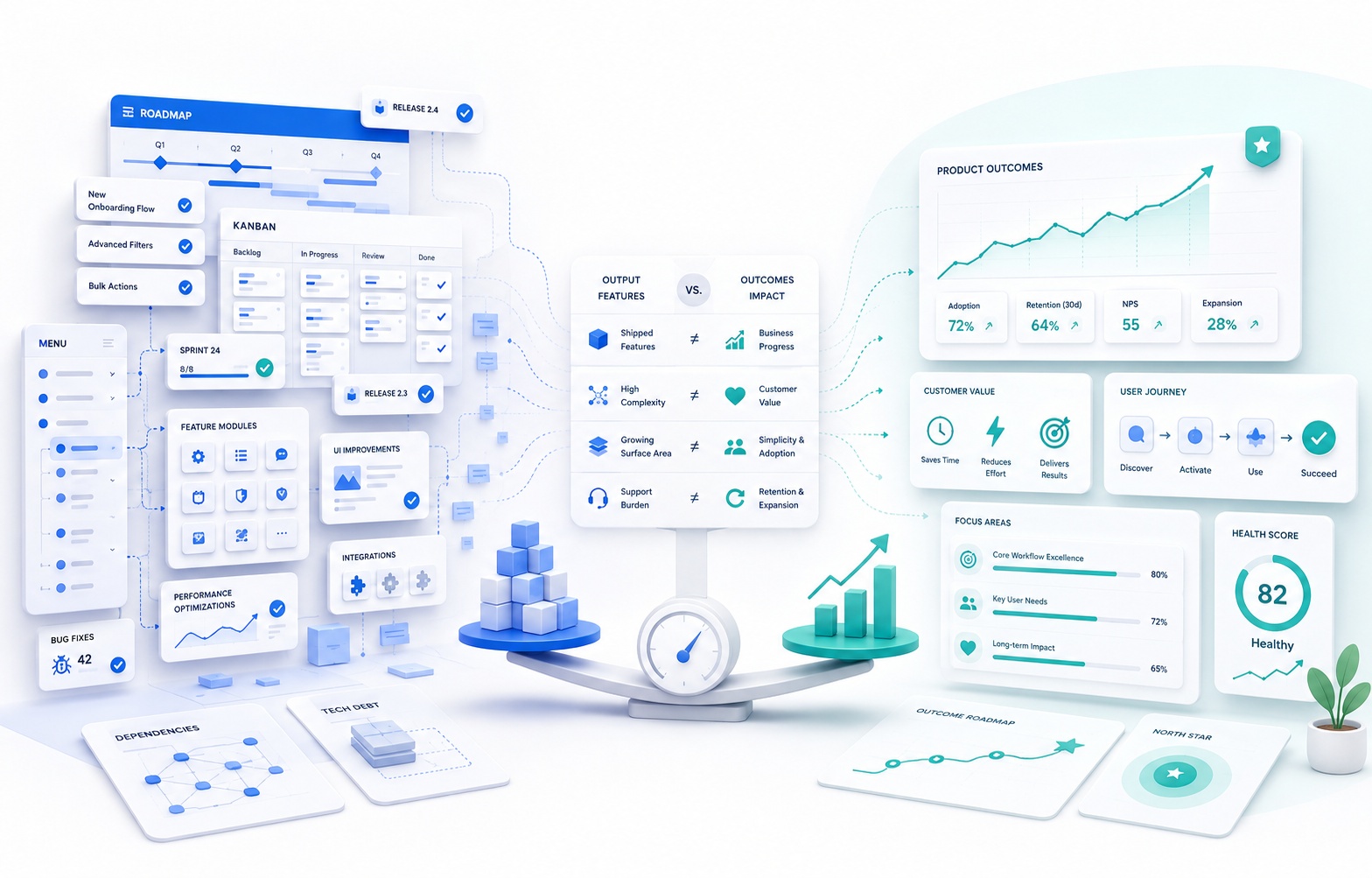
Why Shipping More Features Can Hide Weak Product Progress — and How Founders and CTOs Can Tell the Difference
Thirty-eight roadmap items completed. Twelve releases. Four launches described internally as "major." Several hundred Jira tickets moved from "In Progress" to "Done." Engineering capacity fully booked for the year, sprint after sprint, with almost nothing left idle.
And still: trial conversion barely moved. The workflow that new customers complain about in week one is the same workflow they complained about a year ago. Support tickets keep arriving with the same three or four root causes. Several of the year's headline features are used by a small fraction of the customer base, and adoption has plateaued rather than grown. Sales is still losing the same category of deal, for the same reasons cited in the same call notes.
None of these numbers are drawn from a study. They are the kind of pattern that shows up, in some version, inside a large number of software companies that would describe themselves as productive. The specific figures are illustrative — every reader can substitute their own — but the shape of the situation is common enough to be worth taking seriously: a roadmap can be almost entirely delivered and the year can still be a disappointment.
This is the roadmap paradox. It is not a story about failure. Nothing on the list above describes a missed deadline or a broken release. Teams did what they said they would do. Engineering worked hard, shipped competently, and largely hit its commitments. The paradox is that all of this can be true at the same time as the second, quieter truth: the product did not get meaningfully better for the people who use it, and the business did not get meaningfully stronger as a result.
The natural response to that gap is to look for someone to blame — a slow engineering org, an unfocused product manager, a sales team making promises it shouldn't. Often none of them are the problem. The organization did what it planned. The real question is whether the plan deserved to be executed in the first place.
That question splits into two different capabilities that get routinely confused with each other. The first is execution quality: can the organization reliably turn a decision into shipped software, on time, without breaking things. The second is decision quality: are the things being executed actually the right things to spend scarce engineering and product capacity on. A company can be excellent at the first and mediocre at the second, and from the inside, this is very hard to see, because everything that signals competence — velocity, throughput, release cadence, ticket closure — is a measure of execution quality. Almost nothing in a typical status meeting measures decision quality directly.
That asymmetry is the subject of this article. It is not an argument against building features, against roadmaps, or against moving fast. It is an argument that shipping and improving are not the same activity, that most organizations quietly conflate them, and that the conflation gets more expensive — not less — as a company grows, hires more engineers, and gets better at shipping.
Part I — Shipping Is Easy to See
Every organization eventually measures what is easiest to measure, and output is easy to measure in a way that outcome is not.
A ticket closes and the status changes instantly, visibly, in a shared tool everyone already looks at. A release goes out and it appears in a changelog with a timestamp. A roadmap item moves from "Planned" to "Done" and the board updates in real time. These are discrete events with clear owners, and they can be reported in a five-minute status update without anyone needing to interpret anything. "We shipped it" is a fact. It requires no judgment call.
Outcomes do not behave this way. Whether a shipped feature actually improved retention, reduced the time it takes a customer to complete an important workflow, or changed a purchasing decision is rarely knowable at the moment of launch. It usually takes weeks or months of usage data, and even then the signal is often ambiguous — did retention improve because of the feature, because of a pricing change that shipped the same quarter, because of a seasonal pattern, or because of something a competitor did that pushed unhappy customers out of the market before they could churn from you? Outcomes require someone to sit with ambiguous, sometimes contradictory evidence and make an interpretive claim. That claim can be argued with. A closed ticket cannot.
Outputs also have a single, clear owner. The engineer who wrote the code, the PM who wrote the spec, the designer who delivered the mockups — each has a discrete deliverable that maps cleanly to their role and their performance review. Outcomes rarely belong to one function. Whether a workflow got faster for the customer depends on product decisions, engineering execution, design clarity, onboarding, documentation, and often the customer's own internal process. When something is everyone's responsibility, it tends, in practice, to become no one's job to track.
And outputs are fast. A feature can be scoped, built, and shipped within a sprint or a quarter. An outcome — a shift in retention curve, a change in net revenue retention, a measurable reduction in time-to-value — usually needs a full cohort cycle to become visible, and sometimes several. By the time the outcome data is legible, the team has often moved on to three other initiatives, and attributing a retention change six months later to a specific shipped item becomes an act of reconstruction rather than measurement.
None of this makes output metrics useless. Velocity, cycle time, release frequency, and ticket throughput are legitimate and important signals of execution health. An organization that cannot ship reliably has a real problem, and these metrics catch it. The mistake is not tracking output — it is treating output as a proxy for progress. The two questions are different, and it is worth stating the distinction plainly, because almost every argument in this piece traces back to it:
Output metrics answer: did we ship?
Outcome metrics answer: did shipping matter?
A status meeting full of green checkmarks can accurately describe a quarter in which the company shipped competently and improved nothing that its customers or its board would notice. Both things can be true. The danger is not that outputs get measured — it's that they quietly become the only thing measured, because they're the only thing that's easy to put on a slide.
Part II — The Roadmap Ledger
If shipping is not, by itself, evidence of progress, it helps to have a different mental model for what a roadmap actually is. The most useful one, and the one this article will return to repeatedly, is to treat every roadmap decision as an allocation of scarce organizational capital — not a checklist of promises to keep.
This is a roadmap ledger: every item that enters a roadmap has two sides, a debit and a credit, and most organizations get very good at tracking the debit while barely tracking the credit at all.
The debit side is what the item costs to create and to carry. It includes the obvious items — engineering time, design time, QA effort, product management time spent in discovery and spec-writing — but also the less obvious ones that rarely appear in a sprint estimate: documentation, support team training, migration work for existing customers, and the future maintenance and regression surface the feature adds once it exists. A feature does not stop costing something the day it ships. It becomes a permanent line item in the product's complexity.
The credit side is what the organization actually receives in return: new revenue, improved retention, higher activation, a faster or less frustrating workflow, reduced operational cost, reduced risk, higher customer satisfaction, a new strategic capability, a competitive response, or simply validated or invalidated learning about what customers want. Some of these are genuinely hard to value with precision — a security investment or an architecture improvement may not show up as a line on a revenue report for a year, and that's fine. The ledger is not an accounting exercise that demands a dollar figure for every item. It is a thinking discipline: a habit of asking what was actually received, in whatever form, in exchange for what was spent, rather than assuming that shipping the debit automatically produces the credit.
The failure mode this article is centrally concerned with is the one where an organization records only the debit — "development completed," "feature shipped" — and never circles back to examine the credit. Roadmap execution and business progress quietly become decoupled, because the only side of the ledger anyone is checking is the side that was always going to balance: engineering did the work it was assigned.
A practical version of this ledger, applied per major roadmap item, looks like this:
| Roadmap Item | Expected Outcome | Actual Outcome | Engineering Cost | Ongoing Ownership Cost | Complexity Added | What We Learned | Would We Build It Again? |
|---|---|---|---|---|---|---|---|
| e.g., Custom report builder | Reduce enterprise churn tied to reporting gaps | Adopted by 6% of eligible accounts; churn unaffected | 1 quarter, 3 engineers | Ongoing support load, quarterly bug fixes | New permission model, new data export paths | Enterprise churn wasn't about missing reports | Redesign or deprecate |
Filled out honestly, across a year's worth of significant roadmap items, this table becomes one of the most useful documents a product organization can produce — not because it assigns blame, but because it is often the first place anyone has systematically asked what was actually received for what was spent.
Part III — How a Roadmap Becomes a Queue
Roadmaps rarely start out as queues. They usually start as reasonably coherent strategies, built around a small number of priorities that leadership has thought hard about. The queue emerges gradually, through a process that is almost never the result of one bad decision, but of many individually reasonable ones stacking up.
The inputs into a roadmap are numerous and, taken one at a time, almost all legitimate: sales asks for something to close a deal that's genuinely valuable; an enterprise customer with real revenue at stake asks for a capability; the founder has an idea grounded in a real market signal; a competitor ships something that starts showing up in lost-deal notes; support flags a recurring complaint; investors ask why a category-defining capability doesn't exist yet; engineering flags a technical initiative that will prevent a future outage; a partnership requires an integration; a regulation requires compliance work. None of these requesters are wrong to ask. Each is responding to something real in their part of the business.
The problem is not the individual requests. It's that prioritization in most organizations is structurally additive rather than substitutive. A new item enters the roadmap. The items already there tend to stay, because removing something that someone championed carries a cost that adding something new does not. The roadmap grows. Very little leaves it.
There are specific, understandable reasons organizations are much better at adding priorities than removing them. Saying no to a request has a political cost that saying yes does not — a no is remembered, attributed to a person, and sometimes escalated. Sunk-cost thinking makes it hard to kill an initiative that's already partially built, even when the original assumption behind it turned out to be wrong. Customers who were told "it's on the roadmap" create a standing obligation that feels binding even after the context that justified it has changed. Sales commitments made in a single deal can quietly become permanent product direction. Internal champions who built emotional investment in an idea resist watching it get deprioritized. Fear of a competitor's feature becoming table stakes pushes teams toward defensive parity work rather than considered trade-offs. And there is a simple psychological asymmetry at play: launches are visible, celebrated, and rewarding in a way that quiet decisions not to build something never are. No one throws a launch party for a feature that didn't get built.
None of this makes sales, founders, or customers the villain of the story. Every one of those functions is seeing something real and responding rationally to it. The job of product leadership exists specifically because legitimate opportunities outnumber the capacity to pursue them, and someone has to make trade-offs across genuinely good options — not filter out bad ones. That is a much harder job than it sounds, because it means regularly disappointing people who are not wrong.
What results, when this additive dynamic runs unchecked for a few years, is a roadmap that has stopped functioning as a strategy and started functioning as an accumulated backlog of promises, most of which were reasonable when made and few of which have been revisited since. A roadmap without a mechanism for subtraction is eventually just a queue — and a queue, unlike a strategy, has no opinion about what matters most. It simply processes items in whatever order they arrived.
Part IV — The Feature Factory Problem
The pattern described above has a name in product management circles: the feature factory. The term and the clearest articulation of the underlying dynamic come from product leader Melissa Perri, whose 2018 book Escaping the Build Trap argues that organizations fall into this pattern when they <cite index="8-1">optimize for output instead of outcomes, mistaking motion for progress</cite>. <cite index="5-1">A team enters what Perri calls the Build Trap — also known as the feature factory — when it becomes bound to thinking about outputs rather than outcomes, compelled to ship new features without evaluating the value those features actually deliver to users.</cite>
Perri's framing is worth taking seriously not because the term is new — it has circulated widely enough in product circles to become close to conventional wisdom — but because it describes something structural, not a failure of individual competence. In a feature factory, a team receives a feature request, builds the feature, and ships it, and organizational success is defined as the completion of that cycle. What is largely missing is any systematic mechanism for verifying, after the fact, whether the feature produced the value it was supposed to produce. <cite index="2-1">Teams in this pattern aren't one or two or three features away from success — that belief is itself the central fallacy of the feature factory, because building more features doesn't automatically create a better product.</cite>
This is not primarily a story about lazy or incompetent employees. It is much better explained by incentives, and it's worth walking through how those incentives are typically structured, function by function, because the pattern is remarkably consistent across companies that otherwise look nothing alike.
A product manager's success is frequently measured by roadmap completion: did the committed items ship on schedule. An engineering team's success is measured by delivery speed and reliability: did the sprint's commitments get delivered without breaking production. A design team's success is measured by assets delivered on time and to spec. A QA function's success is measured by releases approved without post-release incidents. A marketing team's success is measured by launches executed and announced. Every one of these is a reasonable, locally rational measure of a function doing its job well.
The problem is that none of these local measures of success require anyone to ask whether the thing being built was worth building. Each function can perform excellently by its own metric while the product, evaluated as a whole, improves slowly or not at all. This is a systems-thinking failure rather than an individual one — a case where locally optimal behavior by every participant produces a globally mediocre result, because the system was never designed to reward anyone for asking the harder question. Fixing it is not a matter of finding better employees. It is a matter of changing what gets measured and rewarded at the level where roadmap decisions actually get made.
Part V — The Small Feature Tax
Some of the most expensive items on a roadmap never look expensive when they're proposed, because they arrive dressed as trivial requests. "Just add another filter." "Just one more permission level." "Just support another export format." "Just add a notification for that event." Each of these sounds, on its face, like an afternoon of work.
The gap between how small a request sounds and how much it actually costs comes from a simple but often overlooked fact: product cost is not coding time. A genuinely small piece of implementation can still require a real discovery process to understand who needs it and why, a design pass to fit it coherently into the existing interface, a full implementation, a set of new tests, a regression pass across everything the new surface touches, new analytics instrumentation if anyone wants to know whether it's used, documentation, support team briefing so the new capability can be explained to customers who ask about it, a decision about how it interacts with the permission system, a decision about mobile behavior, a decision about how it behaves across supported locales, and consideration of how it will interact with whatever gets built next.
And then, once it ships, the cost does not end. This is worth naming directly, because it's the part organizations consistently underweight: the permanent surface area effect. A shipped feature is rarely finished the day it's released. It becomes a permanent part of the product's regression suite, meaning every future release has to verify it still works. It becomes part of the UI that every new user has to parse when they first open the product, whether or not they'll ever use it. It becomes part of the documentation that has to stay accurate as the product evolves around it. It becomes a source of support questions, indefinitely. It becomes a constraint on future redesigns, because someone, somewhere, is using it, and a redesign now has to account for that.
None of this means that every small feature carries an enormous hidden cost — many genuinely are simple, ship cleanly, and never generate meaningful ongoing burden. The point is not that small requests should be treated with suspicion individually. It's that the accumulation matters at the portfolio level. A product with two hundred small, mostly-reasonable features carries a very different maintenance and comprehension burden than a product with fifty, even if every one of the two hundred was individually justified at the time it was approved. The tax is not paid per feature. It's paid on the whole portfolio, continuously, by every future release.
Part VI — Product Complexity Compounds
It's useful to separate two kinds of complexity that get talked about as if they were one thing. Code complexity lives in the codebase — how tangled the implementation is, how many dependencies exist, how hard the system is to change safely. Product complexity lives in what the customer actually experiences — how many settings exist, how many states a record can be in, how many permission combinations are possible, how many exceptions and edge cases the UI has to account for, how much documentation is required to explain the product fully.
These two are related but not identical. It's entirely possible to build a technically elegant, well-architected system that is nonetheless a complicated product to use, because elegance in the codebase says nothing about how many decisions the interface asks the customer to make, or how many paths through the product now exist.
Every feature added to a product's surface area competes not only for engineering capacity to build, but for something else entirely: customer attention to understand and use. Customer attention is finite in a way that engineering capacity, at least in principle, can be scaled by hiring. A new user opening a product for the first time has a limited tolerance for figuring out what everything does. Sales teams demoing the product have a limited amount of time to show what matters. Support teams have a limited capacity to become expert in every corner of an ever-expanding feature set. And documentation has to grow to match, becoming harder for anyone — customer or new hire — to fully absorb.
This produces a counterintuitive but well-established pattern in mature software products: at a certain point, more capability can reduce perceived usability rather than increase it. This is why a number of long-established, feature-rich products have made public, deliberate choices to simplify their default interfaces or hide advanced capability behind progressive disclosure, rather than surface everything at once — treating "what the product can technically do" and "what the product asks a new user to confront" as two separate design problems rather than one. The specifics of any single company's redesign are easy to get wrong from the outside, so this article won't attribute particular claims to particular products without a verifiable source, but the general pattern — mature products actively working to hide or consolidate capability rather than simply keep adding to it — is widely recognized across the product and design community and worth taking as directional evidence rather than as a single quotable case study.
The practical takeaway is not that features should stop being built. It's that every addition to a product's surface area has a cost measured not just in engineering hours but in the finite attention of the people who have to learn, sell, support, and document it — and that cost compounds with every subsequent addition, because it's the total surface area, not any single feature, that determines how complicated the product feels.
Part VII — Why Removing Software Can Create Value
Product organizations are structurally built to celebrate addition. Launches get announcements, release notes, sometimes press coverage, and internal recognition. Removal gets almost none of this. A feature deprecation, if it's communicated at all, usually appears as a brief, apologetic note buried at the bottom of a changelog. This asymmetry in recognition is worth naming directly, because it quietly biases roadmap decisions toward addition even when subtraction would create more value.
There are real, non-trivial reasons deletion can be one of the highest-leverage things a product organization does. Removing unused features, duplicate workflows that accomplish the same thing two different ways, legacy configuration options nobody remembers the reasoning behind, obsolete integrations, low-value reports, and old API surfaces reduces cognitive load for every future user encountering the product for the first time. It simplifies the UX by shrinking the number of decisions a customer has to make. It shrinks the testing surface that has to be verified on every release, which reduces both the time and the risk associated with shipping. It makes documentation shorter and more accurate. It reduces the volume of support questions tied to obscure, rarely-used paths through the product. And at the architectural level, it can simplify the underlying system in ways that make future changes faster and safer.
But deletion is not free of risk, and treating usage percentage as the sole justification for removing something is a mistake worth calling out explicitly. A feature used by a small fraction of the customer base can still be load-bearing for the highest-value accounts in that base — the largest enterprise customer, the account with the most expansion potential, or the one whose workflow depends entirely on a capability that looks, in an aggregate usage report, like statistical noise. Usage alone answers "how many people use this," not "how much would removing this cost us," and those are different questions with potentially very different answers.
This means feature value cannot be reduced to feature usage alone. A rigorous approach to deprecation has to weigh usage against revenue exposure — how much annual contract value is tied to accounts actively using the feature — against workflow criticality — whether the feature sits in the middle of a process a customer depends on or at the periphery of one they rarely touch — against strategic importance — whether the feature exists for competitive or positioning reasons that don't show up in a usage dashboard — and against the realistic migration options available to affected customers if the feature goes away. A feature that scores low on usage but high on revenue exposure and workflow criticality is a very different deprecation candidate than one that scores low on all four dimensions, and conflating them is how deprecation decisions turn into unplanned churn events rather than deliberate simplification.
Part VIII — Maintenance Is Product Work
There is an artificial and remarkably persistent split in how many organizations talk about their roadmap: "new features" on one side, treated as strategic and visible, and "maintenance" on the other, treated as overhead — something engineering asks for and everyone else tolerates.
Customers do not experience this split. They experience one product. Whether an investment is labeled "new feature" or "maintenance" internally has no bearing on whether it changes what the customer feels when they use the product. Performance work, bug fixes, reliability improvements, faster load times, technical debt reduction, migration work, and investment in test infrastructure are all, from the customer's point of view, product improvements or product regressions depending on which direction they go. A product that gets 30% faster because of a backend migration has genuinely improved for the customer, even though not a single new button was added to the interface.
This matters practically because of how roadmap language shapes leadership perception. When technical work is systematically excluded from the strategic roadmap conversation and only discussed in an engineering-specific forum, leadership tends to perceive it as overhead rather than investment — something to be minimized, not prioritized. The fix is not to force every technical initiative to justify itself with a fabricated revenue number. It's to translate the technical work into the capability and business effect it actually produces, in language a founder or CFO can evaluate on the same terms as a feature: a database migration is, in practical terms, the ability to scale to the next order of magnitude of customers without an outage. Investment in test infrastructure is, in practical terms, the ability to release more safely and more often. Investment in observability is, in practical terms, a shorter time to detect and resolve incidents, which is itself a customer experience metric. Architecture cleanup is, in practical terms, faster future development, which shows up months later as more roadmap throughput per engineer. Dependency upgrades are, in practical terms, security posture and continued vendor support.
None of this is an argument that every piece of technical debt deserves immediate, unconditional investment. Technical work competes for the same scarce capital as everything else on the roadmap, and some technical debt is genuinely low-priority — ugly, but not costing the business anything meaningful. The point is narrower: technical work should be evaluated using the same discipline applied to feature work — what capability does it produce, what does it cost, and what would we lose by not doing it — rather than being waved through as an assumed obligation or waved away as invisible overhead. Both defaults are lazy. Both distort the ledger.
Part IX — The Feature ROI Problem
Calculating a clean, confident ROI figure for a given feature is genuinely difficult, and this article will not pretend otherwise by presenting a formula that implies more precision than actually exists. What's useful instead is a disciplined way of thinking about the range of ways a feature can create or fail to create value, and a habit of comparing what was expected against what actually happened.
On the value side, a feature might generate new revenue directly, improve retention among an at-risk segment, improve activation for new users, enable an upsell motion, reduce churn tied to a specific gap, reduce support burden by resolving a recurring question, improve operational efficiency internally, enable a sales conversation that was previously impossible, produce important strategic learning about the market even if the feature itself doesn't stick, or reduce a specific, identifiable risk. On the cost side sit development time, testing, design, the ongoing maintenance burden discussed in Part VIII, support load, the complexity it adds to the product as a whole, and the opportunity cost of whatever else that capacity could have produced instead.
The most useful discipline available here is a simple before-and-after comparison that most organizations skip entirely: expected value versus observed value. Before building something significant, the team should be able to articulate, in specific terms, what it believes will happen — which metric should move, in which direction, by roughly how much, over what timeframe. After the feature ships and enough time has passed for a signal to appear, the same team should go back and check what actually happened against that stated expectation.
This creates a genuine learning loop, and it changes what "success" means for a shipped feature. A feature does not need to succeed in order to be useful to the organization — a well-designed experiment that clearly fails, but produces a confident, specific answer about why customers don't want something, has created real value in the form of avoided future investment. The dangerous outcome is not a failed feature. It's a feature that gets shipped and never gets checked at all — where nobody ever circles back to find out whether the expected value materialized, and the team simply moves on to the next item, carrying no more information about what works than it had before.
Part X — Opportunity Cost: The Roadmap Item You Cannot See
This is, for a founder in particular, one of the more important ideas in this article, precisely because it concerns something that never appears on the roadmap at all.
Every roadmap item that consumes engineering capacity displaces something else that capacity could have produced instead. If a team spends a full quarter building Initiative A, the organization has, by definition, simultaneously chosen not to spend that same quarter on Initiative B, on performance work, on simplification, on quality investment, on a new market experiment, on the specific customer pain point that keeps coming up in support tickets, or on platform work that would make the next four quarters faster. This is opportunity cost, and it is easy to state abstractly and easy to ignore in practice, precisely because the foregone alternative never shows up anywhere as a line item. Nobody writes a retrospective on the feature that wasn't built.
The way to make this concrete rather than abstract is a simple discipline: before committing meaningful capacity to a roadmap item, require the discussion to include the strongest rejected alternative — not a strawman, but the best other thing that capacity could have gone toward. This single practice changes the shape of prioritization conversations in a meaningful way. Most roadmap discussions implicitly compare a proposed initiative against doing nothing — "should we build this, yes or no" — which is a comparison almost anything can win, because doing nothing rarely sounds appealing. The more honest and more useful comparison is Initiative A against Initiative B, where B is a real, credible use of the same capacity. That comparison forces a genuine trade-off conversation rather than a rubber stamp, and it's the comparison most organizations quietly avoid having.
Part XI — Customer Requests Are Evidence, Not Orders
Customer feedback is indispensable, and nothing in this section argues otherwise. The distinction that matters is between treating a customer request as a direct order to be fulfilled exactly as stated, and treating it as evidence of an underlying problem that may or may not be best solved the way the customer proposed.
Customers, quite reasonably, describe their needs in the language of solutions rather than problems, because a solution is what they can picture and articulate quickly. "We need a dashboard" is a common shape of request. But the actual underlying need behind that request is frequently something narrower and more specific — in a case like this, often something closer to "we cannot currently tell when an account is at risk before it's too late to intervene." A dashboard is one possible answer to that need. It may not be the best one, and building exactly the dashboard as described may satisfy the letter of the request while missing a better solution to the actual problem.
This is not an invitation to turn this section into a general jobs-to-be-done tutorial — that ground is well covered elsewhere, and the useful version of the idea here is narrower and specifically tied to roadmap prioritization: every incoming request, whatever its source, deserves one additional question before it becomes a roadmap item — does this expose a broader problem shared across a meaningful part of the customer base, or does fulfilling it as stated create a one-off exception that primarily benefits a single account? Both are sometimes worth doing. A request from a strategically important enterprise account may be worth fulfilling even if it's genuinely narrow, because the relationship and revenue justify it. But that should be a conscious, named trade-off — "we are building this because of this specific account's value, understanding it may not generalize" — rather than an unexamined assumption that every request that sounds reasonable and comes from a paying customer automatically deserves general product investment.
Part XII — Competitor-Driven Roadmaps
A second common source of roadmap inflation runs through the competitive landscape rather than through customers directly. A competitor ships a feature, it gets noticed — by a salesperson in a competitive deal, by a customer who asks about it, by a founder scanning the market — and the internal reflex is immediate: "we need that too."
Sometimes this reflex is correct. Some capabilities genuinely become table stakes over time — a security certification a competitor obtains can become a procurement requirement across an entire market segment, and failing to match it can disqualify a company from deals regardless of how good the rest of the product is. Matching table-stakes and procurement-gating capability is not optional in the way discretionary feature work is.
But there is a real danger in a purely reactive, feature-by-feature form of competitive response, and it's worth naming clearly: when every company in a category responds to every competitor's launch by building the equivalent feature, products across that category converge toward each other rather than differentiate. Engineering capacity that could have gone toward building a genuine advantage instead goes toward closing a parity gap, indefinitely, because the moment one gap closes, the competitor ships something new and the cycle restarts. A company that spends its entire capacity chasing parity never spends any of it building the thing that would make customers choose this product over the alternative.
The useful distinction is between competitive parity and competitive advantage, and a healthy roadmap needs both, deliberately and separately tracked. Parity work protects against losing deals for a missing checkbox. Advantage work is what actually wins deals and retains customers over the long run. Leadership should be able to look at the roadmap and say, honestly, how much capacity is going toward each — because a roadmap that is entirely parity work, however individually justified each item is, has quietly ceded the question of what makes the product distinctive to whatever the competition happens to build next.
Part XIII — The Roadmap as a Portfolio of Bets
A useful conceptual shift, and one that changes how prioritization conversations actually go, is to stop treating a roadmap as a list of promises made to various stakeholders and start treating it as a portfolio of investments, each with a different risk and return profile — the way a thoughtful investor would think about a set of holdings rather than a checklist of obligations.
A reasonably complete portfolio typically includes several distinct categories: core improvements to the primary workflows customers already rely on; growth bets aimed at expanding the addressable market or increasing expansion revenue; direct responses to customer pain that shows up repeatedly in support and feedback; reliability work aimed at uptime, performance, and operational stability; platform and technical capability investment that makes future work faster or safer; genuine experiments designed to test a hypothesis rather than deliver a guaranteed outcome; compliance and required work with no real discretion attached; and simplification or removal, the category discussed in Part VII that almost never gets its own line item despite deserving one.
This article deliberately will not prescribe a universal percentage allocation across these categories, because the right mix depends heavily on company stage, market, and risk tolerance, and any specific numbers offered here would carry a false sense of precision. A regulated fintech company carrying real compliance obligations and an early-stage consumer startup still searching for product-market fit should not be allocating their engineering capacity the same way, and a framework that implied otherwise would be doing readers a disservice.
What does generalize is the underlying portfolio logic. A roadmap made up entirely of new-feature work tends to become fragile — technically brittle, operationally under-invested, disconnected from the reliability and platform work that makes future speed possible. A roadmap made up entirely of technical improvement, with little new customer-facing capability, risks disconnecting the product from the market it's trying to serve, however sound the underlying engineering becomes. And a roadmap built entirely around enterprise customer requests risks fragmenting the product into a collection of account-specific accommodations rather than a coherent whole. A healthy roadmap, whatever the specific mix, is one where leadership can articulate why the current allocation across these categories makes sense for where the company actually is right now — not simply where the loudest recent requests happened to come from.
Part XIV — Confidence Should Vary
One structural problem with how roadmaps are typically presented, particularly to boards and leadership teams, is that every item on the slide tends to look identical in format and therefore identical in certainty — a bullet point, a target quarter, an owner's name. A regulatory requirement with zero discretion and a speculative bet with a fifty-fifty chance of working end up formatted exactly the same way, which quietly implies a level of confidence about the bet that nobody actually holds.
Introducing explicit confidence tiers fixes this without requiring a complicated system. A useful, simple version distinguishes committed items — required because of a contractual, regulatory, or genuinely critical strategic obligation, where the discussion is about sequencing rather than whether to do it at all — from likely items, which carry strong supporting evidence and high priority but are not absolute commitments — from bets, important hypotheses the organization believes are worth testing but is genuinely prepared to be wrong about — from exploratory items, where the underlying problem is judged worth investigating but no particular solution has been committed to yet.
This is not offered as a rigid taxonomy that every organization must adopt in exactly this form — the specific labels matter less than the underlying discipline of not letting every roadmap item masquerade as equally certain. The practical benefit shows up in executive communication: a board or leadership conversation about a "bet" invites a genuinely different discussion — about risk tolerance, about what would make the team walk away from it, about how quickly it will be evaluated — than a conversation about a "commitment," which is really about execution and timeline. Collapsing that distinction, as most roadmap slides do by default, quietly removes a useful and honest conversation from the room.
Part XV — Discovery Is Not the Opposite of Delivery
There is a real tension between spending time on discovery — figuring out whether something is worth building, and roughly what shape it should take — and simply moving to delivery. Both failure modes are real and worth naming honestly. Weak discovery leads to expensive, confident-sounding output built on an untested assumption, which is precisely the pattern this article has spent most of its length describing. But discovery can also collapse into its own dysfunction — endless research, prototyping, and validation that never converges on a decision, sometimes because no amount of evidence will ever feel sufficient to the people responsible for deciding.
The methods available for cheap, credible discovery are reasonably well established and won't be exhaustively re-taught here: structured customer interviews, low-fidelity prototypes tested with real users before a line of production code is written, fake-door tests that measure interest in a capability before it exists, close analysis of existing usage data for signals about a problem's actual size, limited pilots with a small group of customers before a general release, concierge-style manual delivery of a capability to validate demand before automating it, and narrow technical spikes that answer a specific feasibility question without committing to full implementation.
The question worth asking before any significant roadmap item gets meaningful engineering capacity is not "have we done enough discovery" in the abstract — that question has no satisfying answer — but something much more concrete and specifically tied to the economics discussed throughout this piece: what is the cheapest credible evidence we can obtain before we commit major engineering capacity to this? Sometimes the honest answer is "we already have it — ship it." Sometimes it's "a two-week prototype test would tell us most of what we need to know before we spend a quarter." The point of asking is not to slow delivery down as a matter of process. It's to make sure the size of the discovery investment is proportional to the size of the bet, rather than defaulting either to zero discovery on large bets or exhaustive discovery on small, low-risk ones.
Part XVI — Measure Before You Build
One of the most practically useful disciplines a product organization can adopt is genuinely simple to describe and consistently hard to maintain: before implementation begins on anything significant, write down what problem is being solved, what the current baseline looks like, what behavior is expected to change, what the expected outcome is, over what measurement window, and what would count as evidence the initiative failed.
The value of this discipline is easiest to see through contrast. A weak version of a roadmap item reads something like "build advanced search filters" — a solution stated as a task, with no attached hypothesis about what it's supposed to change. A stronger version of the same underlying initiative reads closer to "reduce the share of users who abandon product discovery because they can't narrow results to what they're looking for" — a problem statement that names the specific behavior being targeted. Framed this way, the team can identify the current abandonment rate as a baseline, state what improvement would count as success, name which user segment is expected to benefit, and decide in advance how the result will be measured. If, after shipping, abandonment hasn't moved, that's a meaningful, actionable signal rather than an ambiguous "well, we shipped it."
This is not a claim that every product outcome reduces cleanly to a single metric — qualitative evidence, direct customer feedback, and support sentiment all matter and sometimes carry information a dashboard cannot capture. But even qualitative goals benefit from being stated as a specific, falsifiable expectation before the work begins, rather than left as a vague sense that the feature will probably help.
Part XVII — Measure After You Ship
The mirror image of Part XVI's problem is what happens after launch, and it is, if anything, the more common failure. Launch frequently becomes the organizational finish line rather than the starting point of an evaluation period. Marketing sends the announcement. Engineering moves on to the next item on the board. Product begins scoping the next requirement. The feature that just shipped quietly stops being anyone's active concern.
Reversing this requires treating major roadmap investments as having a review loop built into their definition of complete, not as an optional follow-up that happens if someone remembers. The questions worth asking, on a set schedule after launch rather than only if a problem surfaces on its own, are straightforward: did the intended users discover the feature at all? Did they actually adopt it, beyond a first curious look? Did their behavior change in the way that was predicted? Did the business metrics the team cared about move? Did support ticket volume related to the underlying problem change, up or down? Did the audience that was expected to use it turn out to be the audience that actually did? Were there unintended consequences — a new source of confusion, a new support burden, an interaction with another part of the product nobody anticipated? And based on all of that, should the feature be expanded, changed, left alone, or removed?
The underlying principle worth stating plainly: the roadmap should have a return path. Items should not simply move into "Done" and disappear from view. They should be able to move back into active evaluation, on a predictable cadence, so that what was learned actually feeds back into the next round of prioritization rather than evaporating the moment the launch announcement goes out.
Part XVIII — The "Done" Column Is Lying to You
It's worth pausing on a single word that carries far more weight in most product organizations than it can actually bear: "done."
"Done" can mean several genuinely different things, and the fact that a single status column collapses all of them into one state is where a great deal of false confidence comes from. It can mean the code is written and merged. It can mean the code is deployed to production. It can mean the capability is generally available to customers. It can mean customers have actually adopted it. And it can mean — the meaning that actually matters to the business — that the feature has demonstrably produced value. A ticket can move to "Done" in the first sense while the underlying business hypothesis it was meant to test remains completely unresolved, and from the board's or the leadership team's perspective, both look identical: a checked box.
This is not a criticism of Jira, Linear, or any particular project management tool — the issue has nothing to do with the software and everything to do with a conceptual gap in how organizations think about completion. Execution systems, by design, are built to track whether work got done. They are not built to track whether the work mattered, and expecting them to do so is asking the wrong tool to answer the wrong question. Leadership needs a separate system, however lightweight, that tracks impact rather than completion — which is exactly what the roadmap ledger from Part II and the post-launch review loop from Part XVII are designed to provide.
Part XIX — Quality Changes the Outcome
A feature that is well-conceived and genuinely addresses a real problem can still fail to produce the value it should have, for reasons that have nothing to do with whether it was the right thing to build. Bugs, poor performance, UX friction that makes the capability harder to discover or use than intended, broken edge cases, integration failures, mobile-specific problems, unreliable behavior, and simple inconsistency across parts of the product can all quietly erode a feature's expected value after it ships. Feature ROI, in other words, depends not only on whether the underlying decision was sound but on whether the execution that followed it was sound.
This is not an argument that quality assurance is the missing ingredient that explains every disappointing roadmap outcome — that would overstate QA's role and understate everything else this article has covered. It is one variable among many in the larger economics of product decisions, but it is a real one, and it's worth naming directly rather than assuming execution quality is a constant that can be ignored once the roadmap decision itself has been made.
Where quality engineering genuinely earns its place in this conversation is in the feedback it can provide both before and after a release — risk-based testing that concentrates effort on the parts of a release most likely to affect the outcome the business actually cares about, rather than treating every path through the product as equally worth testing; production monitoring that surfaces how a feature is actually behaving under real usage, not just whether it passed a test suite; usage data that reveals whether customers are hitting friction points invisible in a lab environment; and incident analysis that traces a production problem back to the decision, upstream, that made it likely. Used this way, quality engineering is not a gate that slows a feature down before it ships. It's a source of evidence that feeds directly back into the ledger described in Part II — evidence about whether what got built is actually delivering what it was expected to.
Part XX — When Shipping Less Can Create More Progress
Everything in this article up to this point points toward a conclusion that is worth stating directly, even though it cuts against a deeply held cultural assumption in most software organizations: more shipped output is not automatically more progress, and there are real circumstances where a smaller number of more carefully chosen initiatives, pursued with deeper iteration and better measurement, produces more actual business value than a larger number of items moved quickly through the pipeline.
This is not an argument for artificially slowing engineering down as a matter of principle. Speed remains genuinely valuable — a faster team can test more hypotheses, respond more quickly to what it learns, and iterate its way to a better answer faster than a slow one. The distinction that matters is not speed versus caution. It's direction. Speed is valuable when the thing being executed quickly is worth executing. Fast execution applied to weak priorities does not produce a smaller version of the same waste a slow team would produce — it compounds the waste, because a fast team can commit an entire year's capacity to the wrong things more thoroughly than a slow one ever could.
The strategic implication is that removing low-value work, improving the workflows customers already depend on rather than adding new ones, investing in measurement rigorous enough to actually know what's working, and making technical investments that unlock future speed can all represent more genuine progress than a quarter spent shipping five more items to a roadmap that was already too full. This is a harder story to tell in a status update than "we shipped five things," and that difficulty is itself part of why the pattern persists — but it doesn't make it less true.
Part XXI — Roadmap Debt
Engineering organizations have a well-established vocabulary for the cost of past shortcuts: technical debt. Product organizations, by contrast, mostly lack an equivalent term for a closely related but distinct phenomenon, and it's worth naming explicitly as a practical management concept — not, it should be said clearly, an established academic metric with a formal definition in the literature, but a useful frame for something real that most product organizations are quietly carrying.
Roadmap debt is the accumulated set of decisions still consuming attention, complexity budget, or ongoing maintenance, whose original justification has expired or was never verified. It includes unfinished experiments that were never formally closed out, features that shipped but were never evaluated against the expectation that justified building them, old commitments made under conditions that no longer apply, capabilities that were half-adopted and then quietly abandoned by the team that built them, customer-specific exceptions that were granted once and never revisited, initiatives that persist purely because no one wants to be the one to remove them, and work that has been carried forward across multiple planning cycles without anyone reassessing whether it still makes sense.
Roadmap debt is meaningfully different from technical debt, and the distinction is worth being precise about. Technical debt lives primarily in the implementation — in code that is harder to change than it should be. Roadmap debt lives in decisions — in things that remain active on the roadmap, or active in the product, after the reasoning that originally justified them has expired, been forgotten, or never actually been tested. A codebase can be technically clean and still carry substantial roadmap debt, if the organization keeps building well-implemented things nobody has verified are worth having.
Auditing it is, practically, a version of the exercise described in Part XXII below: going through the set of significant decisions made over the past year or two and asking, honestly, whether the reasoning behind each still holds — and if nobody can answer that question with confidence, that uncertainty is itself the finding.
Part XXII — Run the "Would We Build It Again?" Review
This is one of the more directly actionable exercises this article can offer, and it works best as a structured retrospective rather than an informal conversation.
Take the set of meaningful features shipped over the previous twelve to twenty-four months — not every minor change, but the initiatives that consumed real capacity and were expected to matter. For each one, ask a single, deceptively simple question: would we build this again, knowing what we know now?
If the honest answer is yes, it's worth asking why — what evidence supports that confidence, and is it strong enough to hold up under scrutiny, or is it closer to an assumption restated as a conclusion. If the answer is no, the more valuable question is which specific assumption turned out to be wrong — was the underlying problem misjudged, was the target audience smaller than believed, was the execution weaker than the concept deserved. And if the honest answer is genuinely uncertain, the right response is not to guess either way, but to ask directly why the organization has never measured it — which is often the most revealing answer of the three, because it points at a gap in the post-launch discipline described in Part XVII rather than at the feature itself.
A useful way to sort the results of this exercise is into a small number of categories: keep and invest, for items that are clearly working and would benefit from further investment; keep, for items that are doing their job and don't need more attention right now; redesign, for items where the underlying idea was sound but the execution wasn't; merge, for items that overlap enough with something else in the product that consolidating them would reduce complexity without losing value; deprecate, for items that should be wound down deliberately, with a plan for the customers still using them; remove, for items that can be cut cleanly with minimal customer impact; and unknown — need evidence, for items where the honest answer is that nobody actually knows, and finding out is the next step before any other decision gets made.
The purpose of this exercise is explicitly not to assign blame for past decisions. A decision can be entirely rational given the evidence available at the time it was made and still turn out, with the benefit of hindsight, to have produced a disappointing result — that's the nature of decisions made under uncertainty, and treating every unsuccessful bet as evidence of poor judgment will only teach the organization to stop being honest about which bets didn't pay off. The value of the review is organizational learning, not accountability theater, and it only works if everyone in the room believes that distinction is genuine.
Part XXIII — What Should Leaders Ask During Roadmap Review?
Rather than a generic checklist — the kind of list this article has deliberately tried to avoid throughout — it's more useful to organize the questions that matter into a small number of distinct strategic lenses, each of which surfaces something the others don't.
On problem: what specific customer or business problem does this address, stated independently of the proposed solution? On evidence: what tells us this problem is real and matters enough to act on — and is that evidence direct, or is it an assumption dressed up as evidence? On value: what actually changes, for the customer or for the business, if this problem gets solved? On alternatives: what else could this capacity produce instead, and is this genuinely the strongest use of it? On complexity: what permanent product or engineering complexity does this add once it exists, beyond the initial cost of building it? On measurement: how, specifically, will the organization know whether this worked, and by when? On reversibility: if this turns out to be wrong, how hard would it be to remove or change later? And on ownership: who is responsible for tracking the outcome after launch — not who built it, but who owns finding out whether it worked?
These questions are deliberately suited to a joint conversation among a founder, a CTO, and product leadership together, rather than to any one of those roles working through them alone — because, as the next section discusses, each of these roles tends to weight a different subset of these questions more heavily, and the value of the exercise comes from holding all of them in view at once.
Part XXIV — The Founder / Product / CTO Triangle
Roadmap disagreement inside a leadership team is rarely a sign of dysfunction. More often it reflects three legitimate perspectives, each grounded in a real part of the business, using a different implicit definition of value.
A founder's perspective is naturally weighted toward market opportunity, direct customer demand, revenue impact, the broader product vision, and speed — the founder is usually the person most directly exposed to the market's pull and the most acutely aware of how quickly a window can close. A product leader's perspective is naturally weighted toward the underlying customer problem, observed behavior, prioritization discipline across competing requests, discovery evidence, and adoption — the person most responsible for making sure the roadmap reflects what customers actually need rather than what they happen to ask for loudest. A CTO or engineering leader's perspective is naturally weighted toward capacity, the complexity a decision adds, architectural soundness, reliability, and long-term maintainability — the person who will be living with the consequences of today's roadmap decisions for years after they ship.
Conflict between these three most often arises not because one perspective is right and the others wrong, but because each is implicitly using a different definition of "value" without anyone naming the difference out loud. The solution is not to hand any one of the three functions final, unilateral authority over roadmap decisions — that simply optimizes for whichever definition of value that function happens to hold, at the expense of the other two, which are equally real. The more durable solution is shared decision criteria — something close to the questions in Part XXIII — that all three can use together, so that disagreement, when it happens, is a disagreement about evidence and trade-offs rather than a contest between competing job titles.
This produces a specific, healthy kind of tension worth cultivating rather than avoiding. A founder asking "why not now" is applying useful pressure against unnecessary delay. A CTO asking "what does this cost beyond the initial implementation" is applying useful pressure against underestimating the ledger's ongoing side. A product leader asking "what evidence says this is actually the best problem to solve right now" is applying useful pressure against acting on the loudest request rather than the most important one. None of these questions is more legitimate than the others, and a leadership team that has stopped hearing all three regularly has probably stopped making its best roadmap decisions, even if it's shipping more than ever.
Part XXV — Roadmaps at Different Company Stages
The right roadmap discipline is not identical across a company's life, and treating early-stage and mature-product practices as interchangeable is a common source of frustration in both directions.
In the early, pre-product-market-fit stage, the roadmap should be optimized primarily for learning speed rather than for feature completeness. Long, heavily committed initiatives are genuinely dangerous at this stage, because the company's understanding of its own market is still changing quickly, and a large bet made on last quarter's assumptions can lock in a direction the company would no longer choose with what it knows now. High reversibility — the ability to change course cheaply — matters more here than almost anything else on the roadmap.
In the growth stage, the customer base has expanded, commitments to existing customers have accumulated, and the cost of an uncoordinated roadmap has risen sharply. Prioritization discipline becomes genuinely load-bearing rather than a nice-to-have, because the volume of legitimate incoming requests has grown faster than engineering capacity has. Reliability and platform investment typically need to grow in proportion, because a growing customer base makes the cost of instability and technical fragility much higher than it was when the company was smaller.
In a mature product, a large installed base and backward compatibility obligations make complexity and removal — the subject of Part VII — genuinely harder than they were earlier, because more customers depend on more of what already exists. Portfolio management, in the sense described in Part XIII, becomes critical precisely because the organization can no longer afford to treat every new request as equally worth pursuing; the accumulated weight of everything already built constrains what can reasonably be added without the product becoming unmanageable.
None of these stages should adopt an identical set of practices wholesale from the others, and a framework that prescribed one universal process regardless of stage would be doing exactly the kind of oversimplification this article has argued against throughout.
Part XXVI — AI Makes Feature Production Cheaper
One current, timely force is worth addressing directly, though briefly, because it changes the economics underlying much of this article without changing the underlying argument.
AI-assisted coding tools are measurably reducing the cost of producing software. <cite index="14-1,14-2">The 2025 DORA report — the long-running, Google Cloud–backed research program on software delivery performance, now titled State of AI-Assisted Software Development — finds that AI does not automatically improve software delivery performance on its own; instead, it acts as a multiplier of whatever engineering conditions already exist, strengthening high-performing teams while exposing weaknesses in organizations with fragmented processes.</cite> <cite index="13-1">Comparing engineers who share similar traits, environment, and process, the report finds that higher AI adoption is associated with higher individual effectiveness, higher throughput, and higher product performance — alongside higher software delivery instability, the one outcome that moves in the opposite direction.</cite>
That last finding is the one most relevant to this article's argument, and it deserves to be stated plainly rather than folded into a longer list: cheaper implementation does not, on its own, improve decision quality. If AI reduces the cost and time required to build something, while the organization's prioritization discipline stays exactly where it was, the most likely result is not a better roadmap — it's a larger one. More experiments get started. More features get built. More complexity accumulates, faster than before, because the constraint that used to slow feature production down — the sheer time it took to build things — has partially lifted, while nothing has changed about how well the organization decides what's worth building in the first place.
This reframes where the real bottleneck sits. For years, the operative question inside many engineering organizations has effectively been "can we build this" — a question of feasibility and capacity. As implementation gets cheaper, that question increasingly answers itself, and the question that actually determines whether a company's product gets better shifts toward something implementation speed cannot answer: "should this exist at all." Every argument made in this article about the roadmap ledger, opportunity cost, and decision quality becomes more urgent, not less, in an environment where the cost of building the wrong thing keeps falling — because a lower cost per feature does not mean a lower cost per portfolio, and the maintenance, complexity, and attention costs described throughout this piece do not shrink just because the initial build got cheaper.
Part XXVII — The Roadmap Reset
For a leadership team that recognizes some version of the pattern described throughout this article in its own roadmap, the following is a practical exercise rather than a chronological, thirty-day program — it can be run in a single working session or spread across a few, depending on the size of the roadmap involved.
Start with the roadmap exactly as it currently exists. Do not add anything new to it during this exercise — the point is to examine what's already there, not to layer another planning cycle on top of an unexamined one. Classify every meaningful item on it into one of several categories: obligation — required for contractual, regulatory, or otherwise non-discretionary reasons; core product improvement — strengthening a workflow customers already rely on; growth bet — aimed at expanding revenue or market reach; customer request — originating from specific feedback rather than internal strategy; technical capability — platform or infrastructure investment; risk reduction — security, reliability, or compliance-adjacent work that isn't strictly an obligation; experiment — a genuine hypothesis test; or unknown / legacy commitment — an item nobody in the room can currently explain the original justification for.
Then require every item that survives that classification to answer a short, consistent set of questions: what outcome is expected of it, what evidence currently supports that expectation, what it displaces — meaning what else the same capacity could otherwise produce — what permanent complexity it introduces to the product once it exists, how success will be measured, and, pointedly, what happens if it simply doesn't get built at all.
Finally, run a second, deliberately uncomfortable exercise: attempt to remove twenty percent of the roadmap. This figure is offered as a forcing exercise, not as a universal management rule that every organization should adopt as policy — the number itself is not the point. The point is what the exercise reveals. If a leadership team finds it genuinely cannot identify anything removable, that is itself an important and somewhat alarming finding, because it suggests the roadmap may not actually reflect a set of prioritized choices at all — it may simply be a queue, in the sense described in Part III, that nobody has ever tested for what it would cost to shrink.
Part XXVIII — From Roadmap Completion to Product Progress
Roadmap completion is fundamentally an execution measure — it answers whether the organization did what it planned to do. Product progress is a broader and harder question, and it's worth being explicit that it cannot be collapsed into any single number, however tempting that would be for a slide.
Genuine product progress can look like customers accomplishing important work faster than they used to. It can look like fewer critical problems recurring in support queues. It can look like adoption climbing among the segment of customers the product is trying hardest to serve. It can look like retention strengthening, particularly among customers who have been active long enough to have formed a real opinion of the product. It can look like new revenue capability that didn't exist before. It can look like lower operational burden internally. It can look like measurably greater reliability. It can look like a simpler, more coherent user experience rather than a more crowded one. And it can look like strategic learning — a clearer, evidence-backed understanding of what the market actually wants, even when that understanding arrives through a feature that didn't work.
No single metric captures all of this, and any framework that claimed otherwise would be oversimplifying in exactly the way this article has argued against throughout. Leadership has to choose the specific metrics that make sense for its particular product, market, and stage, and hold itself to actually tracking them rather than defaulting back to the roadmap's own completion rate because that number is easier to produce. This makes the job of running a product organization genuinely harder than counting shipped items — and also considerably more valuable, because it's the only version of the job that actually answers the question a customer, a board, or an acquirer would ask: is this product actually getting better.
A Full Roadmap Is Not a Strategy
A roadmap can be delivered exactly as planned — every item shipped, every deadline hit, every release note published — and the result can still be a disappointing year. That is not, by itself, evidence that execution failed. Often it means something quieter and more uncomfortable: the organization became very good at executing decisions it did not challenge enough.
Engineering capacity is scarce, and it does not become less scarce just because it becomes cheaper to deploy. Customer attention is scarce, and it shrinks a little with every new setting, every new menu item, every new thing the product now asks someone to understand before they can use it well. Product complexity has a cost that is paid continuously, by every future release, long after the feature that introduced it has been forgotten by the team that built it. None of these constraints go away because a team ships faster.
Which means the strategic advantage available to a software company is not, in the end, simply the ability to ship. Almost every competent engineering organization can ship. The advantage that actually compounds over years — the one that shows up in retention curves, in expansion revenue, in the products customers describe as easy rather than merely capable — is the ability to decide, with real discipline and honest evidence, what deserves to be built at all, and what does not. That decision is harder than execution, it is less visible in a status meeting, and it is the one most roadmaps, however full, still have not learned to make well.
A note on where QAtronic fits into this conversation: none of the above is a claim that a quality engineering partner determines what a product's strategy should be — that decision belongs to the founders and product leaders who understand their market. But the roadmap ledger described throughout this piece depends on having honest evidence about engineering complexity, release risk, and ongoing maintenance burden — the debit side of the ledger that is often the least examined. QAtronic works with engineering and product teams on exactly that side of the equation: technical and quality assessments that surface where complexity, regression risk, and maintenance load are actually accumulating, so that roadmap decisions can be made with a clearer picture of what they truly cost.
If your roadmap keeps growing while product confidence, release reliability, or customer experience isn't keeping pace, a Product & Engineering Quality Review can help clarify the engineering and quality side of that equation — covering release risk, testing strategy, technical complexity, regression burden, delivery process, and maintainability — so that the next round of roadmap decisions is made with better evidence than the last one.