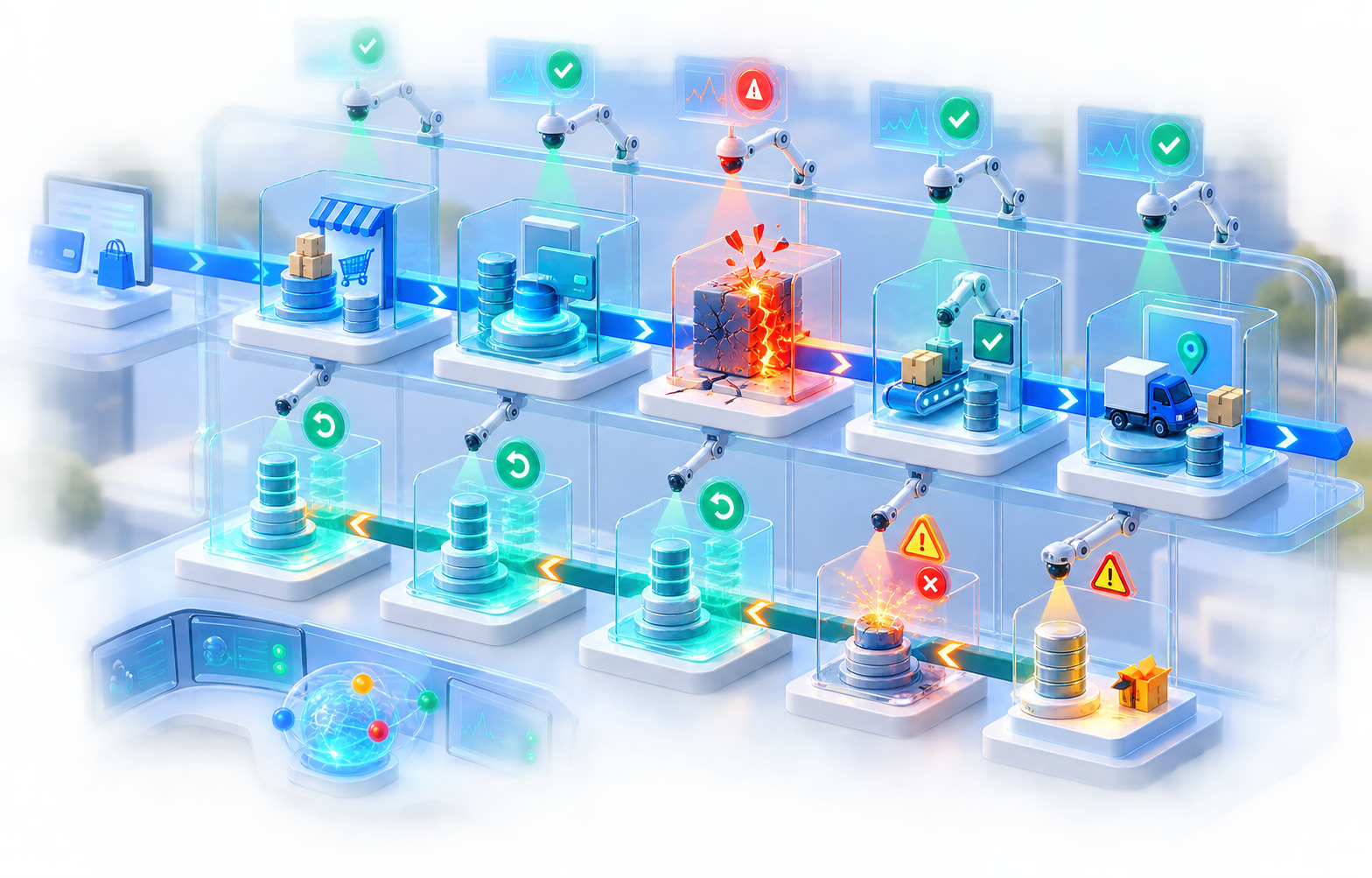
Monday. 9:00 a.m. The VP of Product asks the question everyone in the room has been dreading: why is the release slipping again.
Someone says they need two more backend engineers. Someone else says QA can't keep pace with the surface area. A third voice blames the old monolith — it's always been the monolith. Everyone nods. Everyone half-believes it. Nobody in the room notices that the real answer arrived three weeks earlier, quietly, when nobody could give a straight answer to one small question — and the engineers started writing code anyway, before the decision existed, because the calendar wasn't going to wait for it.
That's the pattern this article is about. Not the meeting. The three weeks before it, where the actual delay was manufactured and nobody wrote it down.
None of the answers in that room are wrong, exactly. They're just not the answer. They're the visible wreckage of something that happened weeks or months earlier, somewhere nobody was looking, in a conversation that never got finished, a Slack thread that trailed off, a requirement that was 80% specified and shipped anyway because the meeting ran long. Code is the last domino. By the time an engineer's fingers touch a keyboard, the outcome of the feature has usually already been decided — badly, or well, by someone who may not have realized they were making a decision at all.
This article makes one argument and holds it up from every angle available: the scarce resource in software organizations was never developer output. It was decision quality. Every organization already runs on an operating system that has nothing to do with its tech stack — call it the Decision Operating System: the largely invisible set of routines that determine who gets to decide what, how fast a question gets an answer, and what happens when nobody's sure. Kubernetes gets a diagram on the wall. The Decision Operating System runs the company and nobody's ever drawn it. Programming is what happens after that system has already decided — explicitly or by default — what to build, who owns it, what "done" means, and how much risk is acceptable. When the Decision OS is fast and well-owned, engineering looks fast. When it's slow, vague, or absent, engineering looks slow, and everyone blames the wrong layer of the stack.
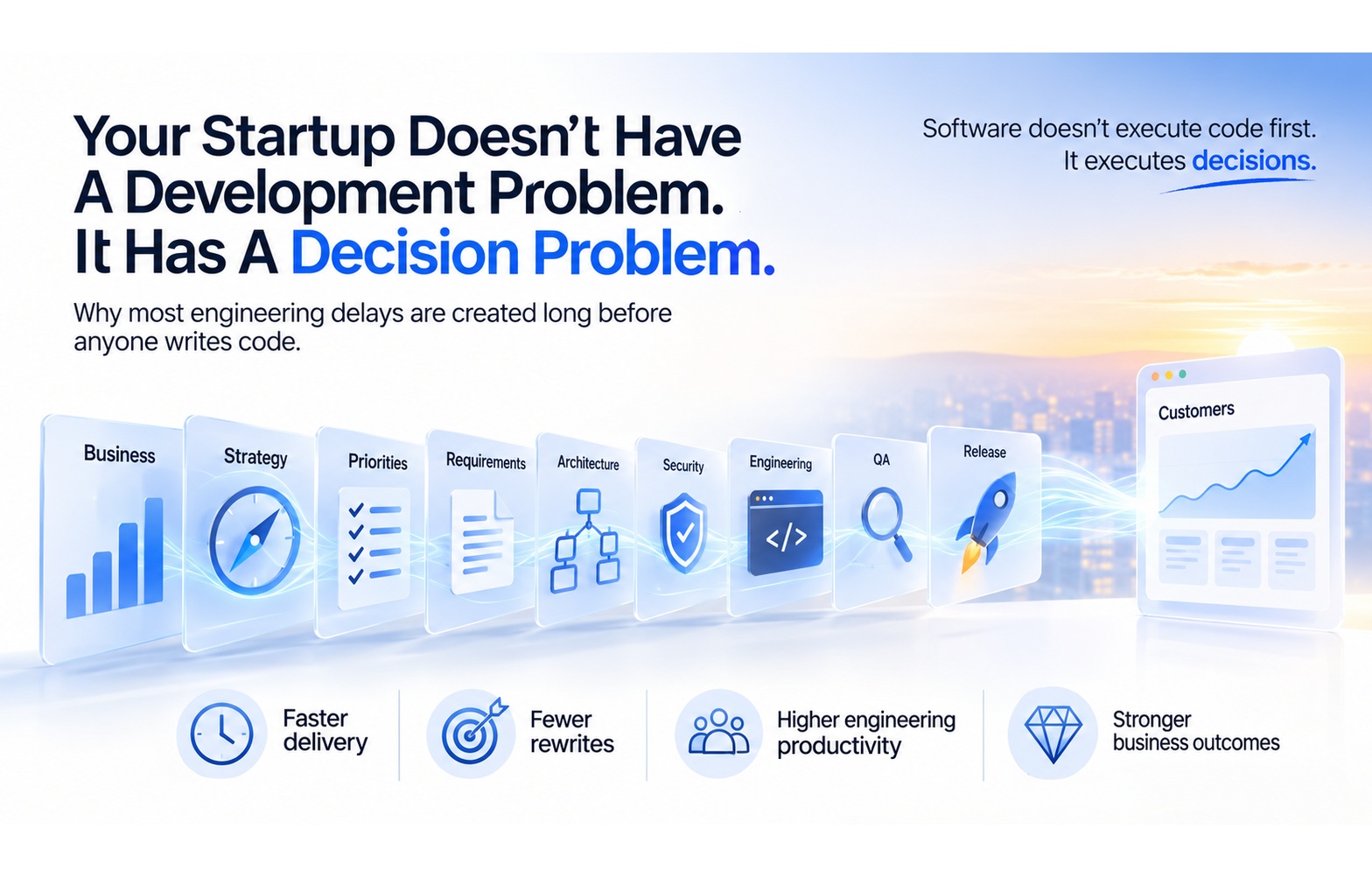
Software doesn't execute code first. It executes decisions.
The Decision Flow
Every company already has this diagram. It's just never been drawn, because it isn't a system diagram — it's an organizational one, and organizations don't tend to sketch themselves the way they sketch their infrastructure.
                    BUSINESS
                       │
                       ▼
                    STRATEGY
                       │
                       ▼
                    PRIORITIES
                       │
                       ▼
                   REQUIREMENTS
                       │
                       ▼
                   ARCHITECTURE
                       │
                       ▼
                    SECURITY
                       │
                       ▼
                   ENGINEERING
                       │
                       ▼
                       QA
                       │
                       ▼
                    RELEASE
                       │
                       ▼
                   CUSTOMERS
Read it top to bottom and it looks like a org chart. Read it the way it actually behaves and it's a river: every layer either passes a clear decision downstream or passes an unresolved one, and an unresolved decision doesn't disappear on its way down — it just changes shape. An ambiguous priority becomes a vague requirement. A vague requirement becomes an architectural guess. An architectural guess becomes a security exception nobody remembers granting. By the time it reaches ENGINEERING, the decision has traveled through six layers that each had the chance to resolve it and didn't, and the code that gets written there is downstream of every one of those unresolved moments — which is why blaming the ENGINEERING layer for the outcome is a little like blaming the delta for what happened upstream.
This is the Decision Flow, and everything in this article is, in one way or another, about what happens at each of its joints.
Instrument a mid-size engineering org for a month — actual calendar time, not story points — and a strange picture emerges. The median engineer spends less time writing code than almost anyone in the building believes, including the engineer. Most of the calendar is consumed waiting: waiting for a product manager to resolve a scope question, waiting for a security review to clear a dependency, waiting for a designer to finalize a flow, waiting for a staff engineer to bless an approach, waiting for a customer to confirm what "urgent" actually meant, waiting for a release manager to open a deployment window, waiting for legal to read three paragraphs of a contract clause that blocks an entire integration.
None of this shows up on a burndown chart, because burndown charts measure ticket state, not organizational latency. A ticket sitting "In Progress" for six days might represent four hours of actual engineering and five days of an engineer periodically checking whether someone has answered a question in a thread. The status is a lie of omission — not deceptive, just blind to the thing that actually matters.
This is the uncomfortable part: waiting isn't a scheduling inefficiency that a better tool will fix. Waiting is what happens when a decision hasn't been made yet and work has already started anyway, because the business doesn't have the patience to let decisions finish before code begins. Organizations don't sequence "decide, then build." They sequence "build, and decide in parallel, and hope the two conversations converge before the deadline." Sometimes they do. Often the code has to be partially rewritten once the decision lands, and that rewrite gets logged as a "bug" or "refactor," never as what it actually was: the cost of starting before the decision existed.
Velocity, in other words, isn't a property of how fast people type. It's a property of how fast the organization resolves the questions that code depends on. Two teams with identical engineering talent, identical frameworks, and identical headcount will ship at wildly different speeds if one has a product leader who answers scope questions within the hour and the other has a product leader who "needs to sync with three stakeholders first." That single difference dwarfs anything a linter, a new CI pipeline, or a language migration will buy you.
Decisions Create Code
It's tempting to think of a feature as a technical artifact that a team "builds." It's more accurate to think of it as a long chain of decisions that eventually gets compiled into a technical artifact, almost as an afterthought. Consider an unremarkable feature: "let users export their data as a CSV." Before a single function is written, dozens of decisions have to exist, even if nobody frames them as decisions:
What counts as "their data" — does it include data other users generated on their behalf? What's the retention policy for the generated file? Is the export synchronous or does it need a job queue, and at what row count does that threshold flip? Who owns the schema versioning if the CSV format needs to change later? Does this touch PII, and if so, does it need a security review before merge or after? What's the acceptable latency, and who defined "acceptable"? Does support need a runbook for when exports fail silently? Is there an existing export system elsewhere in the company that this should reuse instead of duplicating?
Every one of those is a decision. Most of them are invisible, because they get made implicitly — a senior engineer just picks an answer, silently, under deadline pressure, without writing it down, and the decision lives only in the code they wrote. That's not a moral failing. It's what happens when an organization doesn't have a cheap, fast, socially acceptable way to make small decisions explicitly. The engineer becomes the default decision-maker not because they're the right owner, but because they're the only person still in the room.
This matters because implicit decisions don't get reviewed. A decision that's written down — even in two sentences in a ticket description — gets read by someone else, and either confirmed or challenged before it costs anything. A decision buried inside a pull request gets reviewed for code quality, not for whether it was the right decision to begin with. By the time anyone notices the assumption was wrong, it's wired into three other features and the fix is a migration, not an edit.
Architecture is yesterday's thinking made permanent.
Why Hiring More Developers Usually Makes Things Worse
The instinct when delivery slows down is to add headcount. It's an understandable instinct — it worked, sort of, for factory output for a century — and it is very often the wrong move, for reasons that have been documented since Fred Brooks wrote about them in 1975 and that organizations rediscover every few years as if for the first time.
Brooks' Law is usually quoted for its surface claim — adding people to a late project makes it later — but the mechanism is what matters here, and it's a decision-density problem, not a coordination-overhead problem in the narrow sense people usually mean. Every new engineer needs a working model of the decisions that already exist: why the service is split this way, why that table has a nullable column that shouldn't logically be nullable, why the retry logic looks over-engineered for a call that "never fails." None of that is written down, because it was never decided explicitly in the first place — it accreted. So the new engineer either asks (consuming the time of the people they were hired to unblock) or guesses (introducing a decision that conflicts with the unwritten one already in place). Either way, the organization's decision-resolution queue gets longer, not shorter.
Conway's Law compounds this in a specific way that's easy to underestimate: system structure mirrors communication structure, which means a team split without clear decision ownership will produce a system split without clear decision ownership. Two teams building adjacent services, both technically capable, will produce an integration seam full of unresolved tradeoffs if neither team was given explicit authority to decide the contract between them. The resulting mess doesn't look like a decision problem from the outside. It looks like "the API design is inconsistent" or "these two teams don't communicate well." Those are downstream symptoms of an ownership gap that existed before either team wrote a line of code.
Then there's the more mundane arithmetic: every additional engineer is another node in the review graph, another calendar to align for design discussions, another Slack channel to keep in the loop, another person whose merge might collide with a decision someone else made an hour ago in a different thread. None of this is fixed by "better communication tools." It's fixed — or it isn't — by whether the organization has a clear, fast, low-ceremony way to make and record decisions so that new headcount can consume decisions instead of having to regenerate them.
The Cost of Ambiguity
Take one sentence from a real product spec, lightly disguised: "Users should be notified when their subscription is about to expire." That sentence looks complete. It is not a decision. It's a topic that a decision hasn't been made about yet.
How far in advance is "about to"? Does "notified" mean email, in-app, push, or all three, and who decides if the answer differs by plan tier? What happens for users who disabled notifications entirely — is the expiration notice exempt, and did anyone ask legal whether a transactional notice about billing is exempt from marketing opt-outs in every jurisdiction this product operates in? What's the retry behavior if the notification fails to send? Does the notification need a different template for annual versus monthly plans, since the framing of "expiring soon" means something different at each cadence?
None of this is hypothetical pedantry. It's the actual list of questions an engineer runs into three days after starting the ticket, at which point the choices are: guess and ship something, escalate and wait, or build something configurable enough to survive whichever answer eventually arrives. All three options cost something. Guessing wrong means a rewrite later, quietly re-labeled as a bug fix. Escalating means the ticket sits, and the sprint commitment slips, and somebody in a retro says "we didn't estimate this well," when the actual failure was that the spec was ambiguous and nobody noticed until code forced the ambiguity into the open. Building it configurable "just in case" is the most expensive option of all, because it adds permanent complexity to hedge against a decision that could have taken ten minutes to make explicitly, upfront, by the person who actually had the authority to make it.
This is the multiplication effect that makes ambiguity so much more expensive than it looks on the page. One unclear sentence in a spec doesn't cost ten minutes of clarification. It costs however many times that sentence gets independently reinterpreted — by the engineer writing the code, by the reviewer approving the pull request, by the QA engineer writing test cases, by the support engineer answering the first customer ticket about unexpected behavior, by the next engineer six months later who touches the same code and infers a different intent than the original author had. Ambiguity doesn't decay over time. It compounds, because each person who touches it has to independently resolve it, and there's no guarantee any two of them resolve it the same way.
Decision Debt
Technical debt has a home in the industry's vocabulary. Everyone knows what it means, everyone budgets some tolerance for it, everyone has a Friday-afternoon story about a shortcut that's still in production three years later. Decision debt is the upstream cousin nobody names, and it's arguably more expensive, because technical debt is at least visible in the code. Decision debt lives in the space between people, and it's invisible until it becomes technical debt — at which point everyone blames the code instead of the conversation that never happened.
Decision debt accumulates in a handful of recognizable shapes. There's the temporary compromise that was explicitly labeled temporary and never revisited, because revisiting it required someone to schedule a conversation nobody wanted to have. There's the avoided conversation itself — the roadmap discussion where two departments clearly disagreed about priority and the meeting ended with "let's take this offline," and offline turned out to mean never. There's missing ownership, where a system or a decision domain technically belongs to everyone, which in practice means it belongs to no one, and every question about it becomes a small negotiation instead of a lookup. There's the shifting-priority version, where a decision was made in good faith in Q1 under one set of assumptions, the assumptions changed in Q2, and nobody formally re-decided anything — the org is now operating on a decision that both current stakeholders would reject if asked directly, except nobody has asked directly. There's conflicting assumptions held by different teams who both believe they have the authoritative version of how a shared system behaves, and haven't discovered the conflict yet because nothing has forced it into the open. And there's executive indecision at the top of the chain — a genuinely hard tradeoff between two reasonable strategies, deferred quarter after quarter, that leaves every team below unable to make a confident bet, because the bet they'd need to make depends on a call only the executive can make.
Every one of these has the same lifecycle. It starts as a soft, social, seemingly low-stakes gap. It doesn't cost anything on the day it's created — that's exactly what makes it easy to create. Then someone builds on top of the unresolved question, because the deadline didn't wait for the decision to mature, and the ambiguity gets encoded into a specific technical shape: a table schema, an API contract, a service boundary. At that point it has technically become technical debt, but its origin was never technical. Technical debt is what decision debt looks like after it has calcified into code that would need a migration to fix instead of a conversation.
Technical debt usually starts as management debt.
The reason this distinction matters practically, not just semantically, is that the two kinds of debt need completely different remediation. Technical debt gets fixed by refactoring, by better tests, by paying down complexity in the code itself. Decision debt gets fixed by naming an owner, forcing a conversation, writing the decision down, and closing the loop — none of which shows up in a sprint plan, and none of which an engineer can unilaterally do, no matter how senior. An organization that only tracks technical debt is treating the symptom and reinfecting itself with the cause every quarter.
Architecture Is Frozen Decision Making
Pull up any architecture diagram from a company that's been operating for five years, and what you're actually looking at is a historical record — a snapshot of every tradeoff that was accepted at the moment it was drawn, still governing behavior long after the context that justified it has disappeared. The monolith wasn't split into these four services because someone modeled the ideal decomposition. It was split this way because that's how the two teams that existed at the time happened to be organized, and because a particular vendor contract expired and a replacement had to be bolted on somewhere, and because someone left the company mid-project and the boundary they were mid-way through drawing got frozen exactly where they left it.
This is worth internalizing precisely because it reframes what "bad architecture" usually is. It's rarely a failure of technical skill. It's the visible residue of decisions that were reasonable, or at least defensible, given what was known and who had authority at the time — decisions that were never revisited because revisiting an architectural decision requires the same organizational machinery that made the original decision so hard to get right in the first place: someone with authority, time, and the political capital to say "we're changing course," and a business patient enough to fund the change without an immediate feature attached to it.
The practical implication is that architecture reviews shouldn't be graded purely on technical elegance. They should be graded on whether the decisions being encoded are the ones the business actually wants frozen for the next three years, because that's what an architecture decision really is — a bet about which tradeoffs the organization is willing to live with long after the person who made the call has moved to a different project, or a different company.
Meetings Don't Slow Teams
Meetings get blamed constantly, and the blame is usually misplaced. A meeting that produces a clear decision, communicated to the people who need it, is one of the cheapest and fastest tools an organization has — cheaper than a Slack thread that meanders for four days without resolution, faster than an async document that three stakeholders each annotate with contradictory comments and nobody reconciles.
What actually slows teams down is a meeting that fails to produce a decision. This happens more often than most leaders want to admit, and it has a recognizable signature: the meeting ends with "let's think about it and follow up," or "I'll loop back with the team," or a decision gets made in the room and then quietly relitigated afterward by someone who wasn't present and disagreed once they heard about it secondhand. The meeting consumed an hour of six people's time and produced nothing that a downstream engineer can act on with confidence. That's not a meeting problem. It's a decision-quality problem wearing a meeting's clothes.
The fix isn't fewer meetings. Organizations that swing to "no meetings, everything async" frequently discover that ambiguous decisions just take longer to not-resolve, spread out over more days, with less accountability, because nobody in a comment thread has quite the same obligation to reach closure that a room full of stakeholders staring at each other does. The fix is a habit: every decision-oriented meeting ends with the decision stated explicitly, the owner named, and the record written down somewhere durable before anyone leaves. That habit is nearly free to adopt and it's the single highest-leverage process change most organizations can make, because it converts meetings from a place where ambiguity is discussed into a place where ambiguity is closed.
Why AI Won't Fix This
The current enthusiasm for AI-assisted development rests on a real capability — large language models are genuinely good at producing code once the intent behind that code is well-specified. That's not a small thing. But it's worth being precise about what "well-specified" is doing in that sentence, because it's carrying the entire weight of the claim.
An LLM can generate a CSV export function in seconds. It cannot tell you whether "their data" includes records generated on the user's behalf by someone else. It cannot decide whether the security review happens before or after merge. It cannot adjudicate the disagreement between the growth team, which wants the export unrestricted, and the security team, which wants it rate-limited and logged. It cannot decide who owns the resulting file's retention policy. These aren't gaps in model capability that the next generation of models will close, because they aren't technical questions. They're organizational questions, and an organization that hasn't resolved them for its human engineers hasn't resolved them for an AI collaborator either — it has just made the ambiguity produce output faster, which is not obviously an improvement. A well-specified wrong decision, generated instantly, is still a wrong decision; it just arrives with more confidence and less friction to interrogate it.
This produces a specific, underappreciated risk as AI-assisted coding scales inside organizations that haven't fixed their decision layer: the volume of code produced per unit of organizational clarity goes up, which means the volume of decision debt encoded per sprint goes up too, silently, because the code now arrives fast enough that nobody pauses to ask whether the underlying decision was ever actually made. Fast code built on an unresolved question doesn't make the question go away. It just buries it one layer deeper and ships it to production sooner.
LLMs generate code. They don't generate alignment. They don't resolve ownership. They don't negotiate tradeoffs. They don't decide business priorities. Every organization currently measuring the success of its AI coding rollout purely in terms of lines generated or tickets closed is optimizing the one part of the pipeline that was never actually the bottleneck.
The Real Bottleneck
Strip away the surface complaints — slow QA, legacy code, understaffed teams, indecisive product — and four things remain, and they're the same four things in almost every organization that has ever struggled with delivery speed, regardless of industry, headcount, or tech stack.
Alignment — whether the people who need to agree on a direction actually agree, or have merely stopped arguing about it in public while continuing to build toward different mental models in private. Trust — whether an engineer who makes a reasonable judgment call under ambiguity will be supported by their manager, or second-guessed after the fact, because the latter teaches everyone to escalate every decision rather than risk owning one. Ownership — whether every decision domain in the system has exactly one accountable owner, rather than zero (nobody will decide) or three (three people will each decide differently). Decision latency — the actual, measurable time between a question being raised and an authoritative answer being given, independent of how much code sits waiting on that answer.
These four are the load-bearing walls. Everything else — the framework choice, the CI pipeline, the test coverage percentage — is interior decoration by comparison. An organization can have mediocre tooling and still ship fast if these four are healthy. An organization can have the best tooling money can buy and still ship at a crawl if these four are broken, because the tooling was never what was slow.
Enterprise Example: A 100-Engineer SaaS Company
Picture a mid-market SaaS company, roughly a hundred engineers, decent Series C-plus funding, a product that genuinely works and customers who genuinely like it. Leadership is frustrated. The roadmap from a year ago is roughly forty percent complete. Everyone assumes the answer is more engineers, or a platform rewrite, or finally addressing "that legacy service everyone complains about."
Walk the org chart instead of the codebase, and a different picture appears. Product has four PMs, each owning a different surface, none of whom has explicit authority to make cross-surface tradeoffs — so every feature that touches two surfaces stalls until a VP happens to have bandwidth to adjudicate, which happens roughly every three weeks, in a recurring meeting that's frequently rescheduled. Security has one engineer, embedded nowhere, who reviews everything asynchronously with a two-week backlog, and every feature touching customer data queues behind that backlog regardless of its actual risk profile, because there's no tiering system to fast-track low-risk changes. The architecture "review" is technically a Slack channel where a staff engineer weighs in when they see a message, which means the quality of architectural guidance a team receives depends entirely on whether that staff engineer happened to be online that day. There is no written decision log anywhere in the company — every "why did we do it this way" question gets answered by finding whichever engineer has been there the longest and asking them to remember.
None of these are coding problems. None of them would be fixed by hiring engineer number 101. Every one of them is a decision-routing failure — a question that needs an authoritative, fast answer, routed instead through a process with no defined latency, no defined owner, and no memory. The hundred engineers are, on any given week, mostly capable and mostly idle in the specific sense that matters: blocked, not on code, but on someone else's unmade decision.
Case Study: One Feature, From Customer Request to Production
Follow a single, concrete feature through this same company, with a stopwatch on every stage, and the ratio becomes impossible to ignore.
A customer requests the ability to set custom permission roles instead of the three fixed tiers the product currently offers. The request lands with a CSM, who forwards it to a PM (day 1). The PM agrees it's worth doing but needs to check whether it conflicts with an enterprise SSO project already in flight, so it sits in a backlog review queue for the next planning cycle (day 1 to day 9). It's approved for the next sprint, but the spec is thin — "let customers create custom roles" — so an engineer picks it up and immediately hits the first unresolved question: do custom roles need to be scoped per-workspace or account-wide? That's a data-model decision with migration implications, and the engineer escalates it to the tech lead, who agrees it needs architecture sign-off before work continues (day 10 to day 13, waiting for the next architecture review slot). Architecture approves the account-wide model but flags that it touches the permissions table, which security has opinions about; security review gets queued (day 14 to day 24, waiting behind the existing two-week backlog). Security approves with one condition — role changes need an audit log entry — which wasn't in the original spec, so the PM has to decide whether that's in scope for this release or a fast-follow (day 25, a fifteen-minute conversation that could have happened on day 1 if anyone had thought to ask security's opinion before writing the ticket).
Only now does sustained coding actually start. The engineer builds the data model, the permission-check logic, and the audit log integration in six focused days (day 26 to day 31). Code review takes two days, mostly waiting for a reviewer with context to have availability (day 32 to day 33). QA picks it up, finds an edge case around role inheritance that nobody had specified — what happens when a custom role is deleted while users still hold it — and that question bounces back to the PM (day 34 to day 36). The answer comes back, the fix takes an afternoon, QA signs off, and the feature waits four more days for the next scheduled release window because deploys are batched weekly and it narrowly missed the cutoff (day 37 to day 41).
Total elapsed time: 41 days. Actual engineering time, summed across every person who touched code: roughly six days of the original build plus a day of fixes and reviews — call it seven days, generously. That's fifteen to seventeen percent of the total elapsed time. The other eighty-five percent was spent waiting for decisions: prioritization, data-model sign-off, security review, scope clarification on an edge case nobody specified upfront. Every one of those waits was avoidable, not because the people involved were slow or unhelpful, but because nothing in the process forced those questions to surface before code was already underway.
Coding was never the bottleneck in this story. It's rarely the bottleneck in any story like it.
The Same Pattern, Three Industries
None of this is confined to one kind of company. Strip the identifying details and the shape repeats with almost boring consistency.
A European fintech, mid-Series B, spent four months trying to ship a single new payment method. The engineering work took roughly two weeks, spread thin across the four months. The rest of the time was consumed by a compliance question that had no single owner — three different people believed they were the authority on it, none of them believed it was solely theirs, and the question bounced between them for the better part of a quarter before anyone realized nobody had actually decided who got to decide.
A US eCommerce platform, well past product-market fit, wanted to launch a saved-cart feature ahead of a seasonal push. The build was trivial. What wasn't trivial was that data retention policy for abandoned cart contents had never been formally decided, and three teams — growth, legal, and platform — each had a different informal answer they'd been operating on for over a year without anyone noticing the mismatch, until this feature forced all three answers into the same room at once.
A healthcare SaaS company, selling into hospital systems, had a feature stall for six weeks over a single unresolved question: did a new patient-facing notification count as clinical communication, which would trigger a different, slower review path, or as administrative communication, which wouldn't? Nobody had ever needed to draw that line before, so nobody had, and the feature sat exactly where every unresolved category boundary sits — waiting for someone with the authority to draw it.
Different industries, different regulatory weight, completely different codebases. The same failure, every time: a fast build, sitting behind a slow, unowned question that nobody had bothered to answer before the ticket was written.
The Decision Pipeline
Most organizations can draw their deployment pipeline from memory. Almost none can draw their decision pipeline — the actual sequence a question travels through before it becomes an authoritative answer that an engineer can build against. Here's the shape it takes in the case study above, and in most organizations of similar size:
        CUSTOMER
           │  (request, ambiguous intent)
           ▼
        PRODUCT ───────────┐
           │                │  (competing priorities,
           │                │   no cross-surface authority)
           ▼                │
     ARCHITECTURE           │
           │  (review slot  │
           │   scarcity)    │
           ▼                │
       SECURITY             │
           │  (backlog,     │
           │   no risk      │
           │   tiering)     │
           ▼                │
      ENGINEERING ◄─────────┘
           │  (actual code —
           │   the fast part)
           ▼
          QA
           │  (discovers specs
           │   that were never
           │   written)
           ▼
        RELEASE
           │  (batched windows,
           │   not continuous)
           ▼
        CUSTOMER
Every arrow in that diagram is a queue, and every queue has its own latency distribution, its own capacity, and — critically — almost never has an owner accountable for how long things sit in it. Engineering teams optimize the box labeled ENGINEERING relentlessly: better CI, better test infrastructure, better local dev environments. It's the one box in the diagram where the organization has spent a decade of tooling investment, and it's also, per the case study above, the box consuming the smallest share of total elapsed time. The queues on either side of it — architecture review, security review, release batching — rarely get the same investment, because they don't feel like "engineering problems." They're organizational plumbing, and organizational plumbing doesn't get a platform team assigned to it the way CI does.
Decision Quality Metrics
Distributed systems engineering figured this out decades ago: you cannot improve what you cannot observe, and the failure modes that matter most are rarely the ones with an obvious dashboard. The same logic applies to decision-making, and almost no organization measures it, which means almost no organization can tell you, with data, where its actual bottleneck lives. A working set of metrics, deliberately modeled on the observability vocabulary engineers already trust:
Decision Latency — elapsed time between a decision being needed and an authoritative answer being given, tracked per decision domain (architecture, security, product scope, legal). This is the single most important number in the whole framework, and almost no company tracks it today.
Decision Rework Rate — the percentage of decisions that get reversed or substantially revised after downstream work has already started against them. High rework doesn't mean people are indecisive; it usually means decisions are being made without the right information present at decision time.
Requirement Stability Index — how much a requirement changes after engineering has started building against it, measured per feature. A low score here is a leading indicator of decision debt being created upstream of code.
Architecture Churn — how frequently core architectural decisions get revisited within a given window, and whether that churn is deliberate evolution or a symptom of the original decision never having had a clear, communicated rationale.
Ownership Clarity — for any given decision domain, can every engineer in the org correctly name the accountable owner without checking? This is measurable with a simple internal survey and the results are usually more alarming than any code-quality metric.
Approval Depth — the number of distinct approvals a typical decision has to pass through before it's actionable. Depth beyond two or three approvers rarely improves decision quality; it mostly adds latency without adding insight, because each additional approver is reviewing a decision they had no part in shaping.
Decision Confidence — a simple self-reported score, collected at the moment a decision is made, on how confident the decision-maker actually is. Low-confidence decisions made under deadline pressure are the leading predictor of future rework, and tracking this over time tells you where your organization is systematically deciding faster than it should.
Alignment Index — measured by asking the same strategic question to stakeholders across product, engineering, and leadership independently, then scoring how closely their answers converge. Divergence here predicts stalled cross-team features months before the stall becomes visible in a burndown chart.
Decision Cost per Sprint — an estimate of engineering hours spent waiting on, escalating, or reworking around unresolved decisions, as a percentage of total sprint capacity. Most organizations that measure this honestly for the first time are shocked by the number.
Decision Throughput — the raw count of decisions an organization's key decision-making bodies (architecture review, security review, executive staff meetings) can resolve per week, compared against the actual demand for decisions being generated by the roadmap. A mismatch here is a capacity problem hiding behind what looks like a talent problem.
Decision Observability — the meta-metric: does the organization have any durable, searchable record of what was decided, by whom, and why? Without this, every other metric on this list is impossible to compute retroactively, and every decision effectively has to be re-litigated the next time someone asks "wait, why does it work this way?"
Velocity is measured in decisions, not commits. An organization that starts tracking these numbers, even imperfectly, will usually find its actual bottleneck within a quarter — and it is almost never the one leadership assumed going in.
How Great Engineering Teams Actually Work
None of this is a new discovery. It's the quiet subtext of nearly everything publicly discussed about how the fastest-moving engineering organizations actually operate, even when the public framing emphasizes something else.
Amazon's well-known internal writing culture — the narrative memo instead of the slide deck — is, underneath the productivity folklore, a decision-forcing function. A six-page document with actual sentences makes ambiguity visible in a way bullet points don't; you cannot hide an unresolved tradeoff behind a vague bullet the way you can behind a paragraph that has to actually commit to a claim. The "two-pizza team" structure is frequently cited for its size, but the more important property is that small teams have unambiguous decision ownership over a narrow surface area — there's no committee to defer to, so decisions get made where the context lives.
Stripe has spoken publicly about its emphasis on well-scoped, written API design docs before implementation begins, precisely because an API is one of the most expensive places in a system to make an implicit decision — once external customers depend on a contract, reversing it costs orders of magnitude more than getting a design review right the first time. The discipline isn't bureaucracy for its own sake; it's front-loading the decision cost to a stage where changing your mind is still cheap.
Netflix has publicly emphasized a "context, not control" management philosophy — giving engineers the business context needed to make good decisions locally rather than routing every decision through a central authority that becomes a bottleneck the moment the company scales past the point where one person can hold all the context in their head. That's a direct, explicit answer to the ownership and decision-latency problem: push authority to wherever the necessary context already lives, rather than centralizing authority and having context flow inward through slow, lossy channels.
Google's engineering culture, particularly around design docs and readability review, institutionalizes the idea that architectural decisions get written down and reviewed by people with relevant expertise before code exists, specifically so ambiguity gets caught while it's still a paragraph and not yet a service boundary that three teams depend on.
SpaceX's publicly discussed engineering culture emphasizes extremely fast internal decision cycles specifically because the cost of iteration in aerospace hardware is so brutally high that a slow decision is far more expensive than a slow line of code — an ethos that translates directly into software, even though most software organizations haven't internalized how expensive their own slow decisions actually are, because the cost is distributed and hidden rather than concentrated in one visible explosion.
The common thread across every one of these — reported through very different public narratives, in very different industries — is the same: decisions get made explicitly, in writing, by someone with clear authority and sufficient context, as early as the organization can manage, and the record of that decision persists long enough for the next person who needs it.
Building High-Velocity Organizations
None of the above requires a reorganization or a new platform team to start applying. It requires a small number of durable habits, consistently enforced, that most organizations already claim to believe in and rarely actually practice under deadline pressure.
Decision ownership has to be explicit and singular per domain — not a committee, not "the team," a named person or a clearly bounded role who is understood by everyone to have final say, with an equally clear escalation path for the rare case where they're wrong. Small autonomous teams work not because small is inherently virtuous but because small teams have a decision-making surface area narrow enough that context doesn't have to travel far to reach the person who needs it. Clear interfaces between teams — APIs, contracts, service boundaries — function as pre-negotiated decisions that let two teams build independently without re-litigating the same tradeoff every time they touch the seam between them. Written decisions, even brief ones, convert a conversation that exists only in the memory of the people who attended into a durable artifact the rest of the organization can build against without having to ask. Architecture reviews, done well, aren't gatekeeping — they're a forcing function that catches an ambiguous or risky decision while it's still a diagram, before it's a migration. Fast feedback loops — short cycles between a decision being made and its consequences becoming visible — let an organization detect a bad decision in days instead of quarters, which matters more than getting every decision right the first time, because no organization gets every decision right the first time. Independent verification — someone other than the decision-maker checking the decision's consequences — catches the blind spots that come standard with every decision made under deadline pressure by someone too close to the problem to see its edges.
None of these six habits require new tooling budgets. They require leadership willing to treat decision quality as a first-class engineering concern, measured with the same seriousness as uptime, and to stop quietly assuming that a slow roadmap is always a headcount problem waiting for the next req to be approved.
An Actionable Framework
For an organization that wants to act on this immediately rather than merely agree with it in the abstract, the sequence looks like this. Start by mapping every decision domain in the company — architecture, security, product scope, legal, data, release management — and, for each one, writing down who the actual accountable owner is today, not who it should theoretically be. Most companies discover gaps immediately: domains with three informal owners, or none. Next, for each domain, set an explicit decision-latency target — a maximum time a question in that domain should sit before getting an authoritative answer — and make that target visible to the teams who depend on it, the same way an SLA is visible. Then instrument the pipeline: track decision latency, rework rate, and requirement stability for a full quarter before changing anything else, because most organizations are working from assumptions about where their bottleneck lives that turn out to be wrong once measured. Introduce a lightweight, mandatory decision log — a single shared, searchable place where any decision above a minor threshold gets recorded in two or three sentences: what was decided, who decided it, why, and what it explicitly rules out. Require every decision-oriented meeting to end with a stated decision, a named owner, and a written record before anyone leaves the room — this single habit will do more for velocity than most three-month process overhauls. Finally, revisit the decision-domain map quarterly, because ownership gaps reopen constantly as teams reorganize, and an org chart that was clean in January is rarely still clean in June.
The Checklist
Twenty-two questions worth asking about any engineering organization, answered honestly rather than aspirationally:
- For every major decision domain in the company, is there exactly one named accountable owner?
- Can an engineer name that owner without asking anyone?
- Is there a written record of the last ten significant architectural decisions, including the reasoning and the alternatives considered?
- How long, on average, does a security review actually take, measured, not estimated?
- Is there a risk-tiering system that fast-tracks low-risk changes through review?
- What percentage of tickets get materially rescoped after engineering has already started?
- Do product requirements get reviewed by security and architecture before a sprint commitment is made, or only after?
- Does every decision-oriented meeting end with a stated decision and a named owner?
- Is there a single source of truth for "why does this system work this way," or does that answer live only in senior engineers' memory?
- How many approvals does a typical decision pass through, and does each approver actually add information, or just latency?
- When a decision is reversed, is the cost of that reversal ever tracked or reviewed?
- Do teams have explicit authority to decide within their domain, or does everything route upward by habit?
- Is there a measurable decision-latency target for each decision domain?
- Are architecture reviews a forcing function that happens before implementation, or a formality that happens after?
- Does the release process batch deployments in a way that adds latency unrelated to code readiness?
- When an engineer hits an ambiguous requirement, is there a known, fast path to get it resolved, or do they have to guess?
- Is decision confidence ever measured at the moment a decision is made?
- Do cross-team feature dependencies have a named arbiter for tradeoffs, or does that get resolved ad hoc each time?
- Is there a recurring, protected time slot for architecture and security review, or does it depend on availability?
- When two teams disagree about a shared interface, is there a fast, known escalation path?
- Has the organization ever measured what percentage of a feature's total elapsed time was actual coding versus waiting?
- If the answer to the previous question is "no" — why not, given how easy it is to find out?
CTO Self-Assessment
Fifteen questions for a CTO or VP Engineering to answer privately, without an audience, as a gut check rather than a scorecard:
- If I picked a random feature that shipped late last quarter, could I tell you, with confidence, exactly where the delay actually occurred?
- Do I know my organization's actual decision latency for security and architecture review, or only its intended SLA?
- When was the last time I personally sat on an unresolved decision for more than a week, and what did that cost the teams waiting on it?
- Do my engineering leads believe they have real authority over decisions in their domain, or do they believe everything ultimately routes through me?
- How many of my current "technical debt" line items actually originated as an unresolved business decision?
- Is there a written record of the architectural bets I'm currently making, in language a new hire could read and understand a year from now?
- When I add headcount to a slow team, am I solving a capacity problem or masking a decision-routing problem?
- Do I reward engineers for making confident, reasonable calls under ambiguity, or do I quietly punish the ones that turned out wrong, teaching everyone to escalate instead?
- Is there a single team or role in my org whose informal backlog silently gates every feature that touches their domain?
- Have I ever measured what percentage of a typical feature's timeline is spent coding versus waiting?
- Do my staff and principal engineers spend more time writing code or resolving other people's ambiguity? Is that ratio intentional?
- If I disappeared for a month, would decisions in my organization still get made at the same pace, or would they queue up waiting for me specifically?
- When product and engineering disagree about scope, is there a fast, known way to resolve it, or does it depend on whoever's more persistent?
- Do I actually believe AI coding tools will fix my delivery speed, and if so, have I tested that belief against a specific bottleneck I've measured, or is it an assumption?
- If I'm honest, is my organization's biggest constraint really a shortage of engineers — or a shortage of fast, clear, well-owned decisions?
The Obvious Objections
A framework this confident deserves to be argued with, so it's worth taking the strongest counterpoints seriously rather than only the friendly ones.
What about Google — they have thousands of engineers and still ship enormous amounts of software. Doesn't that disprove the headcount argument? It doesn't, because Google's scale is exactly why it invests so heavily in the mechanisms this article is describing: design docs before code, readability review, explicit ownership of services. Google doesn't ship fast at that size despite having thousands of engineers — it ships at all because it has spent two decades building the organizational machinery that keeps decision latency low across a headcount most companies will never approach. It's the exception that proves the rule, not the counterexample to it.
Isn't technical debt still the bigger day-to-day problem? Engineers feel that pain directly, every sprint. Technical debt is real and it does slow teams down — nothing here argues otherwise. But it's worth asking, honestly, of the last ten pieces of technical debt a team complained about: how many of them started as a clean technical choice that just aged badly, and how many started as a compromise nobody had the authority or appetite to resolve properly at the time? In most organizations, the honest answer skews heavily toward the second category, which doesn't make technical debt less painful — it just means paying it down without fixing the decision layer above it guarantees a fresh supply next quarter.
What if the real problem actually is weak developers — not every team's slowness is a decision problem in disguise? Sometimes it genuinely is a skill or staffing issue, and no framework should pretend otherwise. But it's a useful diagnostic to ask: are the engineers on this team slow at writing code, or slow at getting confident answers to questions they can't resolve themselves? Those look identical from a burndown chart and require completely different fixes — one needs coaching or better hiring, the other needs a faster, clearer decision layer. Treating the second problem as the first is how companies end up performance-managing people for an organizational failure that was never theirs to fix.
And what if the architecture really is bad — isn't that a technical failure, full stop? Usually not a failure of skill, as the earlier section on frozen decisions argued — but it's fair to push back and note that some architectural decisions really were just made poorly, by people who had the authority and the time and got it wrong anyway. That happens. It just tends to be rarer than it looks from the outside, because bad architecture and unowned architecture produce nearly identical symptoms, and it's much more comfortable for an organization to conclude "we made a technical mistake" than "we never actually decided who was allowed to make this call."
None of these objections break the argument. They sharpen it: decision quality doesn't replace the need for skilled engineers, sound technical judgment, or debt repayment — it's the layer that determines whether those other investments actually compound, or quietly get spent paying for questions nobody wanted to answer on time.
Final Thought
Programming has never been the scarce resource. Clear thinking has. Every engineering organization that has ever struggled with delivery speed has looked first at the code, because the code is where the delay finally becomes visible, and it is much easier to blame a visible thing than an invisible one. But the code was only ever the compiled output of everything the organization decided, failed to decide, or decided badly, weeks or months before an engineer opened an editor.
Companies don't become slow because developers write slowly. They become slow because organizations decide slowly — because ownership is unclear, because decisions get made without being written down, because ambiguity is allowed to survive contact with a sprint planning meeting, because nobody is measuring the one queue that actually determines how fast anything ships. Software is simply accumulated organizational decisions, compiled into code, and every team that has ever felt like it was moving through mud was moving through the accumulated weight of decisions that were never quite made.
Every bug has a parent decision. Every delay has a parent decision. The organizations that figure this out stop hiring their way out of a decision problem, stop blaming frameworks for organizational latency, and start treating decision quality as the engineering discipline it actually is — measured, owned, and taken as seriously as uptime. The rest keep buying better keyboards for a bottleneck that was never in anyone's hands.
Organizations don't scale by writing more code. They scale by making fewer uncertain decisions.
Every software system is ultimately a record of organizational decisions. Some of them are written down in architecture documents. The rest are written straight into production.