Introduction
Every engineering leader has lived through some version of the same incident: a deployment that worked perfectly in staging breaks in production. Someone digs through SSH sessions trying to figure out which server has which configuration. Nobody can say with certainty what changed. The postmortem ends with some version of “we need better infrastructure discipline” — and then, often, nothing actually changes.
This pattern is not a personnel problem. It's an architecture problem. When infrastructure is managed by hand — through consoles, ad hoc scripts, and tribal knowledge — reliability becomes a function of how careful people are on any given day. That's not a foundation you can scale a business on.
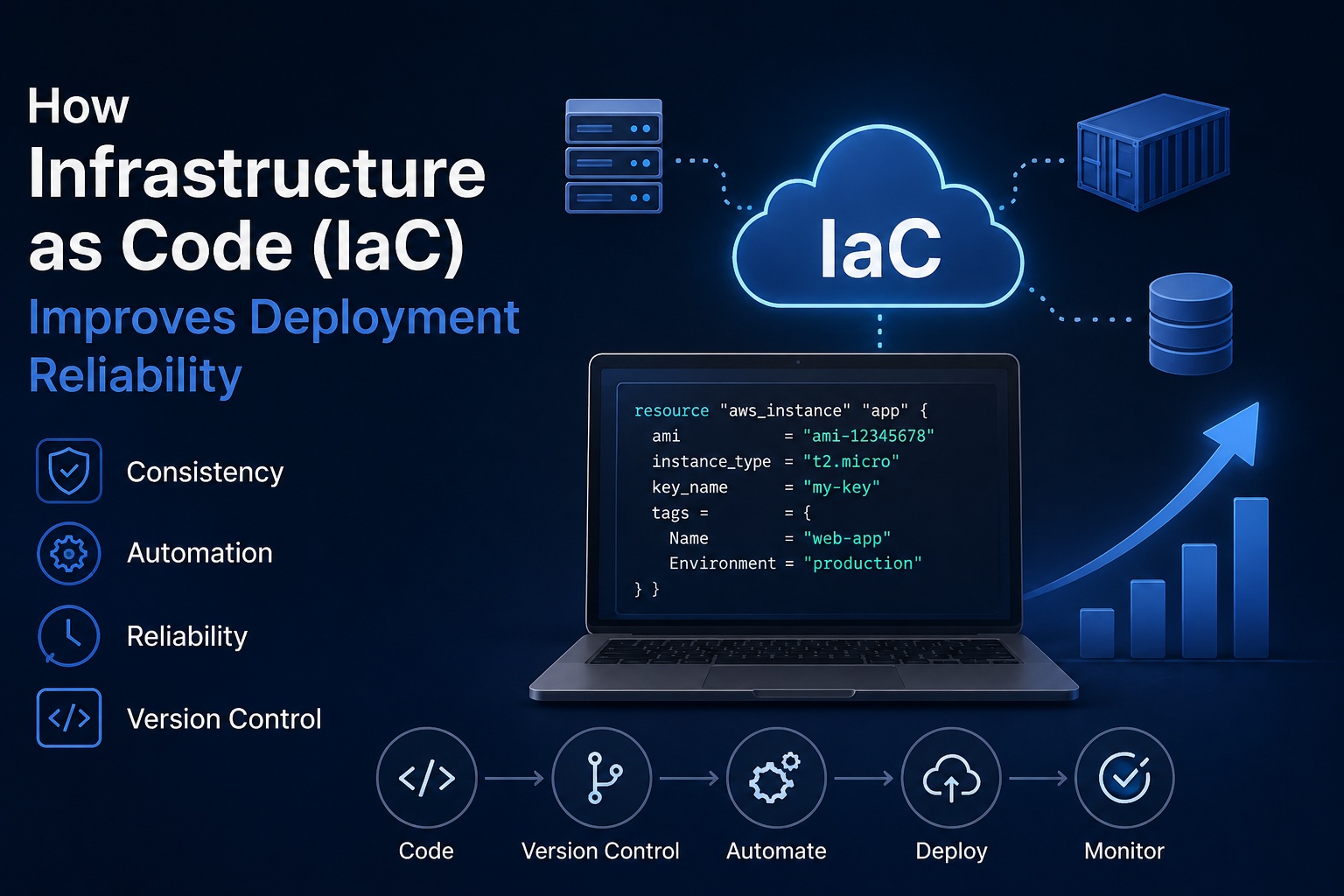
Infrastructure as Code (IaC) addresses this at the root. It treats infrastructure provisioning the same way modern teams treat application code: version-controlled, peer-reviewed, tested, and deployed through repeatable automation. The result isn't just operational convenience — it's a measurable improvement in deployment reliability, recovery speed, and the ability to scale infrastructure without scaling risk.
This article is written for engineering leaders evaluating whether IaC adoption is worth the investment, and for teams already using IaC who want to assess whether their implementation matches best practice. We'll cover the technical mechanics, the business case, and the practical path from manual infrastructure to a reliable, automated infrastructure practice.
What Is Infrastructure as Code?
Infrastructure as Code is the practice of defining and managing infrastructure — servers, networks, load balancers, databases, Kubernetes clusters, and more — through machine-readable configuration files, rather than through manual processes or interactive configuration tools.
In plain business terms: instead of an engineer manually clicking through a cloud console to create a server, configure its network rules, and attach storage, that same engineer writes a file describing what the infrastructure should look like. A tool then reads that file and creates exactly the infrastructure described — consistently, every time.
Traditional Infrastructure Management
Before IaC became standard practice, infrastructure was typically provisioned manually or through custom, often undocumented scripts. An engineer would log into a server, install software, edit configuration files, and adjust settings directly. Scaling meant repeating this process — by hand — for every new server.
This approach worked when infrastructure was small and static. It breaks down as soon as systems need to scale, change frequently, or be reproduced reliably across environments (development, staging, production).
Modern Cloud Environments
Cloud computing changed the underlying economics of infrastructure — servers became disposable, environments became elastic, and the number of moving parts multiplied dramatically. A typical modern SaaS architecture might include dozens of compute instances, managed databases, networking rules, load balancers, container orchestration layers, and third-party service integrations.
Managing this complexity by hand isn't just inefficient — past a certain scale, it becomes practically impossible to do reliably. This complexity is precisely what created the conditions for IaC to emerge as a necessity rather than a nice-to-have.
Why IaC Emerged
IaC emerged from a simple realization: if application code benefits from version control, code review, and automated testing, infrastructure — which is just as critical to system behavior — should benefit from the same discipline. Tools like Terraform, Ansible, AWS CloudFormation, and Pulumi formalized this idea into mature, production-grade tooling over the past decade.
Manual Infrastructure vs Infrastructure as Code
|
Dimension |
Manual Infrastructure Management |
Infrastructure as Code |
|
Consistency |
Varies by engineer and by day |
Identical every time, by design |
|
Documentation |
Often outdated or missing |
Code is the documentation |
|
Change tracking |
Difficult — relies on memory or tickets |
Full history via version control |
|
Recovery speed |
Slow — manual rebuild required |
Fast — re-run automation |
|
Review process |
Rare or informal |
Code review before changes apply |
|
Scaling |
Linear effort per resource |
Near-zero marginal effort |
|
Error rate |
Higher — human execution of repetitive tasks |
Lower — automation removes manual steps |
|
Auditability |
Limited, often manual log review |
Full change history, who/what/when |
|
Onboarding new engineers |
Slow, relies on tribal knowledge |
Faster — infrastructure is self-documenting |
|
Disaster recovery |
Hours to days |
Minutes to hours |
Why Deployment Reliability Matters
Deployment reliability isn't an abstract engineering metric — it has direct, measurable business consequences.
Failed Deployments
A failed deployment isn't just a wasted engineering cycle. It often means a partial or broken state in production: some services updated, others not, leaving the system in an inconsistent condition that's harder to diagnose than either a clean success or a clean failure.
Configuration Drift
Configuration drift occurs when the actual state of infrastructure diverges from what's documented or intended — usually because of manual changes made directly in production without being reflected anywhere else. Over time, drift compounds: each undocumented change makes the system less predictable and harder to reason about.
Human Errors
Human error remains one of the most consistently cited root causes in infrastructure-related outages across the industry. This isn't a reflection of engineer competence — it's an inherent risk of manual, repetitive operations performed under time pressure. The more steps a process has, and the more frequently it's performed by hand, the higher the probability that one of those steps eventually goes wrong.
Downtime Costs
Downtime cost scales with company size and revenue dependency on the platform, but the pattern holds across industries: the longer a system stays down, the more expensive it becomes — not just in direct revenue impact, but in support load, SLA penalties, and engineering hours diverted to firefighting instead of building.
Customer Trust
Reliability is a trust signal. SaaS customers — particularly enterprise customers — increasingly evaluate vendors on operational maturity, not just feature sets. A pattern of unreliable deployments or unexplained outages erodes confidence in ways that are difficult to repair, even after the underlying issue is fixed.
Expert Tip: Reliability problems are rarely about any single incident. They're about the trend. One outage is a technical issue. A pattern of outages is a process issue — and it's almost always traceable back to how infrastructure changes are made.
Common Problems with Manual Infrastructure Management
Inconsistent Environments
When environments are configured manually, “works on staging” frequently does not mean “works in production” — because staging and production were never guaranteed to be identical in the first place. Subtle differences in installed package versions, environment variables, or network configuration become sources of bugs that are extremely difficult to trace.
Missing Configurations
Manual setups depend on someone remembering every step. When a new environment is built, it's common for a configuration detail — a firewall rule, an environment variable, a DNS entry — to be missed simply because it wasn't on anyone's checklist, or the checklist itself was outdated.
Documentation Gaps
Infrastructure documentation written manually almost always falls out of sync with the actual infrastructure within weeks. Engineers move on to other priorities, changes get made without updating the wiki, and the documentation becomes a historical artifact rather than a reliable reference.
Slow Recovery
When something breaks and there's no automated way to rebuild the affected infrastructure, recovery depends on someone manually reconstructing the previous state — often under pressure, often without complete information about what that state actually was.
Scaling Challenges
Scaling manually managed infrastructure means repeating manual work, which means scaling the risk of human error proportionally. Teams that try to scale this way often find that operational overhead grows faster than the business itself.
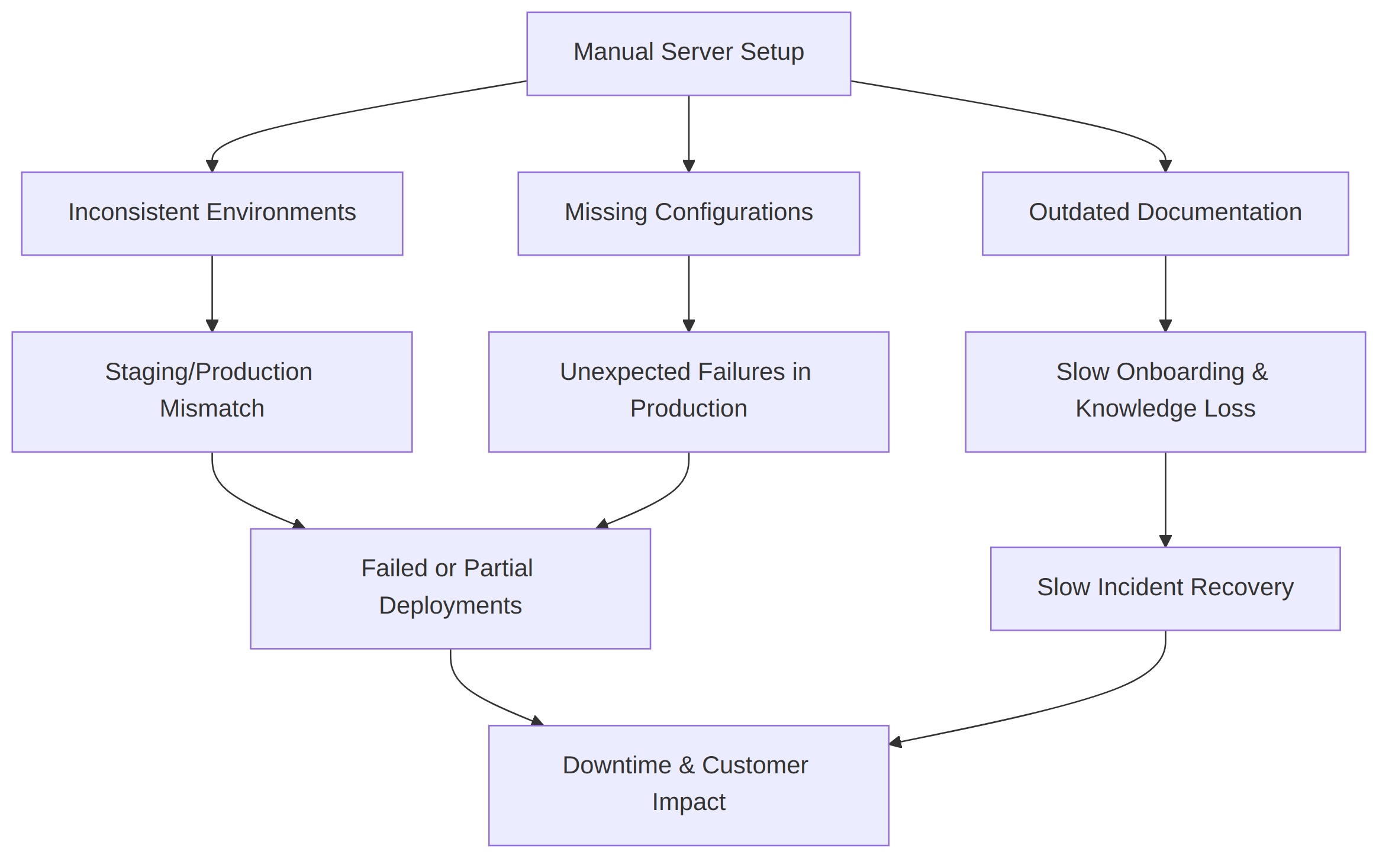
How Manual Infrastructure Problems Compound
How Infrastructure as Code Works
Declarative Approach
Most modern IaC tools use a declarative model: you describe the desired end state of your infrastructure, and the tool determines how to achieve it. You don't write step-by-step instructions — you write a specification, and the automation handles execution, including figuring out what needs to change versus what's already correct.
This is a fundamentally different mental model from imperative scripting, where you'd write out every command in sequence. Declarative tools track current state and compute the difference between current and desired state — applying only what's necessary.
Version Control
Because infrastructure is defined in code, it lives in the same version control systems (typically Git) used for application code. Every change has an author, a timestamp, a commit message, and — ideally — a code review. This turns infrastructure changes from invisible, untracked events into auditable, reviewable history.
Automated Provisioning
Once infrastructure is defined as code, provisioning becomes a matter of running automation rather than performing manual steps. The same definition can provision a development environment, a staging environment, and a production environment — with confidence that all three are structurally identical.
Reproducibility
Reproducibility is the property that makes disaster recovery, environment cloning, and scaling tractable. If your entire infrastructure can be rebuilt from code, then losing a server, a data center region, or even an entire environment becomes a recoverable event rather than a catastrophic one.
Practical Example: Terraform
Terraform is a widely adopted IaC tool that uses a declarative configuration language (HCL) to define infrastructure across multiple cloud providers.
# main.tf - Example: provisioning a web server on AWS
provider "aws" {
region = "us-east-1"
}
resource "aws_instance" "web_server" {
ami = "ami-0c55b159cbfafe1f0"
instance_type = "t3.medium"
tags = {
Name = "production-web-server"
Environment = "production"
}
}
resource "aws_security_group" "web_sg" {
name = "web-sg"
description = "Allow HTTP and HTTPS traffic"
ingress {
from_port = 443
to_port = 443
protocol = "tcp"
cidr_blocks = ["0.0.0.0/0"]
}
ingress {
from_port = 80
to_port = 80
protocol = "tcp"
cidr_blocks = ["0.0.0.0/0"]
}
}
Running terraform plan shows exactly what will change before anything is applied — giving teams a preview and an approval gate before infrastructure changes take effect. Running terraform apply then provisions the resources to match the declared state.
Practical Example: Ansible
Ansible takes a slightly different approach, focusing on configuration management and orchestration using YAML-based playbooks, typically over SSH without requiring agents on target machines.
# deploy_app.yml - Example: configuring a web server with Ansible
- name: Configure production web servers
hosts: web_servers
become: true
tasks:
- name: Install required packages
apt:
name:
- nginx
- python3-pip
state: present
update_cache: true
- name: Deploy application configuration
template:
src: templates/nginx.conf.j2
dest: /etc/nginx/sites-available/app.conf
notify: Restart nginx
- name: Ensure nginx is running
service:
name: nginx
state: started
enabled: true
handlers:
- name: Restart nginx
service:
name: nginx
state: restarted
In practice, many teams use Terraform for provisioning cloud infrastructure (servers, networks, databases) and Ansible for configuring what runs on top of that infrastructure — the two tools are frequently complementary rather than competing.
Key Ways IaC Improves Deployment Reliability
Reducing Human Error
The problem: Manual infrastructure changes require a person to correctly execute potentially dozens of steps, in the correct order, with the correct parameters, every time. Even experienced engineers make mistakes under time pressure or when working from incomplete documentation.
The solution: IaC removes manual execution from the equation. Once a configuration is defined and tested, applying it is deterministic — the same input produces the same output, every time, regardless of who runs it or what time of day it is.
SaaS example: A SaaS company onboarding a new enterprise customer needs to provision an isolated environment with specific compliance configurations. With IaC, this is a parameterized template run that takes minutes and is correct by construction. Without it, it's a multi-hour manual process with multiple opportunities for a missed step.
Business impact: Fewer production incidents traceable to “someone fat-fingered a config” — and less engineering time spent debugging issues that shouldn't have happened in the first place.
Ensuring Environment Consistency
The problem: Differences between development, staging, and production environments are one of the most common sources of “it worked in testing but broke in production” failures.
The solution: IaC defines all environments from the same underlying templates, with environment-specific variables for things that legitimately need to differ (instance sizes, domain names). The structural configuration — networking, security groups, service topology — stays identical.
SaaS example: A team using IaC can spin up a staging environment that is structurally identical to production, run their test suite against it, and have genuine confidence that a passing test means the deployment will behave the same way in production.
Business impact: Higher confidence in pre-production testing translates directly into fewer production surprises and a shorter, more predictable release cycle.
Supporting Automated Testing
The problem: Manually provisioned infrastructure is difficult to test programmatically — there's no clean way to validate that a manual setup process was followed correctly.
The solution: Because IaC definitions are code, they can be tested with the same rigor as application code: static analysis, policy validation, and automated integration tests that provision real (often ephemeral) infrastructure to verify it behaves as expected.
SaaS example: Before merging a change to a Terraform module, a CI pipeline can run terraform validate, policy checks, and a plan against a sandbox environment — catching misconfigurations before they ever reach a shared environment.
Business impact: Infrastructure bugs are caught in code review and CI, the same place application bugs are caught — rather than being discovered in production.
Faster Rollbacks
The problem: Rolling back a manual infrastructure change means someone has to remember (or reconstruct) what the previous state was and manually reverse the change — often while the system is actively degraded.
The solution: Because infrastructure changes are tracked in version control, rolling back is often as simple as reverting to a previous commit and re-applying. The previous known-good state is explicit, not reconstructed from memory.
SaaS example: A misconfigured load balancer rule causes elevated error rates after a deployment. With IaC, the team reverts the relevant commit and re-applies — restoring the previous configuration in minutes, with no ambiguity about what “previous” means.
Business impact: Mean time to recovery (MTTR) drops significantly, directly reducing the customer-facing duration of incidents.
Disaster Recovery
The problem: If infrastructure exists only as a set of manual configurations on running servers, losing those servers — through hardware failure, a regional cloud outage, or an operational mistake — can mean losing the only record of how the system was actually configured.
The solution: With IaC, the entire infrastructure definition lives in version control, independent of any running system. Recovery becomes a matter of re-running automation against a new environment or region, rather than reconstructing configuration from memory and incomplete documentation.
SaaS example: A regional cloud outage takes down a company's primary environment. A team with mature IaC practices can provision equivalent infrastructure in a different region by re-running their existing automation with updated region parameters — a process that can be tested and rehearsed in advance.
Business impact: Disaster recovery shifts from a theoretical plan to a tested, repeatable capability — which matters enormously for SLA commitments and enterprise sales conversations.
Predictable Scaling
The problem: Manually scaling infrastructure — adding servers, replicating configurations, adjusting capacity — multiplies the operational effort and the error surface in direct proportion to growth.
The solution: IaC templates are parameterized, so scaling often means adjusting a variable (instance count, cluster size) rather than repeating manual work. Auto-scaling configurations can themselves be defined as code, removing manual intervention from routine scaling events entirely.
SaaS example: A SaaS platform experiencing seasonal traffic spikes can define auto-scaling rules as part of its infrastructure code, so that capacity adjusts automatically within pre-approved, tested bounds — rather than requiring an engineer to manually provision additional capacity during a traffic surge.
Business impact: Scaling events stop being fire drills and become routine, predictable operations — freeing engineering time for product work rather than reactive infrastructure firefighting.
Version-Controlled Infrastructure
The problem: Without version control, there's no reliable answer to “what changed, when, and why” for infrastructure — which makes root cause analysis slower and audits harder.
The solution: Every infrastructure change becomes a tracked, attributable, reviewable commit. Teams gain a complete history of infrastructure evolution, which supports both operational debugging and compliance requirements.
SaaS example: During a security audit, a SaaS company needs to demonstrate exactly when a specific network rule was introduced and who approved it. With version-controlled infrastructure, this is a git log query. Without it, it's a forensic exercise.
Business impact: Faster incident root-causing, smoother compliance audits, and a defensible record of infrastructure change for regulated customers.
Terraform vs Ansible vs CloudFormation
|
Criteria |
Terraform |
Ansible |
CloudFormation |
|
Approach |
Declarative |
Primarily imperative |
Declarative |
|
Primary use case |
Infrastructure provisioning |
Configuration management & orchestration |
AWS-native provisioning |
|
Multi-cloud support |
Strong — AWS, Azure, GCP & more |
Strong — cloud-agnostic, agentless |
None — AWS only |
|
Learning curve |
Moderate — HCL & state mgmt |
Moderate — YAML is approachable |
Moderate to steep — verbose syntax |
|
State management |
Explicit state file |
Largely stateless |
Managed automatically by AWS |
|
Scalability |
High — enterprise scale |
High, esp. for config tasks |
High within AWS only |
|
Enterprise adoption |
Very high |
Very high |
High among AWS-committed orgs |
Expert Tip: These tools are frequently used together rather than as mutually exclusive choices. A common enterprise pattern: Terraform provisions the underlying infrastructure, Ansible configures what runs on top of it, and CloudFormation may still be used for specific AWS-native services where it offers tighter integration.
Infrastructure as Code and CI/CD Pipelines
IaC reaches its full potential when integrated into CI/CD pipelines, where infrastructure changes go through the same automated review, validation, and deployment process as application code.
GitHub Actions
GitHub Actions workflows can run terraform plan on every pull request, posting the plan output as a comment for reviewers, and run terraform apply automatically on merge to the main branch — turning infrastructure changes into a standard pull-request workflow.
GitLab CI/CD
GitLab CI/CD offers built-in Terraform integration, including a managed state backend and merge request widgets that show infrastructure plan output directly in the merge request UI, keeping infrastructure review in the same interface as code review.
Jenkins
Jenkins pipelines, defined via Jenkinsfile, can orchestrate multi-stage IaC workflows — validation, planning, manual approval gates, and apply stages — making it a strong fit for organizations with established Jenkins infrastructure and a need for custom approval workflows.
Azure DevOps
Azure DevOps Pipelines integrate naturally with Terraform and ARM templates, offering built-in support for variable groups, approval gates, and environment-based deployment tracking — particularly relevant for teams already standardized on the Microsoft ecosystem.
Example Workflow Pattern
A typical, reliable IaC CI/CD workflow follows this pattern:
- Engineer opens a pull request with an infrastructure change
- CI pipeline runs validation and a plan step, posting the proposed changes
- A reviewer examines the plan output alongside the code diff
- On approval and merge, the pipeline runs apply automatically
- Post-apply checks verify the infrastructure is healthy
Diagram: IaC CI/CD Workflow

Infrastructure as Code for Kubernetes Environments
Kubernetes adds another layer of infrastructure complexity — clusters, namespaces, deployments, services, and networking policies — all of which benefit from the same IaC discipline applied to underlying cloud resources.
Kubernetes Provisioning
Tools like Terraform can provision the Kubernetes cluster itself (EKS, AKS, GKE), while Kubernetes-native tools manage what runs inside the cluster. This separation of concerns — infrastructure provisioning versus application deployment — keeps each layer manageable.
Helm
Helm functions as a package manager for Kubernetes, allowing application configurations to be templated, versioned, and deployed consistently across environments. A Helm chart is, in effect, IaC for the application layer running on top of your cluster.
GitOps
GitOps extends IaC principles specifically to Kubernetes: the desired state of the cluster is defined in a Git repository, and an automated controller continuously reconciles the actual cluster state to match. Any drift between Git and the live cluster is automatically corrected — or at minimum, flagged.
ArgoCD
ArgoCD is a widely adopted GitOps controller for Kubernetes. It continuously monitors a Git repository and the live cluster state, automatically applying changes when the repository updates and providing visibility into any divergence between desired and actual state.
Reliability Improvements
For Kubernetes environments specifically, IaC and GitOps practices reduce reliability risk by:
- Eliminating manual kubectl apply commands run directly against production clusters
- Making every cluster change traceable to a Git commit
- Enabling automatic detection and correction of configuration drift
- Supporting fast, consistent recovery if a cluster needs to be rebuilt
Security Benefits of Infrastructure as Code
Auditability
Every infrastructure change made through IaC is recorded in version control with full attribution — who made the change, when, and why (via commit messages and linked tickets). This is a significant improvement over manual changes, which often leave no consistent audit trail.
Compliance
Many compliance frameworks (SOC 2, ISO 27001, HIPAA, and others) require demonstrable change management processes for systems handling sensitive data. IaC, combined with code review and CI/CD gates, provides a natural, auditable change management process that satisfies these requirements with far less manual overhead than maintaining separate change-tracking documentation.
Access Control
IaC shifts the question of “who can change infrastructure” from “who has console access” to “who can merge a pull request.” This is a meaningfully more controllable and reviewable access model, particularly when combined with branch protection rules and required approvals.
Policy Enforcement
Policy-as-code tools allow security and compliance requirements to be enforced automatically, before infrastructure is provisioned — rather than discovered after the fact during an audit or, worse, after an incident.
Security Scanning Tools
Several mature tools scan IaC definitions for security misconfigurations before they're applied:
- Checkov: Static analysis tool that scans Terraform, CloudFormation, Kubernetes, and other IaC formats for security and compliance misconfigurations.
- tfsec: A Terraform-specific static analysis security scanner that identifies potential security issues in Terraform configurations.
- Terrascan: A policy-as-code scanner supporting multiple IaC frameworks, with built-in policies mapped to common compliance frameworks.
Integrating these tools into CI pipelines means a misconfigured security group, an overly permissive IAM policy, or an unencrypted storage bucket gets flagged at pull-request time — not discovered during a security audit or, worse, after a breach.
Expert Tip: Treat security scanning of IaC the same way you treat dependency vulnerability scanning for application code — as a required, automated gate, not an optional periodic review.
Real-World SaaS Scenario
Consider a representative (composite, illustrative) scenario based on patterns commonly seen across growing SaaS companies: a mid-sized SaaS platform with around 40 engineers, running on manually managed cloud infrastructure that had organically grown over several years.
Before IaC
The infrastructure had been built incrementally, mostly through console changes and a collection of ad hoc shell scripts maintained by whichever engineer happened to set up a given service. There was no single source of truth for what infrastructure existed or how it was configured.
- Deployment time: 2–4 hours per release, including manual verification steps
- Outage frequency: Roughly 2–3 infrastructure-related incidents per month
- Recovery time: 4–8 hours for significant incidents, longer for full environment rebuilds
- Onboarding time for new engineers: 3–4 weeks to become comfortable making infrastructure changes safely
The Migration
The team adopted Terraform for cloud infrastructure provisioning and Ansible for application server configuration, migrating service by service rather than attempting a single large cutover. Each migrated service was brought under version control, with a CI pipeline enforcing plan review before any change was applied.
After IaC
- Deployment time: 15–30 minutes, largely automated with minimal manual verification
- Outage frequency: Reduced to roughly 1 incident every 2–3 months, and most incidents were unrelated to infrastructure misconfiguration
- Recovery time: Typically under 30 minutes, with full environment rebuild capability tested and available within hours rather than days
- Onboarding time for new engineers: Reduced to roughly 1 week, since infrastructure is self-documenting through code
Metrics Comparison
|
Metric |
Before IaC |
After IaC |
Improvement |
|
Average deployment time |
2–4 hours |
15–30 minutes |
~85% faster |
|
Infrastructure incidents/month |
2–3 |
~0.4 |
~85% reduction |
|
Mean time to recovery (MTTR) |
4–8 hours |
< 30 minutes |
~90% faster |
|
New engineer onboarding time |
3–4 weeks |
~1 week |
~70% faster |
|
Engineering hours/month on manual ops |
~80 hours |
~15 hours |
~80% reduction |
Diagram: Reliability Improvement Over Time
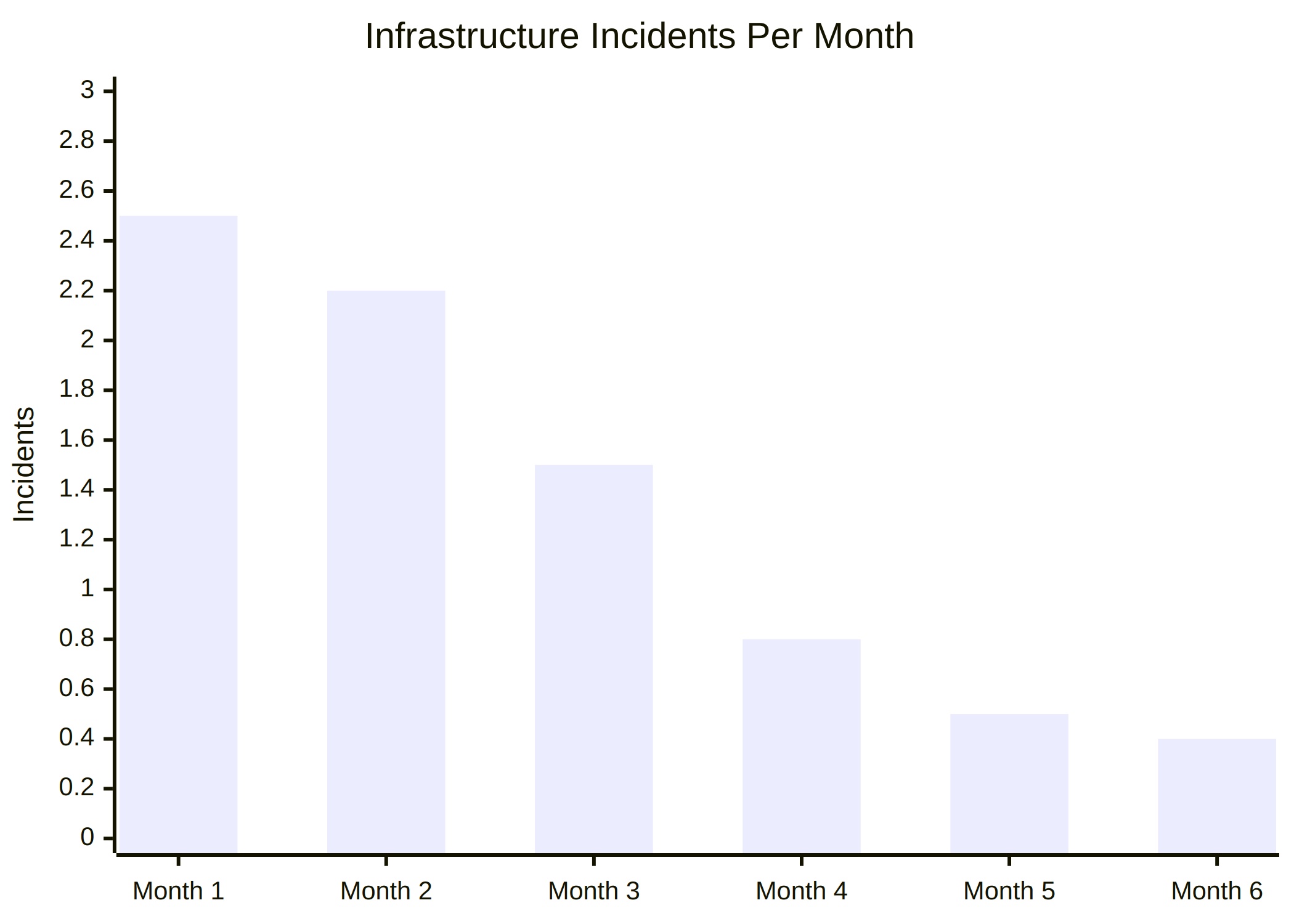
Infrastructure Incidents Per Month — Reliability Improvement Over Time
The pattern in this scenario is consistent with what's broadly reported across the industry: the reliability gains from IaC adoption tend to compound over the first several months as more of the infrastructure estate comes under management, rather than appearing all at once.
Best Practices for Implementing Infrastructure as Code
Modular Design
Break infrastructure definitions into reusable modules (a “VPC module,” a “database module,” a “web service module”) rather than writing monolithic configurations. This makes infrastructure easier to test, review, and reuse across environments and projects.
Reusable Templates
Standardize common patterns into templates that teams can adopt with minimal customization — reducing the chance of inconsistent, one-off implementations of the same underlying pattern across different services.
Code Reviews
Infrastructure changes should go through the same review rigor as application code. A second set of eyes on a terraform plan output catches issues — unexpected resource deletions, overly permissive access rules — before they reach production.
Testing Infrastructure
Apply automated testing to infrastructure code: static analysis, policy validation, and integration tests that provision real (typically ephemeral, automatically destroyed) infrastructure to validate behavior before merging changes.
Documentation
Even though code is largely self-documenting, maintain higher-level architecture documentation explaining why infrastructure is structured the way it is — decisions and tradeoffs that aren't always obvious from the code itself.
Security-First Approach
Integrate security scanning (Checkov, tfsec, Terrascan) into the CI pipeline from the start, rather than retrofitting it after infrastructure has already grown significantly.
Implementation Checklist
- Infrastructure definitions stored in version control with branch protection enabled
- CI pipeline runs validation and plan on every pull request
- Plan output is reviewed by a second engineer before merge
- Security scanning tools integrated into the CI pipeline
- State management strategy defined (remote state, locking, access control)
- Infrastructure organized into reusable, testable modules
- Environments (dev/staging/production) use the same modules with environment-specific variables
- Disaster recovery process tested at least annually
- Architecture decisions documented alongside the code
- Access to apply infrastructure changes is limited to the CI/CD pipeline, not individual consoles
Common Mistakes to Avoid
- Treating IaC adoption as a one-time project rather than an ongoing practice. Recommendation: Build IaC adoption into your standard engineering workflow permanently, not as a project with an end date.
- Skipping code review for infrastructure changes. Recommendation: Apply the same pull-request review standards to infrastructure code as application code, without exception.
- Storing state files without proper locking or access control. Recommendation: Use a remote state backend with locking (e.g., Terraform Cloud, S3 with DynamoDB locking) to prevent concurrent modification conflicts.
- Writing monolithic configurations instead of modular ones. Recommendation: Break infrastructure into logical, reusable modules early — retrofitting modularity later is significantly more work.
- Hardcoding secrets directly into IaC files. Recommendation: Use dedicated secrets management tools (Vault, AWS Secrets Manager, Azure Key Vault) and reference secrets rather than embedding them in code.
- Allowing manual changes to infrastructure that's supposed to be managed as code. Recommendation: Restrict console/manual access for production infrastructure to break-glass scenarios only, and reconcile any emergency manual changes back into code immediately afterward.
- Neglecting to test infrastructure changes before applying them to production. Recommendation: Maintain a staging environment that mirrors production and validate changes there first.
- Not having a rollback strategy for infrastructure changes. Recommendation: Ensure every infrastructure change can be reverted via version control, and periodically test that rollback actually works.
- Ignoring drift detection. Recommendation: Run regular drift detection (e.g., scheduled terraform plan runs) to catch any divergence between code and actual infrastructure state.
- Underinvesting in team training on IaC tools and practices. Recommendation: Treat IaC proficiency as a core engineering skill requiring dedicated onboarding and ongoing learning, not something engineers are expected to pick up informally.
- Over-engineering IaC abstractions before understanding actual reuse needs. Recommendation: Start with straightforward, readable configurations and introduce abstraction only once genuine repetition emerges.
Future Trends in Infrastructure as Code
AI-Assisted Infrastructure Management
AI-assisted tooling is increasingly capable of generating IaC configurations from natural language descriptions, reviewing pull requests for potential misconfigurations, and suggesting optimizations. These tools are best understood as accelerants for experienced practitioners rather than replacements for infrastructure expertise — the underlying judgment about architecture and tradeoffs still requires human oversight.
GitOps
GitOps adoption continues to expand beyond Kubernetes into broader infrastructure management, driven by its strong audit trail and self-correcting drift detection properties.
Platform Engineering
Platform engineering teams are increasingly building internal developer platforms on top of IaC foundations, offering self-service infrastructure provisioning to product engineers through standardized, pre-approved templates — reducing the operational burden on central infrastructure teams while maintaining consistency and governance.
Self-Healing Infrastructure
Combining IaC with continuous reconciliation (as in GitOps) and automated remediation is pushing infrastructure toward a self-healing model, where drift and certain classes of failures are corrected automatically without requiring a human to intervene.
Multi-Cloud Automation
As organizations increasingly operate across multiple cloud providers — whether for redundancy, cost optimization, or regulatory reasons — IaC tooling that abstracts multi-cloud complexity into consistent, portable definitions is becoming a more central architectural consideration rather than an edge case.
Conclusion
Deployment reliability is not primarily a matter of hiring more careful engineers or writing more thorough documentation — though both help. It's fundamentally an architecture and process decision. Infrastructure as Code addresses the structural causes of unreliable deployments: inconsistent environments, undocumented changes, slow recovery, and the inherent risk of repetitive manual work.
The transition from manual infrastructure management to IaC is rarely instantaneous, and it doesn't need to be. Teams that migrate incrementally — service by service, with proper testing and review built in from the start — see compounding reliability improvements over months, not years.
For engineering leaders evaluating where to invest limited engineering capacity, infrastructure reliability is one of the few investments that pays dividends across nearly every other engineering priority: faster releases, fewer incidents, easier scaling, stronger security posture, and a more defensible compliance position with enterprise customers.