1. Introduction
Building AI into your product is no longer a differentiator — it's becoming table stakes. Recommendation engines, AI-powered copilots, intelligent document processors, conversational chatbots, code generation assistants — these capabilities are now standard features in competitive SaaS products.
What most engineering teams discover too late, however, is that shipping AI features is significantly easier than shipping reliable AI features. The testing playbook that served your team well for years — unit tests, integration tests, end-to-end automation — doesn't transfer cleanly to systems that are probabilistic by design.
This guide is for CTOs, product managers, QA leads, and engineering managers who need a grounded, technical understanding of what AI application testing actually involves. We'll cover not just the what, but the why — because understanding the fundamental nature of AI systems is the prerequisite for testing them intelligently.
2. What Are AI-Powered Applications?
AI-powered applications are software systems that use machine learning models — including large language models (LLMs), recommendation algorithms, classification systems, or generative models — as a core functional component.
This isn't a narrow definition. It includes:
- Conversational AI / Chatbots: Customer support agents, internal knowledge assistants, sales copilots powered by LLMs like GPT-4 or Claude.
- Recommendation Engines: Netflix-style content recommendation, e-commerce product suggestion, personalized search ranking.
- AI Copilots: Code generation tools (GitHub Copilot), writing assistants, data analysis assistants embedded in SaaS platforms.
- Generative AI Tools: Image generators, document drafters, contract analyzers, email composers.
- Intelligent Automation Systems: Document processing pipelines, fraud detection systems, predictive maintenance tools.
- AI Search and Retrieval Systems: RAG (Retrieval-Augmented Generation) systems that combine vector databases with LLMs to answer questions from private knowledge bases.
What unites all of these is a dependency on a model whose behavior cannot be fully specified or predicted in advance. That single fact is what makes AI software testing categorically different from anything that came before it.
3. Why Testing AI Applications Is More Difficult Than Traditional Software
Before designing any AI testing strategy, you need to deeply understand why AI systems resist conventional QA approaches. There are several compounding reasons.
3.1 Non-Deterministic Outputs
Traditional software is deterministic: given the same input, it always produces the same output. You can write a test that expects calculateTax(1000) to return 150 — and if it doesn't, there's a bug.
AI systems break this contract entirely. Ask an LLM the same question twice and you may get two different answers, both technically correct, both formatted differently, both using different words. Temperature settings, model sampling, context window state — all of these introduce variance. Writing assertion-based tests for non-deterministic outputs requires a completely different architecture.
3.2 Hallucinations and Confabulation
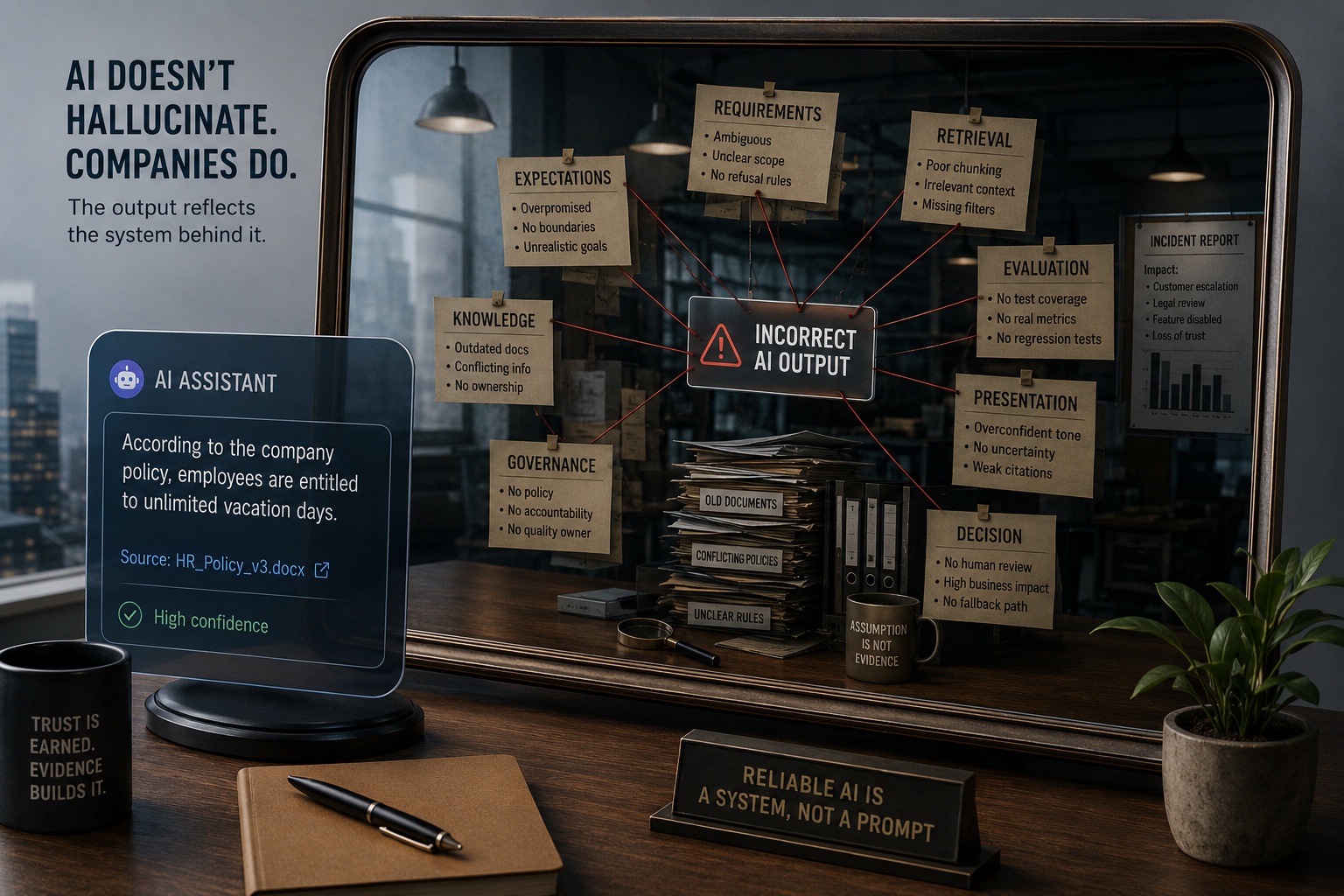
Large language models generate plausible-sounding content based on learned statistical patterns — which means they can confidently produce false information. A medical AI assistant might cite a non-existent study. A legal copilot might invent a precedent case. A customer support bot might quote an incorrect price or policy.
These are not bugs you can catch with code review. They require dedicated hallucination testing regimes, often involving human evaluators or secondary AI judges.
3.3 Model Drift and Behavioral Degradation
Models can change in ways that break your application even when your code hasn't changed. An LLM API provider updates their model, adjusting safety filters or response formatting. A recommendation model retrained on new data subtly shifts its outputs. The retrieval component of your RAG system behaves differently after adding new documents to the knowledge base.
This makes AI regression testing fundamentally more complex. You're not just testing whether your code changed — you're continuously monitoring whether the underlying model behavior has drifted.
3.4 Prompt Variability and Sensitivity
The way a user phrases a question dramatically affects how an AI responds. “Summarize this document” versus “Give me a brief overview of this document” may produce outputs with very different lengths, structures, and coverage. In production, this variability is enormous — you cannot test every possible phrasing, which means coverage is always incomplete.
Prompt engineering changes also require regression testing. A small edit to a system prompt can cascade into unexpected behavior changes across dozens of downstream use cases.
3.5 Emergent Failure Modes
AI systems can fail in ways that are impossible to enumerate in advance. A chatbot might handle 10,000 user inputs flawlessly and then produce a harmful or embarrassing output on the 10,001st — not because of an edge case bug, but because the interaction hit a latent vulnerability in the model's training.
3.6 Security Vulnerabilities Unique to AI
Prompt injection, jailbreaking, data extraction through adversarial inputs — these are attack vectors that have no direct analog in traditional software security testing. An attacker can manipulate an AI system through natural language, exploiting the same mechanism that makes the system useful.
3.7 Evaluation Is Inherently Subjective
With traditional software, test results are binary: pass or fail. With AI systems, evaluation is often a spectrum. Is this response accurate enough? Is it relevant enough? Is the tone appropriate? These judgments require rubrics, scoring frameworks, and often human review — none of which fit neatly into a CI/CD pipeline that wants a green or red light.
4. Core Types of AI Testing
Comprehensive AI application testing spans multiple disciplines. Here's a structured overview:
|
Testing Type |
Primary Goal |
Key Methods |
|
Functional Testing |
Verify outputs meet requirements |
Input/output validation, golden datasets |
|
LLM Testing |
Evaluate language model quality |
Benchmark datasets, LLM-as-judge, human eval |
|
Hallucination Testing |
Detect factual inaccuracies |
Factual grounding checks, reference comparison |
|
Security Testing |
Find exploitable vulnerabilities |
Prompt injection, adversarial inputs, red-teaming |
|
Regression Testing |
Catch behavioral changes over time |
Baseline comparisons, model diff testing |
|
Performance Testing |
Validate latency and throughput |
Load testing, stress testing, token cost analysis |
|
Bias and Fairness Testing |
Detect discriminatory outputs |
Demographic analysis, counterfactual testing |
|
Integration Testing |
Validate end-to-end system behavior |
API testing, RAG pipeline testing, tool-use testing |
|
User Acceptance Testing |
Validate real-world usability |
Beta programs, feedback scoring |
5. LLM Testing Best Practices
LLM testing is one of the most technically demanding areas of AI QA. You're evaluating a system that produces open-ended natural language outputs — which means traditional test automation, on its own, is insufficient.
5.1 Building Evaluation Datasets
The foundation of LLM testing is a curated evaluation dataset: a set of inputs paired with expected outputs, quality criteria, or scoring rubrics. Building this dataset is not a one-time effort — it evolves as your product evolves.
Best practices for eval datasets:
- Cover core user journeys with representative inputs
- Include edge cases: very short inputs, very long inputs, ambiguous phrasing, non-English inputs
- Include adversarial inputs (attempts to mislead, confuse, or exploit the system)
- Version your datasets alongside your model and prompt versions
- Include examples that have historically caused failures
5.2 LLM-as-Judge Evaluation
One increasingly popular approach is using a secondary LLM to evaluate the outputs of your primary LLM. The evaluator model scores responses on dimensions like accuracy, relevance, conciseness, tone, and safety.
This approach scales better than human evaluation and can be automated into CI/CD pipelines. Its limitation is that the evaluator model can share the same blind spots as the model being evaluated — which is why hybrid approaches (LLM evaluation plus periodic human review) are best.
5.3 Benchmark Evaluation
For teams building on top of foundation models, standard benchmarks like MMLU, TruthfulQA, and HellaSwag provide reference points for general model capability. For domain-specific applications, you'll need custom benchmarks — for example, a legal AI assistant needs to be benchmarked against legal reasoning tasks specific to your jurisdiction and use case.
5.4 Prompt Testing and Versioning
Treat prompts as first-class code artifacts. Every system prompt and few-shot example should be version-controlled. When you update a prompt:
- Run your full evaluation dataset against both the old and new prompt
- Compare scores across all quality dimensions
- Flag any regressions, even if overall average quality improves
- Document the rationale for the change
5.5 Consistency and Reproducibility Testing
Even though LLM outputs are non-deterministic, there should be reasonable consistency across runs. Test this explicitly: run the same input 10–20 times and measure the variance in key output characteristics (length, format, factual content, tone). High variance can indicate prompt fragility or model configuration issues.
Common Mistakes in LLM Testing
- Relying solely on “does it look okay” manual review with no structured scoring
- Failing to test at the tails — the unusual, ambiguous, or adversarial inputs
- Updating prompts without regression testing the change
- Not accounting for model version changes from API providers
- Using a single metric (e.g., BLEU score) as the sole quality signal
6. AI Security Testing
AI security testing is a distinct discipline that deserves serious investment, particularly for any AI application handling sensitive data, performing actions on behalf of users, or operating in regulated industries.
6.1 Prompt Injection Testing
Prompt injection is the AI equivalent of SQL injection. An attacker crafts input that hijacks the AI system's instructions, potentially causing it to reveal sensitive information, ignore safety guidelines, or perform unauthorized actions.
There are two main variants:
- Direct prompt injection: The user directly inputs malicious instructions into the AI interface.
- Indirect prompt injection: Malicious instructions are embedded in content that the AI reads and processes — a document, a web page, an email — causing the AI to execute attacker-controlled instructions when processing that content.
Testing approach:
- Maintain a library of known prompt injection patterns and update it continuously
- Test across all input surfaces: direct user input, document ingestion, web retrieval, API responses
- Verify that the AI respects access controls even under adversarial prompting
- Test whether the AI can be made to exfiltrate data embedded in its context window
6.2 Jailbreaking and Safety Bypass Testing
For AI systems with content policies (refusing harmful requests, maintaining certain behavioral constraints), test systematically for bypass techniques:
- Role-playing and persona manipulation
- Encoding and obfuscation attacks
- Token smuggling via unusual formatting
- Multi-turn context manipulation that gradually shifts the model's behavior
6.3 Data Privacy and Leakage Testing
AI systems that ingest private data — customer information, internal documents, personal records — need specific testing to ensure that data doesn't leak across user sessions or into outputs meant for other users.
Key tests include:
- Cross-tenant data isolation (in multi-tenant SaaS)
- PII detection in AI outputs
- Training data memorization checks (particularly relevant for fine-tuned models)
- System prompt confidentiality
6.4 Model Extraction and Intellectual Property Risks
A sophisticated attacker can systematically query an AI system to reconstruct its behavior, training data characteristics, or even approximations of proprietary fine-tuning. This is relevant for companies that invest significantly in model customization as a competitive advantage.
AI Security Testing Checklist
- Prompt injection testing across all input surfaces
- Jailbreak resistance testing
- Cross-user data leakage testing
- PII detection in outputs
- System prompt confidentiality verification
- Rate limiting and abuse prevention testing
- Authorization: can the AI be manipulated to exceed its intended scope?
- Dependency security: model provider security practices reviewed
7. Hallucination and Accuracy Testing
Hallucinations are arguably the most dangerous failure mode for AI applications used in business contexts. A hallucinating AI can create legal liability, damage customer trust, or cause real-world harm.
7.1 Types of Hallucinations
Factual hallucinations: The model asserts something false as if it were true — inventing statistics, misattributing quotes, citing non-existent sources.
Contextual hallucinations: The model's response is factually possible but inconsistent with the provided context — for example, a RAG system that answers a question about Document A using information that only appears in Document B.
Temporal hallucinations: The model's knowledge has a training cutoff and it applies outdated information to current queries without flagging the limitation.
Reasoning hallucinations: The model produces a plausible-sounding chain of reasoning that contains logical errors or unsupported inferential leaps.
7.2 Hallucination Testing Methodologies
Reference-grounded evaluation: For RAG systems, every AI answer should be traceable to specific source documents. Automated testing can flag responses that are not grounded in the retrieved context, or that contradict it.
Factual consistency scoring: Tools like NLI (Natural Language Inference) models can evaluate whether an AI's summary or answer is consistent with a reference document.
Claim decomposition and verification: For high-stakes outputs, decompose the AI response into individual factual claims and verify each against authoritative sources. This is labor-intensive but appropriate for critical domains like healthcare, legal, or financial AI.
Confidence calibration testing: A well-calibrated AI should express uncertainty when it is uncertain. Test whether the system appropriately hedges on questions at the edge of its knowledge.
7.3 Reducing Hallucinations: What QA Can Influence
QA teams can't change the underlying model — but they can validate that system design choices are reducing hallucination risk:
- Verify that RAG retrieval is returning relevant, high-quality context
- Check that system prompts include grounding instructions
- Monitor production outputs for hallucination signals (e.g., citations to non-existent sources)
- Implement human review workflows for high-stakes outputs
8. AI Regression Testing
AI regression testing is the practice of detecting when a change — to the model, the prompt, the data, or the infrastructure — causes AI behavior to degrade.
8.1 What Triggers Regression Testing
Unlike traditional regression testing that runs when code changes, AI regression testing must also trigger when:
- The underlying LLM API updates its model version
- System prompts or few-shot examples are modified
- The retrieval corpus (document knowledge base) is updated
- Embedding models are changed or re-indexed
- Fine-tuned models are retrained or updated
- Infrastructure changes affect latency or token budgets
8.2 Regression Testing Architecture for AI Systems
A practical AI regression testing setup includes:
- Baseline evaluation dataset: A representative set of test cases with scored expected outputs
- Automated scoring pipeline: Scripts that run the AI against the evaluation dataset and record scores
- Comparison logic: Tooling that compares new scores against the baseline and flags degradations
- Threshold policies: Define what level of degradation triggers a block vs. a warning
- Version tracking: Link evaluation runs to model versions, prompt versions, and deployment IDs
8.3 Semantic Regression Testing
Because AI outputs are natural language, traditional string comparison regression tests are too strict. A response that changes from “The policy covers dental treatment” to “Dental treatment is included in the policy” hasn't regressed in any meaningful sense.
Semantic regression testing uses embedding similarity, LLM-as-judge, or task-specific metrics to evaluate whether the meaning and quality of outputs have changed, not just the exact text.
8.4 Shadow Testing and A/B Deployment
Before fully deploying a model or prompt change, run it in shadow mode alongside the existing production system. Capture both outputs without serving the new response to users. Analyze the shadow outputs for regressions before promoting the change to production.
9. Performance and Scalability Testing for AI Systems
AI performance testing goes beyond standard load testing. You're managing a new category of constraints: token consumption, model latency, cost per request, and infrastructure scaling behavior under concurrent AI workloads.
9.1 Latency Profiling
LLM inference is slow compared to most backend operations. Time-to-first-token (TTFT) and total response generation time are key metrics. Profile latency across:
- Different prompt lengths (more tokens = more latency)
- Different output lengths (streaming vs. complete response)
- Different concurrency levels
- Different model configurations (temperature, max tokens)
For user-facing applications, establish clear SLAs: what's the acceptable 95th and 99th percentile latency? Test whether you meet them under realistic load.
9.2 Throughput and Cost Testing
AI API costs are typically token-based. Load testing should include token consumption analysis:
- Average tokens per request (input + output)
- Token cost per user session
- Cost at scale: what does 100k daily active users cost at current usage patterns?
- Cost anomaly testing: can a user craft inputs that generate unexpectedly large outputs, driving up costs?
9.3 Concurrency and Queue Testing
Most AI applications depend on external model APIs with rate limits and concurrency caps. Test what happens when:
- Concurrent users exceed your API rate limit
- The model API experiences latency spikes
- Requests time out or fail mid-stream
Well-designed systems should handle these gracefully with queuing, fallback logic, and clear error handling.
9.4 Degradation and Circuit Breaking
Test how your application behaves when AI components degrade:
- What happens when the LLM API is unavailable?
- What happens when latency exceeds 30 seconds?
- Does the system fail gracefully, or do cascading failures occur?
- Is there a non-AI fallback for critical paths?
Performance Testing Metrics Summary
|
Metric |
Target Range |
Testing Method |
|
Time-to-first-token |
< 1s (P50), < 3s (P95) |
Load test with latency tracking |
|
Total response time |
Depends on output length |
Benchmark across typical outputs |
|
Error rate under load |
< 0.1% |
Stress testing |
|
Token cost per session |
Defined by business model |
Usage analysis under realistic load |
|
Throughput (req/sec) |
Meet peak traffic SLA |
Load testing at 2–3x expected peak |
10. Human-in-the-Loop QA
No matter how sophisticated your automated AI testing becomes, human judgment remains essential — particularly for high-stakes applications.
10.1 When Human Review Is Non-Negotiable
Some AI outputs should never be fully automated in production QA:
- Healthcare or medical advice
- Legal document generation
- Financial recommendations
- Customer communications sent at scale
- Any output where a mistake creates material business or legal risk
10.2 Designing Human Review Workflows
Effective human-in-the-loop QA requires structure:
Structured scoring rubrics: Human reviewers should evaluate outputs against defined criteria (accuracy, tone, helpfulness, safety, format) using numeric scales. Free-form feedback is useful qualitatively but doesn't aggregate well.
Inter-annotator agreement: When multiple reviewers evaluate the same output, measure their agreement. Low agreement indicates unclear rubrics or genuinely ambiguous cases — both of which need resolution.
Reviewer calibration sessions: Regularly review samples as a team to ensure consistent standards. Reviewers drift in their judgments over time.
Feedback loops into the system: Human review findings should feed back into prompt improvement, fine-tuning, and retrieval optimization — not just serve as a quality gate.
10.3 Sampling Strategies for Human Review
You cannot review every AI output in production at scale. Sampling strategies determine which outputs receive human attention:
- Random sampling: Baseline coverage of production traffic
- Flagged sampling: Prioritize outputs flagged by automated classifiers (low confidence scores, toxicity flags, hallucination signals)
- User feedback sampling: Review outputs that received negative feedback from users
- High-risk sampling: Prioritize outputs on sensitive topics, high-value transactions, or vulnerable user segments
11. Common AI Testing Challenges
Even well-resourced teams consistently run into the same friction points when implementing AI QA programs.
Challenge 1: No Ground Truth for Open-Ended Tasks
For many AI tasks, there's no single correct answer — which makes it genuinely hard to define test pass/fail criteria. Is a 300-word summary better than a 200-word summary? It depends on context. Build consensus on evaluation criteria before you build test infrastructure, not after.
Challenge 2: Test Data Generation at Scale
AI systems need large, diverse, realistic evaluation datasets. Generating these by hand is slow and expensive. Consider using AI to generate synthetic test data — but validate that synthetic data reflects the statistical properties of real production data. A team at QAtronic working on a financial AI application, for example, generated synthetic customer query datasets that were validated against real support ticket distributions before being used for evaluation.
Challenge 3: Keeping Up with Model Updates
Model providers update their models frequently, sometimes without detailed changelogs. You can only detect behavioral regressions if you're running continuous evaluation — not if you test at deployment time only.
Challenge 4: Evaluating Long Context Behavior
As context windows grow to 128k+ tokens, new failure modes emerge: the model may lose track of information from earlier in the context, weight recent information more heavily, or behave inconsistently across different context lengths. Testing long-context behavior requires dedicated evaluation strategies.
Challenge 5: The Alignment Gap Between Test and Production
AI systems often behave differently in controlled test environments versus chaotic production environments. Real users are less predictable, more adversarial, and use the system in ways you didn't anticipate. Invest in production monitoring alongside pre-deployment testing — they're complementary, not substitutes.
12. AI Testing Tools and Frameworks
The AI testing tooling landscape is maturing rapidly. Here's a practical overview:
Evaluation Frameworks
|
Tool |
Best For |
Notes |
|
LangSmith |
LLM application tracing and evaluation |
Deep integration with LangChain ecosystem |
|
Weights & Biases |
ML experiment tracking and model evaluation |
Strong for training/fine-tuning workflows |
|
Promptfoo |
Prompt testing and red-teaming |
Open-source, fast, CI/CD-friendly |
|
Ragas |
RAG pipeline evaluation |
Specialized metrics for retrieval-augmented generation |
|
Evals (OpenAI) |
LLM evaluation |
Open-source framework, extensible |
|
PromptLayer |
Prompt versioning and analytics |
Good for production monitoring |
|
Giskard |
AI model testing and vulnerability scanning |
Strong compliance and bias testing features |
Security Testing Tools
|
Tool |
Use Case |
|
Garak |
LLM vulnerability scanning |
|
PyRIT |
Red-teaming for generative AI (Microsoft) |
|
Vigil |
Prompt injection detection |
Performance and Monitoring
|
Tool |
Use Case |
|
LangFuse |
Production LLM observability |
|
Helicone |
LLM usage monitoring and cost tracking |
|
Arize Phoenix |
LLM and ML model monitoring |
Important Note on Tooling
No single tool covers all AI testing needs. Mature AI testing programs at SaaS companies typically combine 3–5 specialized tools. The selection should be driven by your stack, your AI use case, and your team's existing expertise — not by what's trending.
13. Best Practices for Testing AI-Powered Applications
Drawn from real implementation experience across multiple AI-powered SaaS products, these practices represent the difference between an ad hoc testing process and a systematic AI QA program.
Practice 1: Define Evaluation Criteria Before Building
The single most common mistake is building first and defining quality criteria later. Before you write a line of AI implementation code, answer: what does “good” look like for this feature? What's a failure? What's a borderline case? Encode these answers in a rubric that your evaluation framework can execute.
Practice 2: Treat Prompts as Rigorously as Code
Prompts are logic. They should live in version control. They should go through code review. Changes to prompts should trigger automated regression tests just as code changes do. A casual prompt edit that isn't regression-tested is the AI equivalent of shipping unreviewed code to production.
Practice 3: Invest in Evaluation Infrastructure Early
Evaluation infrastructure — the tooling, datasets, and pipelines that let you measure AI quality — feels like overhead early in development. It becomes the most critical investment as your AI features scale. Build it incrementally, but start early.
Practice 4: Monitor Production Continuously
Pre-deployment testing is necessary but not sufficient. Production AI behavior can degrade for reasons entirely outside your codebase — model provider updates, distribution shifts in user input, changes in retrieved context. Implement production monitoring for key quality signals from day one.
Practice 5: Build Red-Teaming into Your Release Process
Dedicated adversarial testing — where team members (or specialized red-teamers) systematically attempt to break, mislead, or exploit the AI system — should be a required gate for every major AI feature release. This is particularly important for customer-facing AI.
Practice 6: Document and Communicate Limitations
Every AI system has failure modes and limitations. Documenting them explicitly — for engineering teams, for product teams, and often for end users — is both responsible and practically useful for prioritizing testing effort.
Practice 7: Maintain a Failure Log
Track every significant AI failure: what happened, why it happened, how it was detected, and how it was resolved. This failure log becomes an invaluable resource for designing future tests and for onboarding new QA team members.
14. Future of AI QA Testing
The AI testing discipline is evolving faster than most software quality practices have in decades. Several trends are worth watching closely.
Autonomous AI Testing Agents
AI-powered testing tools are emerging that can autonomously generate test cases, execute them, analyze failures, and suggest fixes — creating a recursive loop where AI is used to test AI. Early versions of this exist today in tools like Giskard and Promptfoo, but the capability is advancing rapidly.
Continuous Behavioral Monitoring
The model for AI quality assurance is shifting from “test before deploy” to “monitor continuously in production.” As AI systems become more deeply integrated into products, the distinction between testing and production monitoring will blur.
Regulatory and Compliance Requirements
The EU AI Act, sector-specific AI regulations in financial services and healthcare, and emerging standards from NIST and ISO are starting to mandate formal testing, documentation, and audit trails for AI systems. Companies that have invested in systematic AI QA will be better positioned to demonstrate compliance.
Standardized AI Testing Benchmarks
The industry is moving toward more standardized evaluation benchmarks for specific AI application types — legal AI, medical AI, customer service AI. Expect these standards to mature significantly over the next two to three years.
Multimodal and Agentic AI Testing
Current AI testing practices are predominantly focused on text-in, text-out systems. As multimodal AI (handling images, audio, video) and agentic AI (systems that take real-world actions) become mainstream, entirely new testing disciplines will be required. Agentic AI testing — validating that an AI agent takes the correct sequence of actions to complete a task — is arguably the most complex AI QA challenge on the horizon.
At QAtronic, we're actively developing frameworks for agentic AI testing that treat action sequences as the unit of evaluation, not just individual outputs.
15. Conclusion
Testing AI-powered applications is one of the genuinely hard problems in modern software engineering. It combines the rigor of traditional QA with the analytical complexity of data science, the adversarial thinking of security engineering, and the judgment-intensive evaluation work of human quality assurance.
The companies that will build reliable, trustworthy AI products are not those with the most sophisticated models — they're the ones that treat testing as a first-class concern from the very beginning of development.
The good news is that the discipline is maturing quickly. Evaluation frameworks, tooling, and methodologies are improving. Teams that invest now in building systematic AI testing programs are building a capability that will compound in value as their AI usage grows.
If you're at the beginning of this journey, start with the fundamentals: define your quality criteria, build an evaluation dataset, automate what you can, and invest in human review for what you can't. If you're further along and hitting scaling challenges, consider how QAtronic's specialized AI testing services can help you build the infrastructure and processes to match the pace of your AI development.
The bar for production-ready AI is high. The methods to meet it exist. The question is whether your QA program is ready to use them.
16. FAQ
Q1: What is AI application testing, and how is it different from traditional software testing?
AI application testing is the practice of validating the behavior, quality, accuracy, security, and performance of software systems that incorporate AI or machine learning models. It differs from traditional testing primarily because AI outputs are non-deterministic — the same input can produce different outputs — and quality is often a spectrum rather than a binary pass/fail. AI testing requires specialized evaluation frameworks, metrics, and human judgment that go beyond conventional test automation.
Q2: What is prompt injection, and why is it a serious security risk?
Prompt injection is an attack where a malicious actor crafts input designed to hijack an AI system's instructions. In indirect prompt injection, malicious instructions are embedded in documents or web content that the AI processes, triggering unintended behavior. It's a serious risk because it can cause AI systems to bypass safety guidelines, expose sensitive information, or perform unauthorized actions — all through natural language, with no code execution required.
Q3: How do you detect hallucinations in AI-generated content?
Hallucination detection methods include: reference-grounded evaluation (checking whether AI outputs can be traced to source documents), natural language inference models that assess factual consistency, claim decomposition followed by verification against authoritative sources, and LLM-as-judge approaches where a secondary model evaluates factual accuracy. For production systems, monitoring for signals like citations to non-existent sources, contradictions with known facts, or outputs that diverge significantly from retrieved context is also important.
Q4: What is AI regression testing, and when should it run?
AI regression testing validates that changes to an AI system — whether to the model, the prompts, the retrieval system, or the infrastructure — haven't degraded behavior compared to a known baseline. It should run whenever model versions change, prompts are updated, the knowledge base is modified, fine-tuned models are retrained, or any infrastructure component affecting AI behavior is modified. Unlike traditional regression testing, it uses semantic comparison methods rather than exact string matching, since AI outputs can change wording while preserving meaning and quality.
Q5: How do SaaS companies scale AI testing as their product grows?
Scaling AI testing requires several investments: building and continuously expanding curated evaluation datasets, implementing automated evaluation pipelines integrated into CI/CD, deploying production monitoring for real-time quality signals, establishing sampling strategies for human review, and adopting specialized tooling (LangSmith, Ragas, Promptfoo, etc.). Companies that scale AI testing well typically treat their evaluation infrastructure as a product in itself — one that evolves alongside the AI features it validates.