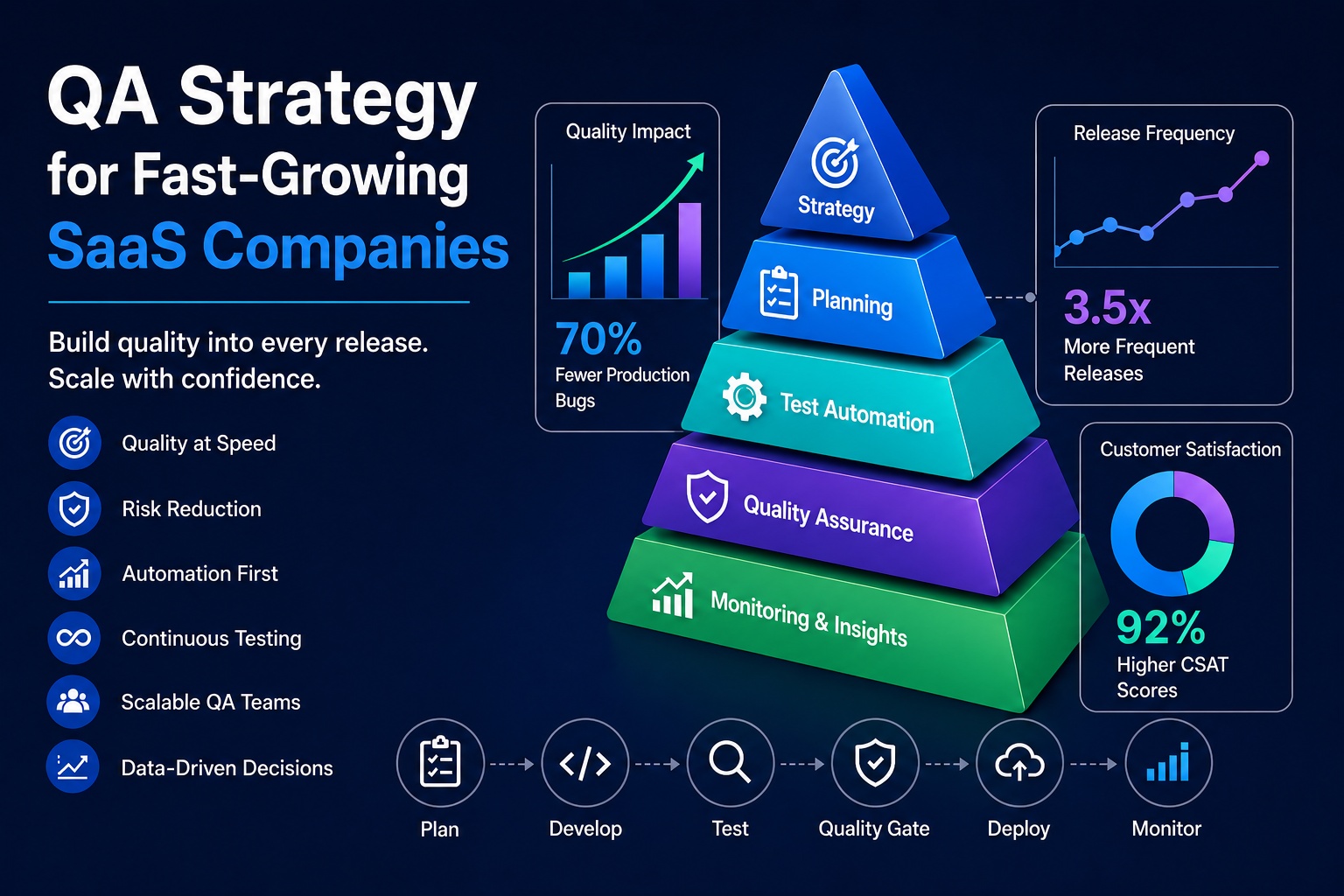
Introduction
Every SaaS company eventually hits the same wall. The product that once shipped clean, stable releases every two weeks now ships multiple times a day — and quality starts slipping in ways that are hard to see until a customer notices first. Engineering velocity goes up. Confidence in that velocity goes down. Nobody planned for this moment, and yet it arrives in nearly every growth-stage company, usually right after a funding round, a major customer win, or a push into a new market.
Software quality is not a soft metric anymore — it has a hard dollar value. Poor software quality costs U.S. organizations an estimated $2.41 trillion annually, according to long-running industry research from the Consortium for IT Software Quality. That figure includes failed projects, operational failures, and the downstream cost of defects that escape into production. For a SaaS company, those costs show up as churned accounts, blown SLAs, escalations that consume your best engineers, and a brand reputation that erodes one outage at a time.
The deeper issue is structural, not just operational. As a SaaS company grows, three forces collide:
- Faster releases. Continuous deployment becomes the norm, often shipping many times per day across multiple services.
- Increasing complexity. A monolith becomes a constellation of microservices, integrations, and customer-specific configurations.
- Rising customer expectations. Enterprise buyers expect uptime guarantees, security certifications, and zero tolerance for regressions — while paying significantly more for that assurance.
QA strategy is the discipline that reconciles these forces. Done well, it is not a brake on velocity — it is the mechanism that makes velocity sustainable. This guide lays out a practical, stage-by-stage approach to building that discipline, grounded in how engineering organizations actually scale, not in textbook QA theory.
Why SaaS Companies Struggle with Quality as They Scale
Quality problems in SaaS rarely stem from a single bad decision. They accumulate as a company moves through predictable stages, each with its own blind spots.
Startup Stage. The team is small, the codebase is young, and the founders or a handful of generalist engineers test features manually before shipping. This works because everyone holds the entire system in their head. The risk is invisible technical debt: no test suite, no documented edge cases, and an assumption that this informal process will scale. It won't.
Growth Stage. Headcount doubles or triples. Release frequency increases as the company chases product-market fit across multiple customer segments. The original "everyone tests everything" model collapses because no single person understands the whole system anymore. This is usually the stage where the first dedicated QA hire — or the first serious automation investment — gets approved, often only after a painful customer-facing incident forces the conversation.
Scale-Up Stage. The company now has multiple engineering teams, a multi-service architecture, and customers who depend on the product for revenue-critical workflows. Manual regression testing becomes physically impossible to complete before each release. Without a deliberate strategy, teams either slow releases dramatically (killing competitive advantage) or ship with reduced confidence (increasing incident rates).
Enterprise Stage. Compliance requirements (SOC 2, ISO 27001, HIPAA, GDPR) introduce formal audit trails for testing. Customers run their own UAT cycles against your releases. QA shifts from "find the bugs" to "provide evidence of systemic quality," including traceability, risk-based test coverage, and security testing baked into every release cycle.
| Company Stage | Team Size | Release Frequency | QA Challenges | Recommended QA Approach |
|---|---|---|---|---|
| Startup | 1–15 engineers | Weekly to ad hoc | No dedicated QA, tribal knowledge only, no regression safety net | Lightweight manual testing by engineers; smoke tests on critical paths |
| Growth | 15–50 engineers | Daily to several times/week | Knowledge silos, growing regression risk, first production incidents | First QA hire(s); begin automating critical user journeys |
| Scale-Up | 50–200 engineers | Multiple times/day | Manual regression no longer feasible, cross-team coordination gaps | Dedicated QA team + SDETs; CI/CD-integrated automation; risk-based testing |
| Enterprise | 200+ engineers | Continuous deployment | Compliance, multi-tenant complexity, customer-specific regressions | Quality engineering function; embedded QA in every squad; full traceability and audit-ready reporting |
Practical example: A 30-person SaaS company selling to mid-market customers might ship three releases a week with one QA engineer covering everything manually. By the time they reach 150 engineers and a multi-tenant enterprise customer base, that same manual approach would require an impossibly large QA headcount just to keep pace — which is exactly why automation investment timing (covered later in this guide) is one of the highest-leverage decisions a CTO makes.
The Hidden Cost of Poor Software Quality
Quality issues rarely show up on a single line item. They diffuse across the business — into support costs, into churn, into the hours your best senior engineers spend firefighting instead of building.
Revenue loss. A multi-hour outage during a peak usage window doesn't just cost the SLA credit you owe; it costs the renewal conversation that happens three months later, when the customer remembers the outage more vividly than the feature you shipped.
Downtime. Beyond direct SLA penalties, every hour of downtime for a B2B SaaS product translates into blocked customer workflows, which generates support tickets, account management escalations, and in the worst cases, public visibility on status pages or social media.
Customer churn. Quality issues are a leading — and frequently underweighted — churn driver. A customer who experiences two or three frustrating bugs in their first 90 days is far less likely to renew, regardless of how good the core feature set is.
Support costs. Every escaped defect generates a support ticket, often several, as multiple customers hit the same bug. Support teams escalate to engineering, pulling developers off roadmap work to triage issues that better testing would have caught pre-release.
Engineering inefficiency. Perhaps the least visible cost: engineers who could be building new value spend their time instead on hotfixes, rollback coordination, and post-incident reviews. This is a direct tax on innovation velocity.
| Impact Area | Example Scenario | Approximate Business Cost |
|---|---|---|
| Revenue Loss | Billing bug undercharges customers for one release cycle | Lost revenue + correction effort + customer trust impact |
| Downtime | 3-hour outage during business hours for a workflow-critical SaaS tool | SLA credits, escalations, potential churn risk on enterprise accounts |
| Customer Churn | Repeated bugs in onboarding flow for new customers | Reduced activation rate, lower lifetime value |
| Support Costs | A UI regression affects 5% of active accounts | Spike in ticket volume, increased average resolution time |
| Engineering Inefficiency | Senior engineers spend 20% of sprint time on hotfixes | Reduced roadmap throughput, delayed feature delivery |
The cost of a defect is not static — it grows the longer it survives undetected. This is one of the oldest principles in software quality, and it remains true in modern SaaS delivery: a requirements-stage ambiguity is cheap to fix; the same issue discovered in production is exponentially more expensive once you account for engineering time, customer impact, and incident response overhead.
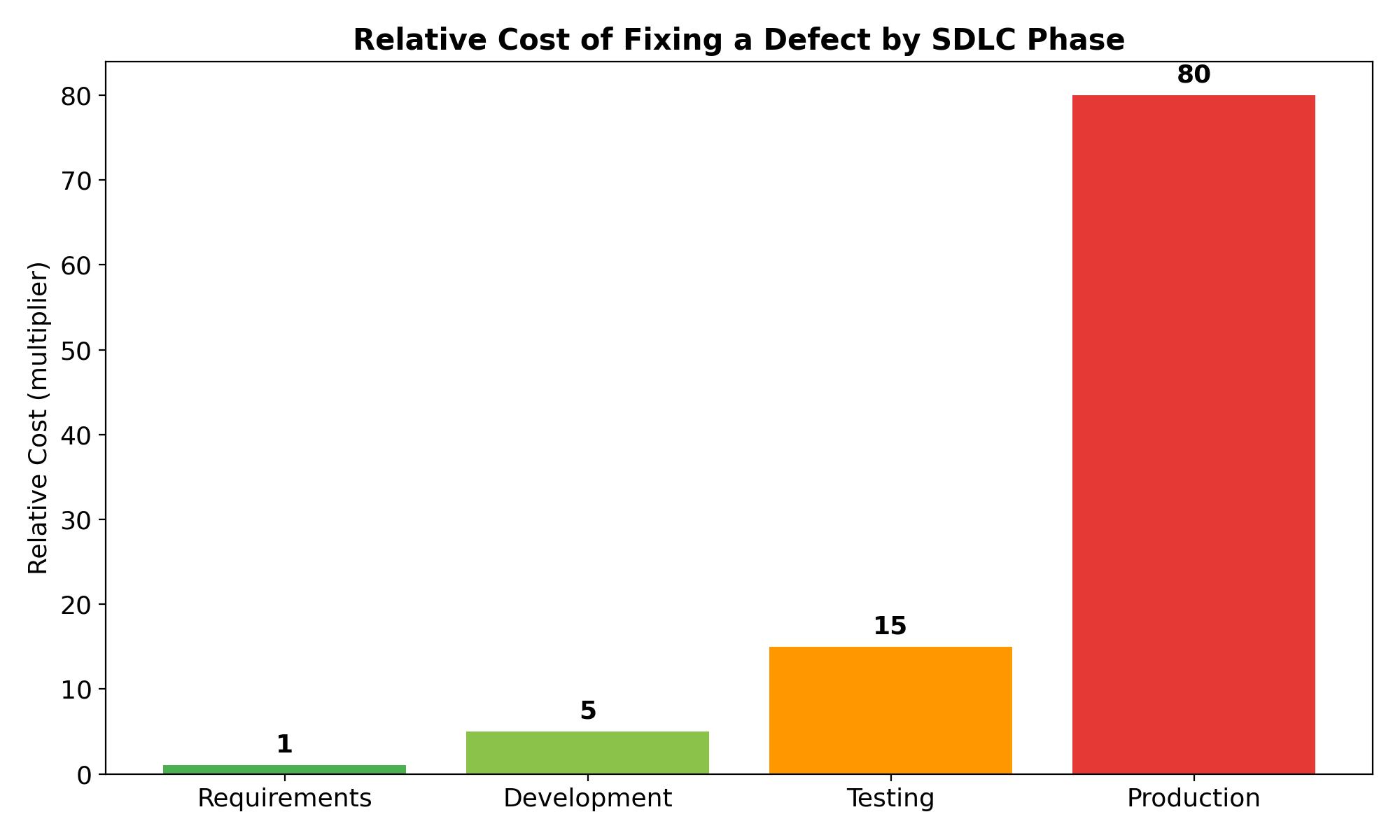
Expert Tip: If you only fund one shift in your QA strategy this year, fund the move that catches defects earlier in this curve — not the one that catches more defects overall. Catching the same number of bugs earlier is a different (and far higher-ROI) outcome than catching more bugs late.
Key Components of a Modern SaaS QA Strategy
A mature SaaS QA strategy is not one practice — it's a layered system. Each layer below answers a different risk, and skipping one creates a predictable failure mode later.
Test Planning
Why it matters: Test planning is the difference between QA that reacts to whatever engineers happen to build and QA that deliberately targets the highest-risk areas of the product. Without it, testing effort gets distributed evenly across features regardless of how critical or risky they are.
Business value: Risk-based test planning concentrates limited QA capacity where a failure would hurt the business most — billing, authentication, data integrity — rather than spreading it thin across low-impact UI polish.
Common mistakes: Treating test planning as a one-time document instead of a living artifact; planning tests only against happy-path requirements while ignoring edge cases and failure modes.
Recommended approach: Build lightweight, living test plans tied to risk tiers (critical, high, medium, low) for each feature area, refreshed every planning cycle, not once a year.
Manual Testing
Why it matters: Manual testing remains essential for exploratory testing, usability evaluation, and edge cases that are expensive to automate, especially for new or rapidly changing features.
Business value: Human testers catch the issues automation structurally can't — confusing flows, visual inconsistencies, "this technically works but feels wrong" problems that directly affect customer satisfaction.
Common mistakes: Using manual testing for repetitive regression checks that should be automated; treating manual QA as a junior, low-skill function rather than a craft requiring deep product knowledge.
Recommended approach: Reserve manual testing for exploratory work, new feature validation, and usability — and systematically migrate repetitive checks to automation as features stabilize.
Automated Testing
Why it matters: Automation is what makes frequent releases possible without linearly scaling QA headcount with release frequency.
Business value: A solid automated suite lets engineering ship faster with measurable, repeatable confidence instead of optimism.
Common mistakes: Automating brittle UI tests before stabilizing the underlying feature; chasing 100% automation coverage instead of automating the highest-value, highest-risk paths first.
Recommended approach: Prioritize automation by business risk and change frequency — critical workflows and frequently modified code first, low-risk static pages last (or never).
Regression Testing
Why it matters: Every new feature is a chance to break something that already worked. Without regression testing, growth itself becomes the primary source of new defects.
Business value: A strong regression suite protects existing customer trust while the company keeps shipping new functionality.
Common mistakes: Letting the regression suite grow unmaintained until it's slow, flaky, and ignored; never pruning obsolete tests for deprecated features.
Recommended approach: Treat the regression suite as a product in its own right — owned, maintained, pruned, and continuously measured for execution time and flakiness.
Performance Testing
Why it matters: SaaS products fail under load in ways that never show up in functional testing — slow queries, memory leaks, connection pool exhaustion.
Business value: Performance testing protects the SLAs that enterprise contracts are built on and prevents the kind of "it works on my machine but melts under real traffic" incidents that damage credibility fast.
Common mistakes: Only load-testing before a known traffic spike (like a launch) rather than continuously; ignoring database and third-party API performance under realistic concurrency.
Recommended approach: Bake performance benchmarks into CI for critical endpoints, and run full load tests ahead of any major feature or customer onboarding expected to add significant traffic.
Security Testing
Why it matters: A single security incident can end customer trust — and in regulated industries, the contract — overnight.
Business value: Demonstrable security testing is now a sales enabler for enterprise SaaS deals, frequently required during procurement and security review.
Common mistakes: Treating security testing as an annual penetration test rather than a continuous practice; ignoring dependency and supply-chain vulnerabilities.
Recommended approach: Combine automated SAST/DAST scanning in CI with periodic manual penetration testing and a clear vulnerability remediation SLA.
API Testing
Why it matters: Modern SaaS products are built on APIs — internal microservice contracts and external integrations alike. A broken API can silently break every client that depends on it.
Business value: Strong API test coverage protects integration partners and downstream customers who build on your platform, which matters enormously for retention in platform-style SaaS businesses.
Common mistakes: Testing APIs only through the UI rather than directly; not testing for backward compatibility when versioning APIs.
Recommended approach: Maintain a contract-testing layer independent of the UI, with explicit backward-compatibility checks on every API change.
UI Testing
Why it matters: The interface is where customers experience quality directly, even when the underlying logic is correct.
Business value: Consistent, well-tested UI reduces support tickets driven by confusion rather than actual defects.
Common mistakes: Over-investing in brittle, pixel-perfect UI automation that breaks on every minor styling change.
Recommended approach: Automate critical user journeys end-to-end; rely on manual or visual-regression tools for cosmetic consistency rather than exhaustive scripted UI tests.
Cross-Browser Testing
Why it matters: B2B SaaS customers use a surprising range of browsers and versions, often dictated by their own IT policies, not personal preference.
Business value: Cross-browser reliability protects enterprise accounts that may be locked into specific browser versions for compliance reasons.
Common mistakes: Testing only on the engineering team's preferred browser; ignoring older but still common enterprise browser versions.
Recommended approach: Define a supported browser matrix based on actual customer analytics, and automate testing against that matrix rather than guessing.
Mobile Testing
Why it matters: Many SaaS products now have companion mobile apps or must function on mobile web, and mobile-specific bugs (touch targets, responsive breakpoints, offline behavior) are easy to miss.
Business value: Mobile reliability protects user engagement for any SaaS product where usage spans devices.
Common mistakes: Treating mobile as a smaller version of desktop testing rather than testing mobile-specific behaviors like interruptions, connectivity loss, and gesture interactions.
Recommended approach: Maintain a dedicated mobile test matrix covering both device/OS combinations and mobile-specific interaction patterns.
When SaaS Companies Should Invest in Test Automation
Automation timing is one of the most consequential — and most frequently mistimed — investments in a SaaS company's engineering history. Invest too early, and you automate a product that's still changing shape weekly, burning engineering time rewriting tests as fast as you write them. Invest too late, and manual regression becomes a bottleneck that quietly throttles release velocity for months before anyone names the problem.
Team size, release frequency, and product complexity are the three variables that should drive this decision — not calendar time or competitor benchmarking.
| Signal | Manual Testing Still Sufficient | Time to Invest in Automation |
|---|---|---|
| Team Size | Under ~15 engineers | 15+ engineers, multiple concurrent feature teams |
| Release Frequency | Weekly or less | Multiple releases per week or per day |
| Product Complexity | Single product surface, low integration count | Multi-service architecture, multiple integrations/APIs |
| Regression Risk | Small, stable core feature set | Frequent changes touching shared/critical code paths |
Decision Matrix
| Low Release Frequency | High Release Frequency | |
|---|---|---|
| Low Complexity | Manual testing sufficient | Light automation on critical paths |
| High Complexity | Targeted automation on integration points | Full automation strategy required |
| Dimension | Manual Testing | Automated Testing |
|---|---|---|
| Best for | Exploratory testing, new features, usability | Regression, repetitive checks, critical paths |
| Speed at scale | Degrades as product grows | Scales independently of team size |
| Upfront cost | Low | Higher (tooling, scripting time) |
| Long-term cost | Grows linearly with QA headcount needs | Amortizes over many release cycles |
| Flexibility | High — adapts instantly to UI changes | Lower — requires maintenance as UI/logic changes |
| Confidence at scale | Decreases as release frequency increases | Increases with broader, well-maintained coverage |
ROI example: A regression suite that takes a team of three QA engineers two full days to run manually, run instead through automation in 45 minutes, doesn't just save time — it removes the bottleneck that was previously capping release frequency at twice a week. Multiply that unblocked release cadence by the revenue impact of shipping customer-requested features faster, and the automation investment typically pays for itself within two to three quarters for a mid-growth-stage company.
Building a Scalable QA Team
QA team structure should evolve deliberately alongside company stage — not accidentally, in reaction to the most recent incident.
Core roles:
- QA Engineer — owns manual and exploratory testing, test case design, and bug triage for assigned feature areas.
- Automation Engineer — builds and maintains automated test suites, focuses on framework health and CI integration.
- QA Lead — owns QA strategy for a product area or team, balances manual/automated coverage, and represents quality in planning.
- SDET (Software Development Engineer in Test) — a hybrid role, writing test infrastructure and tooling with engineering-level technical depth, often embedded directly in feature teams.
| Stage | Team Structure | Typical Headcount Ratio (QA:Eng) |
|---|---|---|
| Startup | No dedicated QA; engineers self-test | N/A |
| Growth | 1–2 generalist QA engineers, centralized | ~1:15–20 |
| Scale-Up | QA leads + automation engineers + SDETs, partially embedded in feature teams | ~1:8–10 |
| Enterprise | Quality engineering function, QA embedded in every squad, central platform team for shared tooling | ~1:5–7 |
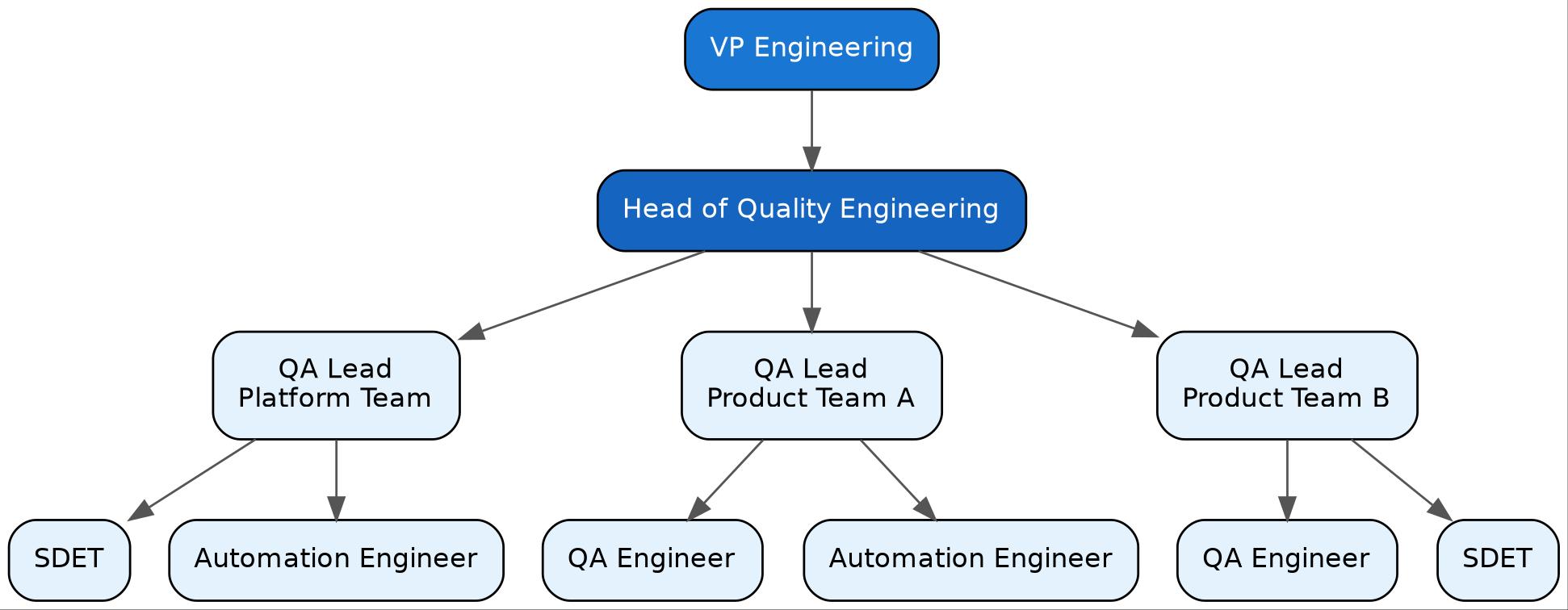
Expert Tip: The transition from "centralized QA team" to "QA embedded in every squad" is usually the hardest organizational change in this progression. It requires QA leads to give up direct control over testers while retaining accountability for quality outcomes — a shift that needs explicit executive sponsorship, not just a reorg announcement.
QA Metrics Every SaaS CTO Should Track
What gets measured gets managed — and QA is one of the easiest engineering functions to under-measure, because "no news" often gets mistaken for "good news."
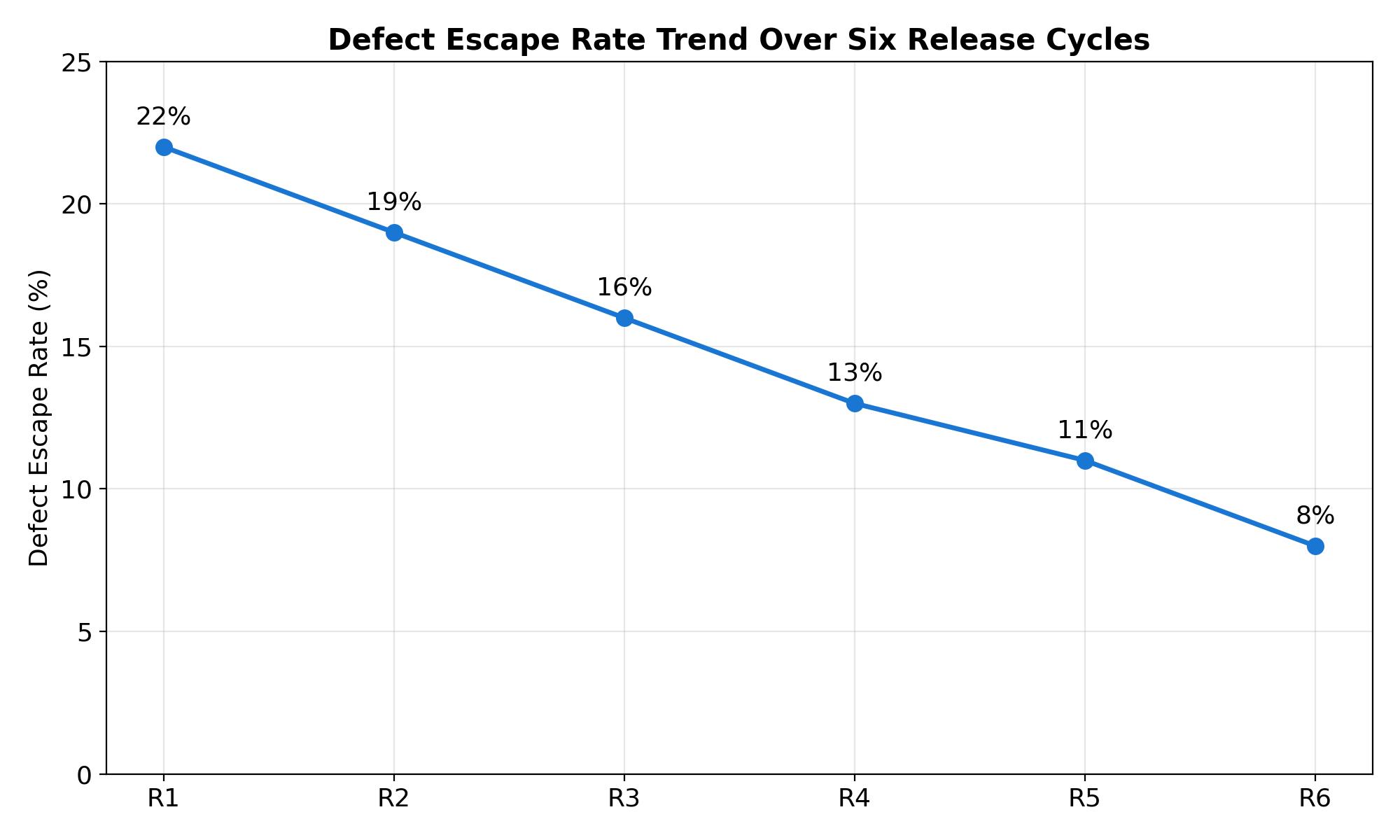
Defect Escape Rate Definition: The percentage of defects that reach production instead of being caught pre-release. Formula: (Production Defects ÷ Total Defects Found) × 100 Target Benchmark: Under 10% for mature SaaS QA functions. Business Impact: Directly correlates with support volume and customer-facing incident rates.
Test Coverage Definition: The proportion of code or critical user journeys exercised by automated tests. Formula: (Lines/Paths Covered ÷ Total Lines/Paths) × 100 Target Benchmark: 70–85% for critical paths (100% coverage is rarely the right goal). Business Impact: Higher coverage on critical paths reduces regression risk during rapid iteration.
MTTR (Mean Time to Resolution) Definition: Average time to resolve a defect once identified. Formula: Total Resolution Time ÷ Number of Defects Target Benchmark: Under 24 hours for critical bugs, under a week for minor ones. Business Impact: Faster MTTR limits customer exposure window and support escalation volume.
Production Bugs Definition: Total number of defects identified after release, per release cycle. Formula: Raw count, typically normalized per release or per month. Target Benchmark: Trending downward release over release. Business Impact: A leading indicator of customer-facing quality and support load.
Automation Coverage Definition: The percentage of the regression suite that runs automatically versus manually. Formula: (Automated Test Cases ÷ Total Regression Test Cases) × 100 Target Benchmark: 80%+ for scale-up and enterprise-stage companies. Business Impact: Directly enables release frequency without proportional QA headcount growth.
Release Success Rate Definition: The percentage of releases that ship without requiring a rollback or emergency hotfix. Formula: (Successful Releases ÷ Total Releases) × 100 Target Benchmark: 95%+ for mature CI/CD pipelines. Business Impact: A direct proxy for engineering confidence and customer-facing release stability.
Customer-Reported Issues Definition: The number of defects first identified by customers rather than internal testing. Formula: Raw count, typically tracked monthly and segmented by severity. Target Benchmark: Should represent a minority of total defects found, trending down. Business Impact: The most expensive category of defect, both in support cost and trust impact.
| KPI | Current Target | Reporting Cadence | Owner |
|---|---|---|---|
| Defect Escape Rate | <10% | Per release | QA Lead |
| Test Coverage (critical paths) | 70–85% | Monthly | Automation Engineer |
| MTTR (critical) | <24 hrs | Weekly | Engineering Manager |
| Production Bugs | Downward trend | Per release | QA Lead |
| Automation Coverage | 80%+ | Monthly | Head of Quality Engineering |
| Release Success Rate | 95%+ | Per release | VP Engineering |
| Customer-Reported Issues | Minority of total, downward trend | Monthly | Head of Quality Engineering |
Shift-Left Testing for SaaS Teams
Traditional QA, where testing happens only after development is "done," is structurally too late for SaaS release cadences. By the time a tester finds a bug in that model, the developer has often moved on to other work, context is cold, and the fix takes longer than it would have a day earlier.
Shift-left testing moves quality activities earlier into the development lifecycle — into design review, into the pull request, into the developer's own local environment — rather than treating QA as a separate downstream gate.
This requires real developer involvement: writing unit tests as a default practice, running static analysis before code review, and treating a failing automated check in CI as a blocking issue, not a suggestion.
Example: Instead of a QA engineer discovering three days after a feature merges that an edge case around trial expiration wasn't handled, a shift-left model catches that gap during pull request review, because the test plan for trial-related logic is a known, shared checklist that both the developer and reviewer apply before merge.

Continuous Testing in CI/CD Pipelines
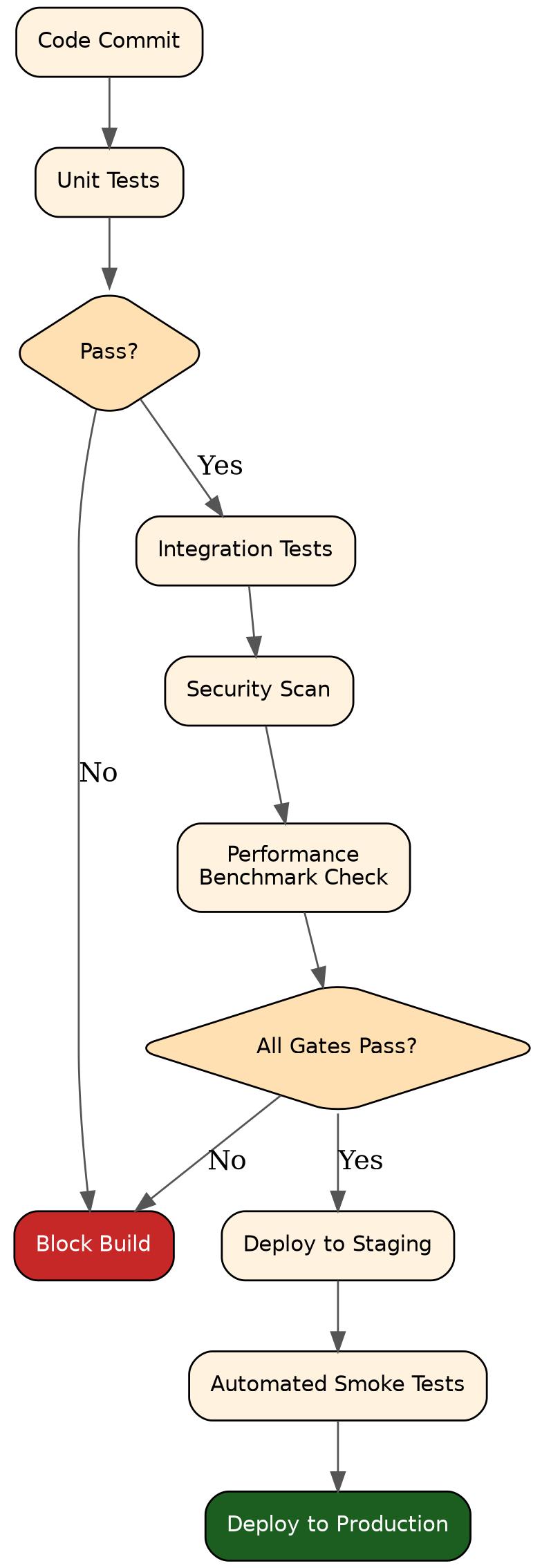
Continuous testing embeds automated quality gates directly into the deployment pipeline, so that confidence is built incrementally with every commit rather than assessed all at once before a release.
Most SaaS engineering organizations build this on one of a handful of common platforms — GitHub Actions, GitLab CI/CD, Azure DevOps, or Jenkins — each supporting the same core pattern: a pipeline of test stages that must pass before code can progress to the next environment.
Automated testing gates stop a build from progressing if unit tests fail. Quality gates go further, blocking promotion to production if coverage drops below a threshold, performance regresses beyond a tolerance, or a security scan flags a new critical vulnerability. Together, these gates are what allow a team to deploy many times a day without each deployment requiring a manual sign-off — deployment confidence becomes a property of the pipeline, not a person.
How QA Supports Faster Releases
It's a common misconception that QA slows releases down. In mature engineering organizations, the opposite is true: the presence of strong automated quality gates is precisely what allows release frequency to increase, because it replaces slow, ad hoc manual sign-off with fast, repeatable automated confidence.
| Metric | Companies with Mature QA | Companies with Weak QA |
|---|---|---|
| Release Frequency | Multiple times per day | Weekly or less, often delayed |
| Rollback Rate | Low, isolated incidents | Frequent, sometimes per release |
| Customer Satisfaction (quality-related) | High, few quality-driven escalations | Lower, recurring complaints about bugs |
| Engineering Time on Hotfixes | Minimal | Significant, recurring drag on roadmap |
| Deployment Confidence | High — automated gates provide assurance | Low — releases depend on manual sign-off and "gut feel" |
The pattern is consistent across growth-stage SaaS companies: teams that invest in QA earlier reach higher release frequency sooner, not later, because they aren't perpetually firefighting the last release while trying to plan the next one.
Common QA Mistakes in Fast-Growing SaaS Companies
1. No automation strategy Problem: Automation efforts are ad hoc, with no prioritization framework. Impact: Engineering time is spent automating low-value tests while high-risk paths remain manual. Solution: Build a risk-based automation roadmap tied to business-critical workflows.
2. No regression suite Problem: Every release risks breaking previously working functionality with no safety net. Impact: Recurring "we fixed this before" bugs erode customer and engineering trust alike. Solution: Establish a maintained regression suite as a first-class engineering asset.
3. No clear QA ownership Problem: Quality is "everyone's job," which in practice means no one's job. Impact: Gaps in coverage go unnoticed until they cause an incident. Solution: Assign explicit ownership for quality outcomes per product area.
4. Testing only before release Problem: QA is treated as a final gate rather than a continuous practice. Impact: Bugs are found too late to fix without delaying the release. Solution: Shift testing earlier into design, development, and code review stages.
5. Ignoring performance testing Problem: Functional correctness is verified, but behavior under load is not. Impact: Products fail precisely when usage — and business stakes — are highest. Solution: Integrate performance benchmarks into the regular release cycle.
6. Lack of metrics Problem: QA effectiveness is judged subjectively rather than measured. Impact: Leadership can't identify whether quality is improving or degrading. Solution: Track and report the core KPI set consistently, every cycle.
7. No risk-based testing Problem: Equal testing effort is applied regardless of feature criticality. Impact: Scarce QA capacity is wasted on low-impact areas. Solution: Tier features by business risk and allocate testing effort accordingly.
8. Flaky automated tests left unaddressed Problem: Tests fail intermittently for reasons unrelated to real defects. Impact: Teams start ignoring failures altogether, undermining the entire automation investment. Solution: Treat flaky test remediation as a standing priority, not background noise.
9. No environment parity between staging and production Problem: Tests pass in staging but the behavior doesn't hold in production. Impact: False confidence going into release. Solution: Invest in infrastructure-as-code to keep environments consistent.
10. Hiring QA too late Problem: The first QA hire happens only after a major incident forces the issue. Impact: Months of accumulated, undetected technical and quality debt. Solution: Tie QA hiring triggers to team size and release frequency thresholds, not crisis response.
11. Over-automating too early Problem: Automating a product surface that's still changing shape weekly. Impact: Constant rewriting of brittle tests, wasted engineering time. Solution: Automate once a feature has stabilized, not on day one.
12. No security testing integration Problem: Security testing is treated as a separate, occasional exercise. Impact: Vulnerabilities accumulate silently until a breach or failed audit. Solution: Integrate automated security scanning directly into CI/CD.
13. Ignoring mobile and cross-browser coverage Problem: Testing happens only on the primary development environment. Impact: A meaningful share of customers experience undetected platform-specific bugs. Solution: Define and test against an explicit supported-platform matrix.
14. No defect triage process Problem: Bugs are logged but not consistently prioritized or assigned. Impact: Critical issues sit unresolved while minor ones get fixed first. Solution: Establish a standing triage cadence with clear severity definitions.
15. Treating QA as a cost center in planning Problem: QA headcount and tooling investment are the first things cut during budget pressure. Impact: Short-term savings create much larger long-term incident and churn costs. Solution: Frame and report QA investment in terms of incident reduction and release velocity, tying it directly to revenue protection.
16. No post-incident learning loop Problem: Production incidents are resolved but never systematically analyzed for root cause. Impact: The same class of defect recurs across multiple releases. Solution: Run blameless post-incident reviews with concrete action items tracked to completion.
Real-World SaaS Quality Transformation Case Study
The following is an illustrative composite scenario representative of common SaaS QA transformations, not an account of any specific company.
A mid-market SaaS company at the scale-up stage — roughly 120 engineers, shipping a B2B workflow platform — found itself averaging 12 production incidents per month, with an 18% defect escape rate and recurring weekly outages tied to a handful of high-traffic services. Customer support volume had grown faster than the customer base itself, and two enterprise renewals were placed at risk directly due to quality concerns raised during contract review.
Before QA Transformation:
- 12 production incidents per month
- 18% defect escape rate
- Weekly outages affecting core workflows
- Manual regression testing taking 3+ days per release cycle
- No formal quality metrics reported to leadership
The company restructured its approach over roughly three quarters: building a risk-based regression suite, embedding QA engineers directly into feature teams, integrating automated quality gates into CI/CD, and introducing a formal KPI dashboard reviewed monthly by engineering leadership.
After QA Transformation:
- 70% fewer production bugs
- 90% regression automation coverage
- Release cycle time cut from weekly to multiple times per week
- Defect escape rate reduced from 18% to under 6%
- Zero enterprise renewals lost to quality concerns in the following two quarters
| Metric | Before | After | Change |
|---|---|---|---|
| Production Incidents/Month | 12 | 3–4 | ~70% reduction |
| Defect Escape Rate | 18% | <6% | ~67% reduction |
| Regression Automation Coverage | <10% | 90% | +80 points |
| Regression Testing Time | 3+ days | Under 2 hours | ~90% faster |
| Release Frequency | Weekly | Multiple times/week | Significant increase |
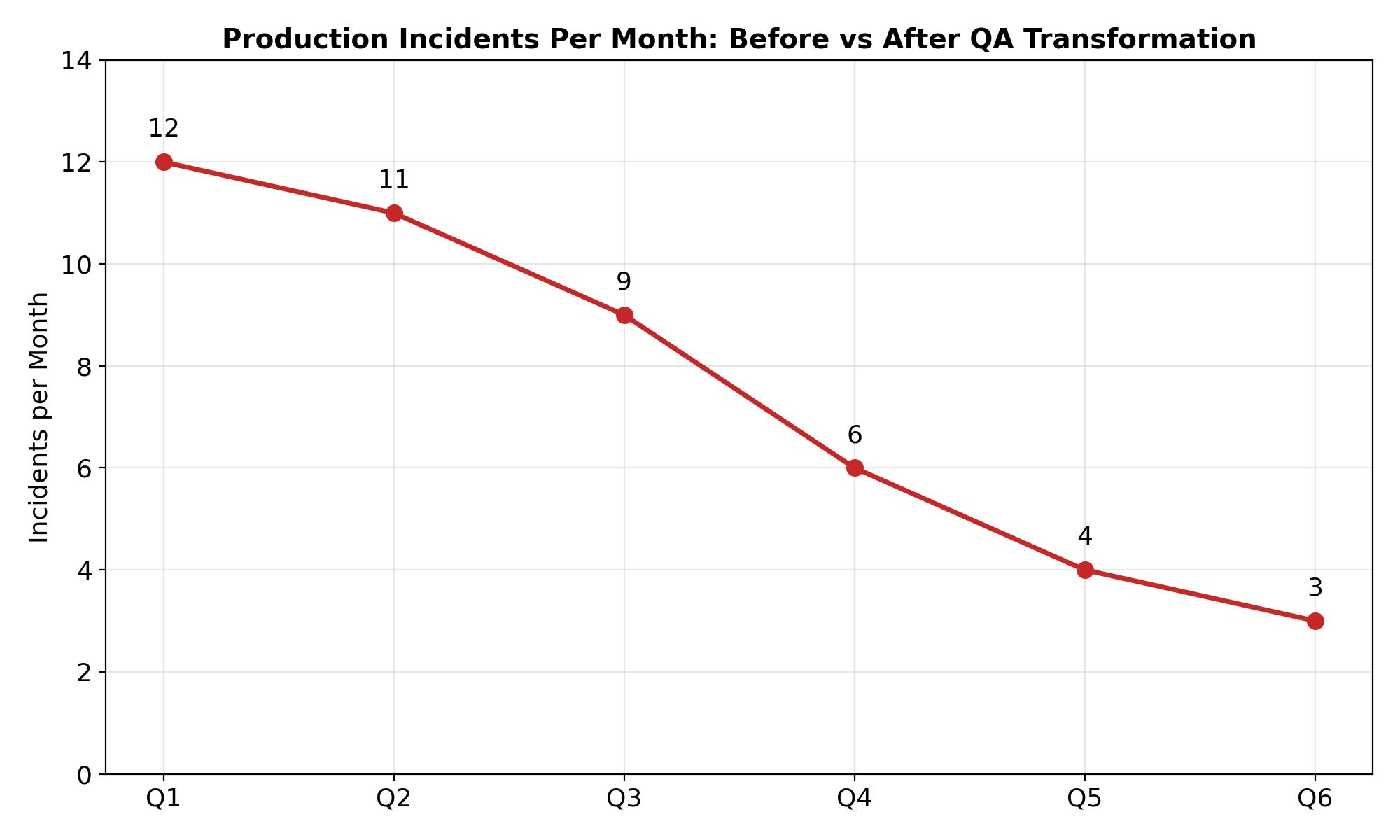
The pattern in this composite scenario mirrors what consistently shows up across real growth-stage SaaS transformations: the gains don't come from a single tool purchase, but from the combination of organizational ownership, automation investment, and disciplined metrics tracking working together.
Future of QA in SaaS
QA is entering a period of structural change, driven by both AI capability and the maturing discipline of platform engineering.
AI Testing is increasingly used to generate test cases from requirements, identify untested code paths, and even predict which areas of a codebase are most likely to contain defects based on historical change patterns.
LLM Testing has emerged as a discipline of its own, as SaaS products increasingly embed LLM-powered features that require fundamentally different validation approaches — testing for output quality, consistency, and safety rather than simple pass/fail assertions.
Continuous Quality extends continuous testing into a broader philosophy: quality signals (performance, security, defect trends) are monitored constantly in production, not just validated pre-release.
Autonomous Testing — test suites that adapt themselves to UI and API changes with minimal manual maintenance — is moving from research concept toward practical tooling, reducing the maintenance burden that has historically made automation expensive to sustain.
Quality Engineering reflects a broader shift in title and mandate: QA is being repositioned from a downstream checking function to an upstream engineering discipline embedded in system design itself.
Platform Engineering increasingly owns the shared tooling and infrastructure that quality engineering depends on — test environments, CI/CD pipelines, observability — treating these as internal products rather than one-off scripts.
DevOps + QA Integration continues to deepen, with the line between "QA team" and "engineering team" blurring further as quality ownership becomes distributed rather than centralized in a single function.
QA Strategy Checklist for SaaS Leaders
- Defined risk tiers for all major product areas
- Documented test plans tied to those risk tiers
- Maintained, pruned regression suite
- Automation coverage tracked and reported monthly
- Defect escape rate tracked per release
- MTTR tracked and reviewed for critical defects
- Release success rate tracked per deployment
- Customer-reported issues tracked and trended over time
- Automated quality gates integrated into CI/CD
- Security scanning integrated into the pipeline, not handled separately
- Performance benchmarks run on critical endpoints in CI
- API contract testing in place for all external/internal integrations
- Supported browser and device matrix explicitly defined and tested
- Mobile-specific test coverage in place if applicable
- Clear QA ownership assigned per product area
- QA embedded in feature teams, not siloed centrally (at scale-up stage and beyond)
- Flaky test remediation treated as an ongoing priority
- Staging and production environment parity maintained
- Defect triage process with defined severity levels
- Blameless post-incident review process in place
- Shift-left practices adopted (unit tests, static analysis, PR-stage review checklists)
- QA hiring and automation investment tied to objective growth triggers, not crisis response
- Quality metrics reported to engineering leadership on a regular cadence
- QA investment framed in business terms (incident reduction, release velocity, churn prevention)
- Compliance and audit-readiness considerations incorporated for enterprise-stage requirements
- Continuous improvement loop in place — metrics reviewed and strategy adjusted regularly
Conclusion
Quality assurance cannot stay static while everything else about a SaaS company scales. The team grows, the architecture grows, the customer base grows — and QA strategy has to grow deliberately alongside all of it, or it becomes the bottleneck that quietly throttles the rest of the business. The companies that get this right don't treat QA as a phase-gate or a cost line to minimize; they treat it as the infrastructure that makes speed sustainable.
Automation matters because it's the only way to decouple release frequency from QA headcount. And quality, ultimately, is a competitive advantage — not a defensive measure. In a market where customers can switch SaaS vendors easily, the companies that ship fast and reliably win the renewal conversations that companies shipping fast but unreliably eventually lose.